




Related: Growing Ohio District Finds Success in Refined Routing, Training
Alabama District Fosters New Leaders With Management Class
Baldwin County Schools’ transportation department’s class grows current leaders and cultivates new ones by introducing attendees to other district leaders, covering different types of leadership styles and responsibilities, and emphasizing service.
by Tony Pollard
March 31, 2020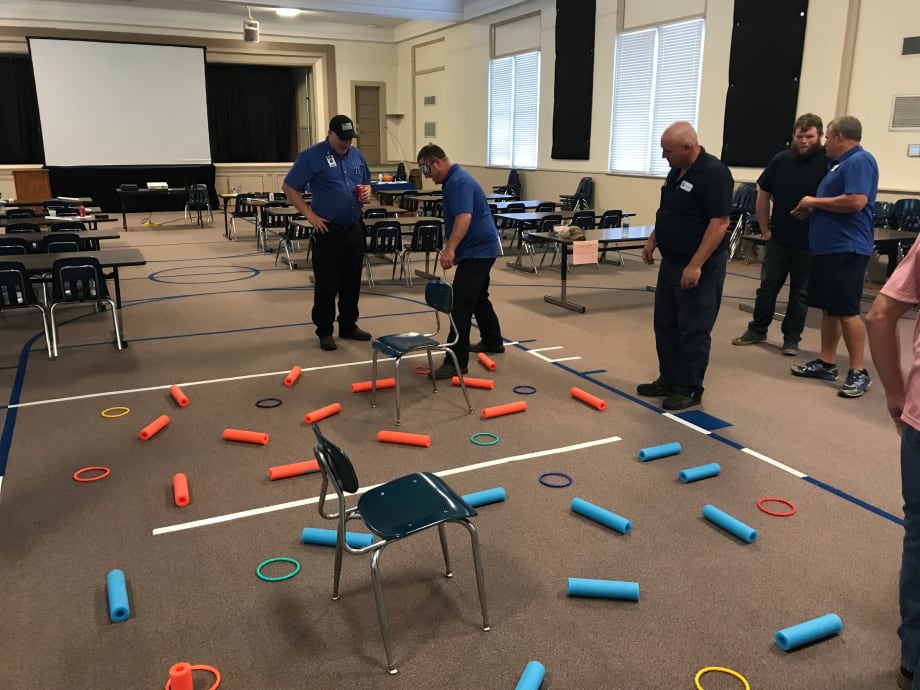
Management class attendees took part in a leadership game called “catching a snake” with the objective of the group, or “snake” working together to fill a bucket with 10 balls. Photo courtesy Mike Vivar
6 min to read
Management class attendees took part in a leadership game called “catching a snake” with the objective of the group, or “snake” working together to fill a bucket with 10 balls. Photo courtesy Mike Vivar
Coach Vince Lombardi once said, “Leaders are not born, they are made.” Actually, leaders are not born and they are not made just by being promoted.
We learned that here in the Baldwin County (Ala.) Schools transportation department, we had not provided proper training to our own leaders. Moreover, based on their positive attitudes and work ethic, we discovered that we were also working with several potential leaders.
These two factors led us to conclude that we needed to provide some essential leadership training to our current shop personnel and route specialists. We also saw an opportunity to train future leaders in the day-to-day expectations a leader must deal with and to change the culture in the department.
We created a management class to bolster our employees’ leadership skills. We introduced them to other leaders throughout the district, taught them about different types of leadership styles and responsibilities, assigned group exercises, and placed an emphasis on service.
Using a Leadership Model
Our class also reviewed the Blake Mouton Managerial Grid model of leadership, which identifies five different leadership styles, based on concern (rated as high, medium, or low) for people and production.
1. Authority-Obedience. The leader’s maximum concern is for task completion and is combined with a minimum concern for people (i.e., dictating to followers what they should do and how they should do it, the leader concentrates on maximizing getting tasks done).
2. Country Club. The leader shows a minimum concern for getting tasks completed, but a maximum concern for people (i.e., even at the expense of achieving results, fostering good feelings gets primary attention).
3. Impoverished. The leader has a minimum concern for both production and people and puts forth the least effort required to remain in the organization.
4. Organization Man. The leader goes along to get along, which results in conforming to the status quo.
5. Team Management. The leader integrates the concern for production and the concern for people at a high level; is goal centered; and seeks results through the participation, involvement, and commitment of all those who can contribute.
Training Topics
We set our training up to encompass approximately six weeks. Each week we focused on some basic leadership skills:
Week 1: Several leaders in our school system discussed the paths they took to become a leader. The superintendent spoke about his journey from bus driver to the head of the school system. When our future leaders realized that opportunities are not limited, they became more receptive.
Week 2: Our human resources director shared how to properly communicate, document, and handle employee disciplinary issues and concerns.
Week 3: We taught a class on time management, including how to account for an employee’s day.
Week 4: Our focus was on communication. Each participant was tasked with presenting a 3- to 5-minute speech that was evaluated by their peers.
Week 5: We covered in a role-play exercise how to handle scenarios that may arise in the department. Each group was given a problem, such as an unmotivated employee, and developed a solution.
Week 6: We tied all the lessons together with a group project that involved designing and building a cornhole game using materials they would purchase from a mock vendor. The goal was to expose them to other areas of transportation, in part by giving them experience in working with vendors, materials, and employee time sheets.
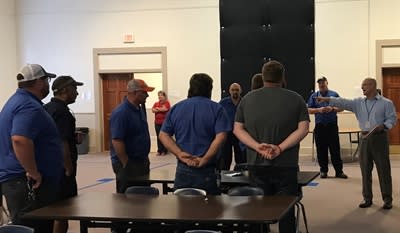
Tony Pollard, shown right, directs attendees in a management class. Photo courtesy Mike Vivar
Expectations
The first class set the tone for the six-week course. After our main presenters shared their journeys into leadership, I explained how each week would work. Every week a group would be assigned to prepare the class. That group would be responsible for setting up the room, preparing a breakfast (usually doughnuts, fruit, and biscuits), leading the Pledge of Allegiance, introducing the speaker, and closing the class.
Each group was made up of a team leader, assistant team leader, and a sergeant of arms to maintain order in the meeting. After each class, all participants had to give feedback to the group that was assigned to lead the class that day. Once class was released, our fleet manager and I would meet with the group that would lead the next week’s class.
This approach helped the teams take ownership of their assigned day to lead. It gave them an opportunity to plan, prepare, and present to a large group, which in turn gave them direct leadership experience.
Promoting Service First
The main goal was service to the team. The leadership team for the assigned day had to serve breakfast to their team members and the rest of the class with a white handkerchief draped across their arm. The lesson: when we provide service to others, they will in turn provide service.
We want our high-potential employees and leaders to approach our students, bus drivers, school administrators, and community with a heart to serve. That does not mean we just give; we also lead. Sometimes leadership involves making hard decisions.
We also want the group to understand that as leaders, it is necessary to make decisions that sometimes are not popular. In the scenario training, the class had to confront issues of that nature.
One of our goals was to expose our high-potential leaders to all areas in the department, so the classes ranged from mechanics, custodian, and administration. We did not want participants to be limited by their skills as a mechanic or route specialist. We wanted them to share, listen, and grow from all areas in the department. Leaders must deal with multiple departments and the needs may be different for each. So, if a mechanic is promoted to a leadership role, they only have one perspective: that of a mechanic. We wanted to change that perspective.
Each week when the main instruction was concluded, the class participated in team-building games that promoted communication, participation, and leadership. This was a great way to end the class each week and led to some interesting and fun discussions.
Participant Feedback
Employees who took part in the classes shared feedback that showed that the messages of working as a team and looking to others to learn from and for help resonated with them. Here are a few participant responses:
• “If all moving parts of the team are working properly, we can run the machine smoothly.”
• “A title is not necessary to be a leader.”
• “I have strengths and weaknesses. In some areas, I can offer more help than I can in others. There are also areas that others dominate in and it is ok to ask for help.”
• “There is always someone we can learn from.”
• “I discovered that everyone has their own tasks/job to complete and that one job is not bigger than the other. Basically, everyone working cohesively, limiting negativity, [and serving] one another will grow our team.”
Tony Pollard is the transportation supervisor for Baldwin County (Ala.) Public Schools.
Subscribe to Our Newsletter
More Management

How to Build a Better Driver Training Program
Ready to boost up your school bus instructor training? Here’s how to pick the right talent and improve recruitment, retention, and safety.
Read More →
CALSTART and Forth Combine to Form Catalyst Mobility
The new name represents a renewed vision for the nonprofit focused on advancing clean, equitable, and affordable transportation solutions that move people and goods.
Read More →
What Makes a Great School Bus Driver Trainer?
Choosing the right school bus driver trainer takes more than experience. Learn six keys to selecting and developing trainers and evaluating program effectiveness.
Read More →


School Bus Contractors Expand Through New Deals, Acquisitions & Partnerships
STA's Canadian division acquires Ontario-based G&L Stevenson Transport while Durham School Services adds a new district contract in California, First Student adds a New Jersey contract, and Minnesota Coaches acquires Halo Transportation.
Read More →
Logan Bus Company Rolls Out AI Phone System for NYC School Bus Families
A summer pilot found that AI agents could handle most routine calls, freeing up time for customer service staff to focus on emergencies and complex family concerns.
Read More →
From Intent to Impact: What I Learned About Leadership from TAPT
A Texas transportation supervisor shares lessons on self-awareness, accountability, managing stress and building trust — and why investing in leadership development matters at every stage of your career.
Read More →
NAPT Names 2026 Award Recipients, Hall of Fame Inductee
Who earned national recognition for their work in student transportation? This year, NAPT named five recipients of its 2026 awards for service, safety, and leadership, plus its newest Hall of Famer.
Read More →
Sponsored•September 2, 2026
2026 State of Student Transportation Report
Driver shortages. Rising costs. Growing safety expectations. More data, but not enough time to act on it. The 2026 State of Student Transportation Report reveals what transportation leaders say is putting the most pressure on their operations—and where they’re investing next. See how your priorities compare.
Read More →
How to De-Escalate an Angry Person: 5 Steps for Handling Workplace Conflict
What makes emotions run high, and how should you handle an angry colleague or parent? Follow these steps for staying calm, listening, showing empathy, and resolving conflict.
Read More →
Sponsored•September 1, 2026
What Readiness Looks Like This School Year
Learn about the challenges shaping the 2026–2027 school year, from persistent driver shortages and budget pressure to technology and readiness gaps. See how school districts are responding and adapting in Zonar’s 2026 Back-to-School Readiness Report.
Read More →