





Op-Ed: Propane Industry Offering More Innovations for School Buses
A Push for Propane: Schools Report Alt-Fuel Successes
As alternative fuels are quickly catching on in school districts across the country, many report discovering a passion for propane. Find out what these schools are saying about their propane pivot and what benefits are being seen.
September 22, 2021

Propane supplier Blossman Gas has partnered with Mobile County Schools in Alabama. One major reason behind the district’s move away from diesel was driven by health benefits for students.
Photo courtesy Blossman Gas Inc.
6 min to read
Gone are the days of gas-guzzling vehicles. As people and companies across the country are looking at ways to lower their carbon footprint, coupled with the federal government pushing for lower emissions, the school bus industry is quickly adopting alternative fuels including propane in this new environment.
Why Propane?
Unlike traditional propane from the days of old, the renewable propane used in vehicles contains one key chemical difference when compared to the former: it’s not made from fossil fuels.
For those interested in the science behind it, Blossman Gas, a full-service propane company, offers up some background in its report, “Renewable Propane Has Arrived.” It explains that recycling cooking oil and meat fats into biodiesel and renewable propane cuts the amount of waste deposited into landfills. They also say it can be scaled up while remaining an ultra-low carbon intensity process. In a school bus engine, renewable propane has a carbon intensity of 19%, which is five times better than diesel and gasoline. And its carbon intensity score is 14, compared to 39 for an electric vehicle, 78 for fossil propane, and 86 for gasoline.
The move to alternative fuels like propane brings many benefits for fleets, including reduced maintenance, increased cost savings, and of course, renewability. But unlike electric vehicles, fleets running propane buses don’t need to worry about range restrictions or recharging.
To learn more about real-world results with propane-fueled school buses, School Bus Fleet talked to a few districts that operate propane buses to learn what works, what doesn’t, and what the future of fuels for their fleets look like.
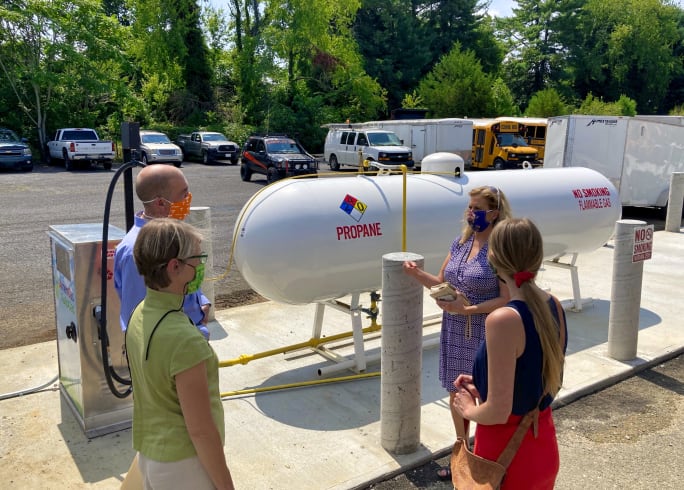
Washington County Schools held a ribbon cutting ceremony for its five new propane school buses in August 2020. Since then, the district added six more, for a total of 11 propane buses in its fleet.
Photo courtesy Washington County Department of Education
Benefits to the Switch
In Alabama, Mobile County Public School Systems (MCPSS) has partnerered with Blossman Gas to fuel more than 200 of its propane buses since 2018. The school system transports about 26,000 students daily during the school year.
“Our county school system and Blossman has had a great affiliation with each other for many years,” says Pat Mitchell, director of transportation for MCPSS. “We were excited for the opportunity to fuel our buses with renewable propane. Reducing our carbon footprint and providing a clean bus ride for our students is vital to what we want to accomplish in our school bus fleet.”
In Indiana, Carmel Clay Schools (CCS) started running propane buses in 2014, with 30 Blue Bird buses running currently. The first order happened after CCS participated in two Indiana School Bus Propane grants to add emissions-control measures to its older diesel buses, and they then realized the opportunity in using propane buses to further reduce emissions. CCS also has one Blue Bird Type D electric bus purchased in 2020 with the receipt of a Volkswagen Mitigation Settlement Trust Fund grant.
“We have been purchasing new propane buses when older diesel buses were due for trade,” explains Ron Farrand Jr., recently retired director of facilities and transportation at CCS. “These buses have been focused on our special-needs student transportation in response to a student group that may have compromised health issues. The use of propane-powered buses reduces emissions in proximity to student loading areas.”
Blossman Gas backs up the health benefits for students, too, citing a 2019 study by Georgia State University that directly links exhaust fumes and noise from traditional school buses with lower test scores. Previous studies showed that diesel exhaust also contributes to allergies, asthma, and bronchitis.
Farrand also notes the niceties of reduced maintenance and lower fuel pricing, plus the fact that propane buses are quicker to heat up in cold weather, meaning less idling time to get the cabin temperatures up to comfort levels.
Another district making the switch is Washington County Schools in Tennessee, which operates 11 propane buses — five from Blue Bird and six from IC Bus. The buses came through East Tennessee Clean Schools’ “Reducing Diesel Emissions for a Healthier Tennessee” rebate program. The first five were ordered in 2019, and the rest were purchased this past spring, with all on the road now.
With about 95 buses operating on any given day, Jarrod Adams, chief operations officer for Washington County Schools, says ultimately the move to propane was fueled by a desire to be greener.
“That’s a lot of emissions, and we really wanted to reduce our footprint on the community," Adams adds. “Going to propane was quite serendipitous when the grant came about.”
Adams says the drivers love the new buses, the mechanics love that maintenance is next to none, and the kids love that the ride is quieter with no gas smells.
He adds that, so far, the district is seeing fuel costs about equal to diesel, with diesel at $2.56 a gallon and propane at $1.89 a gallon — or 36 cents per mile for diesel and 45 cents per mile for propane, although factoring in maintenance brings diesel to around 70 cents per mile and propane to around 47 cents per mile. However, Adams hopes to see even more savings once they become more adept at driving the new buses. The district also operates one electric bus — the first in the state of Tennessee.
Fueling Infrastructure
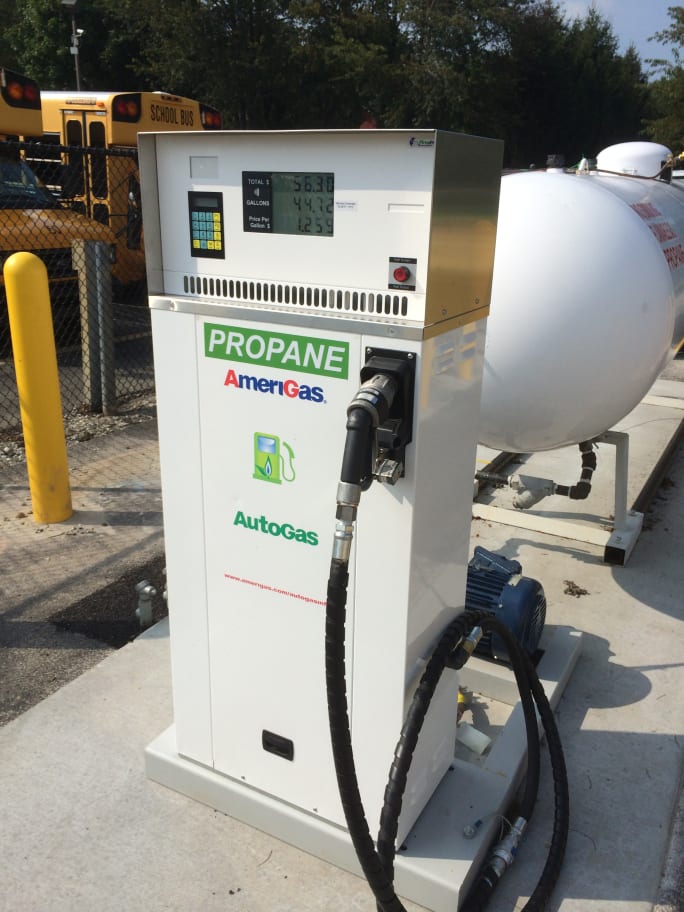
Thirty propane buses are operating at Carmel Clay Schools in Indiana. The district’s 1,000-gallon fueling station was secured from its propane supplier, AmeriGas.
Photo courtesy Carmel Clay Schools.
Any new initiative means some sort of resulting change, and when schools make the shift to propane, new fueling needs must be considered. Some schools choose to build their own on-site fueling stations while others secure propane refueling partners at either a private or public network.
CCS uses two transportation facilities for their buses, each with a 1,000-gallon fueling station. The district purchases its propane from AmeriGas, which also supplies them with tanks and pumps. Farrand says so far it has been a favorable partnership.
Meanwhile, in Tennessee, Washington County Schools put up their own ballasts and concrete pad and has one area in their garage for a 1,000-gallon tank, with room for more. The district's propane gas company provided the tanks and fuel monitoring system.
Federal Mandates
As many fleet operators know, the federal push to reduce vehicle emissions is real, with President Joe Biden looking to tackle the climate crisis. An executive order seeks to make half of all new vehicles sold in 2030 zero-emissions vehicles, including battery electric, plug-in hybrid electric, or fuel cell electric vehicles. Fortunately for school buses, propane steps up to that plate.
Farrand says CCS is interested in increasing the number of electric buses in their fleet, but because the cost is prohibitive without significant grant money, for now, the district will watch electric bus pricing.
Adams echoed that sentiment, expressing the desire to electrify their entire bus fleet, but notes cost as a barrier. He says they’ll be first in line when prices come down. But, he says, the infrastructure bill is good for the country and their school system, and he hopes the bill passes.
“Here in Tennessee, we’re trying to be on the cutting edge,” Adams says. “We’re happy to set a standard and be a beacon of knowledge for other schools.”
Stuart Weidie, CEO of Blossman Gas, also shares excitement when looking to the future of the propane industry.
“If we expect to grow gallons while ignoring public perception and policymakers’ goals, we risk losing the status as a viable energy source in the future,” Weidie says. “It is past time that we initiate a serious discussion on renewable propane if we intend to position our energy source as a modern fuel.”
Subscribe to Our Newsletter
More Alternative Fuels

CALSTART and Forth Combine to Form Catalyst Mobility
The new name represents a renewed vision for the nonprofit focused on advancing clean, equitable, and affordable transportation solutions that move people and goods.
Read More →
Alt-Fuel Moves: New Buses, Charging Hubs & Real-World EV Testing
Propane and electric school bus deployments continue to grow as districts add new vehicles, expand charging infrastructure, and gather more real-world operating data.
Read More →
Fewer Electric School Bus Models Reshape the U.S. Market
WRI’s latest buyer’s guide points to a consolidating electric school bus market, but fewer options may reflect a maturing industry rather than fewer meaningful choices for school bus operators.
Read More →
The Fuel Budget You Can Actually Predict: How Propane Autogas Keeps Money in the Classroom
Learn how propane autogas helps school districts manage fuel costs with predictable pricing, lower maintenance, and reduced emissions from former transportation director Joel Stutheit.
Read More →
Hendrickson, Driventic Introduce New Electric Powertrain for School Buses
ELECTRAAX, the electrified, lightweight drive axle offers integrated ePowertrain efficiency and modular flexibility for Class 6–7 school bus use.
Read More →
The Mobility House Joins PowerFlex in Fleet Electrification Deal
The acquisition combines intelligent charging software, bidirectional charging expertise, and fleet electrification services to support the growing adoption of electric school buses across North America.
Read More →
Alt-Fuel Moves: Electric School Bus Investments Hit the Road
See which districts across the U.S. are putting electric school buses into service, expanding charging infrastructure, and planning the next phase of fleet electrification.
Read More →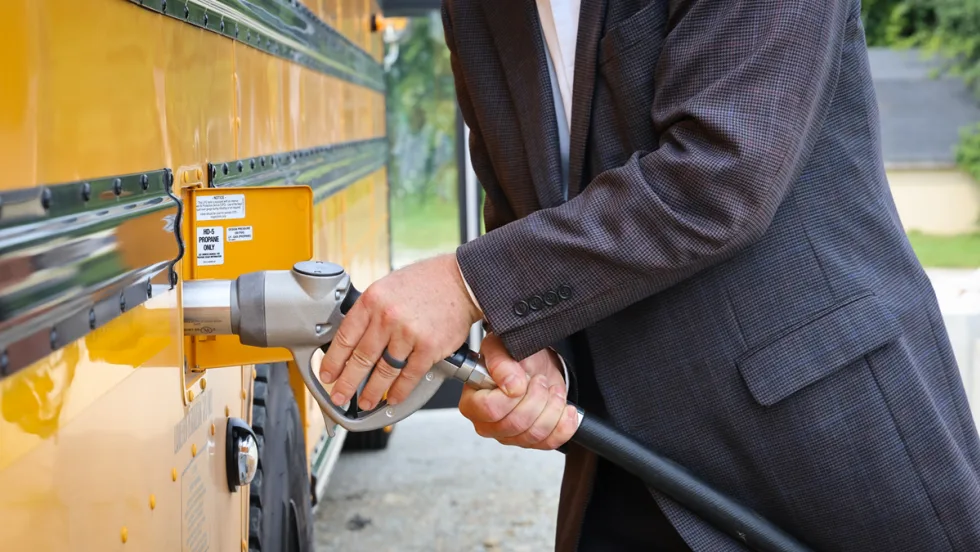
With Fuel Volatility Ahead, School Districts Turn to Propane
While diesel prices peaked above $5 this spring, districts with propane autogas-powered fleets paid under $2 per gallon, according to PERC.
Read More →
EPA Unveils Proposed Changes to 2027 Heavy-Duty Engine Rules
The federal agency has proposed changes to next year’s targets that would eliminate DEF derates, ease warranty requirements, and retain current NOx emissions standards.
Read More →
Alt-Fuel Moves: EV Charging & Infrastructure Projects Gain Momentum
The latest developments include new funding, charging infrastructure, utility investments, and fleet technologies designed to support the transition to electric school buses nationwide.
Read More →