





Last Year's Predictions: 5 Student Transportation Trends to Watch in 2025
6 Student Transportation Trends to Watch in 2026
In the year ahead, school transportation faces a mix of familiar and emerging challenges, safety tech, illegal passing, and alt fuels among them. Here’s a look at what’s coming and how to stay ahead.
December 26, 2025
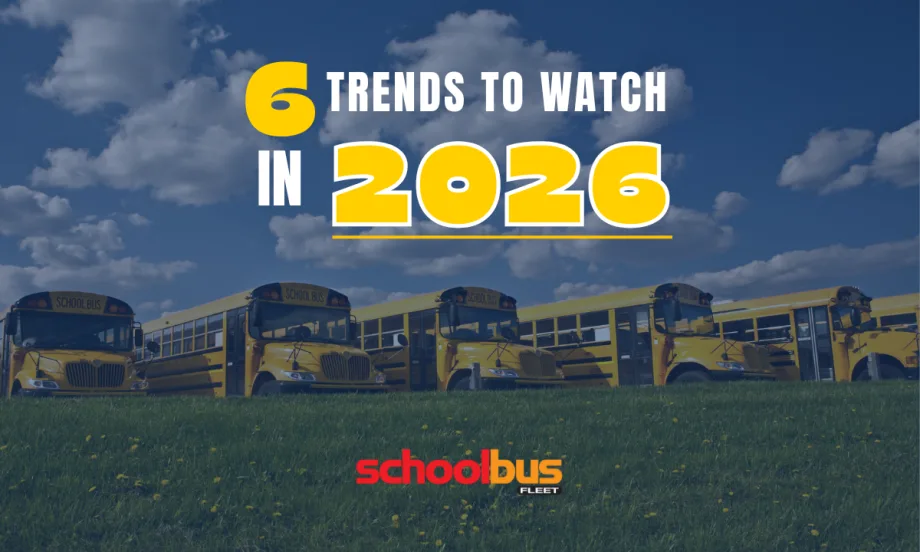
What issues will student transportation pros find ahead in 2026? These six themes are likely to be at the forefront.
Photo: School Bus Fleet
3 min to read
The past year brought significant shifts in policy, fuels, funding, technology, and operations as we settled into another new normal. Based on conversations and trends that shaped 2025, we expect to see several themes — some new, some déjà vu — play out in 2026.
What’s most likely to affect school transportation in the year ahead? Our best guesses are the following.
Technology’s increased role, including AI becoming a daily part of our routines
A focus on safety, especially illegal stop-arm passing
A new (again) normal for alternative fuels, with funding shifting to the states
Let’s dig in to a few of these here (find the deep dives on the rest in the links above).
A Focus on Safety and Illegal Passing
We have no doubt that illegal school bus passing will remain at the forefront of safety issues in the years ahead. We’re encouraged that NSTA and other groups are leading efforts to increase public awareness of the consequences of this dangerous trend.
We also expect to see increased discussion around seat belts as more states consider legislation, and increased ADAS features on buses.
A Quick Take on Alt Fuels
When it comes to alt-fuel adoption, Todd Anderson, CTO of PHINIA, believes that on- and off-highway transport is entering a more heterogeneous transition — and the same is likely true for school transportation.
“The past year has given us a new perspective on the energy transition,” Anderson said. “As OEMs recalibrate EV timelines, the focus has shifted from a single path to electrification to a more pragmatic approach, encompassing multiple options. There is now an emphasis on reducing emissions from the vehicles operating today and those that will remain in service for the foreseeable future.”
As we discussed in SBF’s October 2025 feature, the new federal environment and funding changes have (somewhat) shifted the appetite for electrifying bus fleets. The EPA’s Clean School Bus Program (CSBP) supercharged it for a few years, and now it’s stabilizing into something more manageable, which will likely help charging and utility infrastructure catch up to EV production.
OEMs say that they still have demand for electric models, so don’t expect alt-fuel adoption to taper out much. Instead, it’s settling back into what we saw pre-CSBP.
While federal funding for cleaner buses slowed in 2025, we saw more states set up programs to replace older diesel models, and that trend will likely continue into 2026. According to the Alliance for Electric School Buses, in the first nine months of 2025, states awarded over $80 million in grants and rebates totaling $346.1 million for new applications.
We expect continued adoption of alternative fuels that offer a lower point of entry (and cost), such as propane, biofuels, RNG, and retrofits and repowers.
Many are looking forward to Cummins’ new Octane gasoline engine coming this year to meet 2027 emissions requirements.
Putting It All Together
As the school transportation industry continues to evolve and pivot, there are just as many opportunities as there are challenges ahead.
One initiative we’re excited for is NAPT’s new public awareness campaign, Driven Together. It aims to educate the public about the importance and safety of the yellow school bus, with a calendar of specific objectives, taglines, and target audiences. Messaging will cover driver heroes, safety, trust, partnerships, policy, technology, and more to raise awareness and support for the school bus industry at the national level.
Transportation teams must remain agile in the year ahead. Those who think creatively, advocate for their teams, forge fruitful relationships across district administration, community members, lawmakers, and are active in trade groups and associations, will be well-positioned to thrive, no matter what 2026 throws at us.
What are you looking forward to in the new year? What concerns you? We’d love to hear your take.
Subscribe to Our Newsletter
More Management

How to Build a Better Driver Training Program
Ready to boost up your school bus instructor training? Here’s how to pick the right talent and improve recruitment, retention, and safety.
Read More →
CALSTART and Forth Combine to Form Catalyst Mobility
The new name represents a renewed vision for the nonprofit focused on advancing clean, equitable, and affordable transportation solutions that move people and goods.
Read More →
What Makes a Great School Bus Driver Trainer?
Choosing the right school bus driver trainer takes more than experience. Learn six keys to selecting and developing trainers and evaluating program effectiveness.
Read More →

School Bus Contractors Expand Through New Deals, Acquisitions & Partnerships
STA's Canadian division acquires Ontario-based G&L Stevenson Transport while Durham School Services adds a new district contract in California, First Student adds a New Jersey contract, and Minnesota Coaches acquires Halo Transportation.
Read More →
Logan Bus Company Rolls Out AI Phone System for NYC School Bus Families
A summer pilot found that AI agents could handle most routine calls, freeing up time for customer service staff to focus on emergencies and complex family concerns.
Read More →
From Intent to Impact: What I Learned About Leadership from TAPT
A Texas transportation supervisor shares lessons on self-awareness, accountability, managing stress and building trust — and why investing in leadership development matters at every stage of your career.
Read More →
NAPT Names 2026 Award Recipients, Hall of Fame Inductee
Who earned national recognition for their work in student transportation? This year, NAPT named five recipients of its 2026 awards for service, safety, and leadership, plus its newest Hall of Famer.
Read More →
Sponsored•September 2, 2026
2026 State of Student Transportation Report
Driver shortages. Rising costs. Growing safety expectations. More data, but not enough time to act on it. The 2026 State of Student Transportation Report reveals what transportation leaders say is putting the most pressure on their operations—and where they’re investing next. See how your priorities compare.
Read More →
How to De-Escalate an Angry Person: 5 Steps for Handling Workplace Conflict
What makes emotions run high, and how should you handle an angry colleague or parent? Follow these steps for staying calm, listening, showing empathy, and resolving conflict.
Read More →
Sponsored•September 1, 2026
What Readiness Looks Like This School Year
Learn about the challenges shaping the 2026–2027 school year, from persistent driver shortages and budget pressure to technology and readiness gaps. See how school districts are responding and adapting in Zonar’s 2026 Back-to-School Readiness Report.
Read More →