




The End of CNG? School Buses Find a Future in RNG
Compressed natural gas once looked like the future, but renewable natural gas is proving cleaner, cheaper, and easier to adopt for today's fleets.

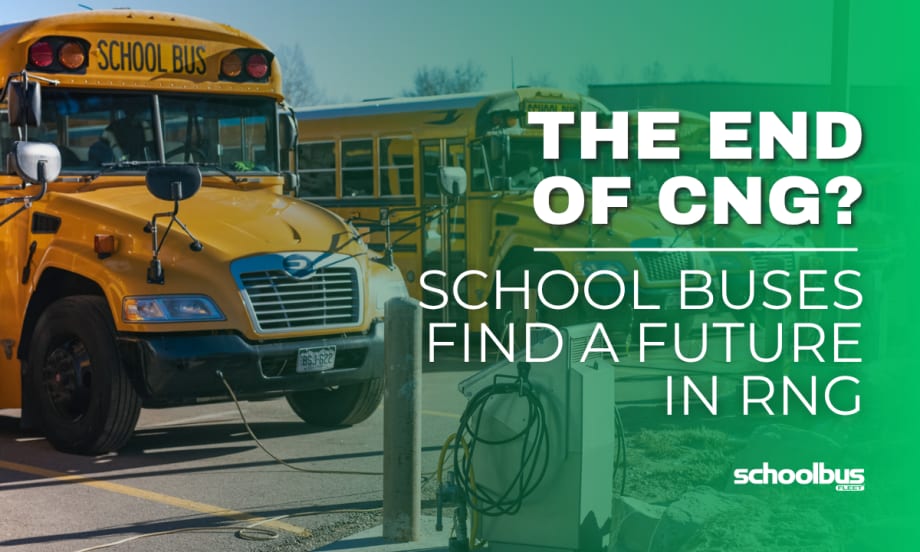
School bus fleets are exploring renewable natural gas as an additional alternative to diesel.
Photo: Ingevity
For decades, student transportation leaders and districts have been balancing two competing priorities: controlling emissions and cutting costs.
While electric school buses dominate the headlines today, most districts still operate fleets that rely heavily on diesel. That reliance comes with challenges such as fluctuating fuel costs, pressure to address health impacts, and mounting sustainability goals expected from many directions.
Compressed natural gas (CNG) once seemed like the natural solution. Cleaner than diesel and relatively abundant, it gained wider interest as the future of school bus fleets in the late 2000s and early 2010s, according to Mario DiFoggio, general manager of direct sales and marketing at Thomas Built Buses.
However, the industry continued to shift, and CNG's presence quietly diminished for clear reasons, including high infrastructure costs, the purchase cost of new fully dedicated CNG buses (exacerbating capital expenditure challenges and introducing range anxiety), lack of federal incentives, and improved diesel technology that narrowed its advantages.
Enter renewable natural gas (RNG). Chemically identical to CNG but sourced from decomposed organic matter, RNG has emerged as a cleaner, more flexible alternative that some districts are beginning to adopt. With the right technology, transitioning from diesel buses to dual-fuel vehicles that utilize RNG as an addition to diesel can maintain the same level of reliability and contribute to improved affordability.
As districts weigh their options, alternatives like Ingevity's "CowFartBus,” a diesel displacement system built on the DEMI-NeuFuel platform, demonstrate how RNG can turn waste into a practical step toward cleaner, more sustainable student transportation.
Defining the Fuels: CNG vs. RNG
At first glance, these two types of natural gas appear to be the same fuel, well, on a molecular level. According to David King, Cummins' North American on-highway product manager for natural and renewable gas engines, both are types of natural gas, specifically methane. Both are stored and dispensed in similar ways. Both can power natural gas engines already on the market.
The difference lies in how they're made:
- CNG is produced by compressing natural gas to less than 1% of its volume at standard atmospheric pressure, as described by the U.S. Department of Energy. It burns cleaner than diesel, producing fewer greenhouse gases and lower levels of nitrogen oxides (NOx) and particulate matter (PM).
- RNG, by contrast, is derived from decomposed organic matter, such as agricultural waste, including manure, and from sources like landfills and wastewater treatment plants. RNG is essentially a biodiesel or biogas that has been processed to "purity standards," per the Department of Energy. Its renewable origin makes it carbon-neutral, or in some cases even carbon-negative, when lifecycle emissions are measured.
However, according to Ingevity, the methane molecules are indistinguishable between CNG and RNG when they are “comingled” and injected into the U.S. natural gas pipeline. This makes RNG widely available as a transportation fuel.
While both fuels reduce harmful emissions compared with diesel, RNG offers greater reductions in greenhouse gases. According to the California Low Carbon Fuel Standard, RNG consumed in transportation achieved a carbon intensity of -194 gCO2e/MJ in 2024, meaning it removed more carbon than it emitted.
For school districts under pressure to meet sustainability goals and stay within budget constraints, RNG represents a leap forward.
Why Compressed Natural Gas Lost Ground
When CNG buses first entered the school transportation market in the 1990s through the likes of Thomas Built Buses and Blue Bird, the pitch was straightforward: stable fuel prices, cleaner tailpipe emissions, and an established supply pipeline. However, adoption lagged outside a few regions, and eventually, manufacturers began to step back.
Although still in use by some districts, several factors contributed to CNG's popularity decline. As a result, Blue Bird ended CNG bus production in 2024, whereas Thomas Built Buses ended ordering in 2022 and is not pursuing RNG solutions. The latter company’s investment is in other fuel sources, with a focus on electrification in the long term.
Major industry concerns include:
- High Infrastructure Costs: According to DiFoggio, a single CNG fueling station for a mid-sized fleet could cost upward of $1 million. That expense was difficult to justify for school districts already juggling tight budgets. As DiFoggio noted from Thomas Built’s past CNG experience, the cost was "on par with EV charging but without the significant incentives available for electric.”
- Cost of New Vehicle Purchase: The high infrastructure costs were exacerbated by the cost of having to purchase enough new, fully dedicated CNG school buses to achieve the appropriate returns on the capital expended. For example, Ingevity notes 50 CNG buses would cost over $5 million.
- Shifting Incentives: Federal and state subsidies that poured into battery-electric buses in the past decade left CNG largely unsupported. Even though the fueling infrastructure was robust, we're inclined to follow EV funding.
- Improved Diesel Technology: Advances in diesel emissions technology, which reduce NOx and PM output, have eroded some of CNG's competitive edge, but not when factoring the use of RNG and the cost advantage of natural gas.
Brad Beauchamp, Blue Bird’s EV segment leader, said it was in the CNG business from 1991 through 2024, pivoting away from the tech when its EV business took off and when engine manufacturers were not producing certified engines for CNG anymore.
As a result, CNG faded from some, but not all, school bus lineups, with manufacturers focusing instead on electric, other alternative fuels, and gasoline.
What Else Sets RNG Ahead?
In addition to its environmental impact, RNG offers several advantages that make it more compelling for fleets today.
Unlike electric or hydrogen, RNG doesn't require an entirely new fueling ecosystem. Due to its interchangeable nature, the Department of Energy explains that it can flow through the existing natural gas pipeline and be dispensed using standard fueling equipment. That compatibility makes it relatively easy to implement, and Ingevity’s system builds on this advantage by lowering fuel pressure requirements.
Additionally, according to King, RNG vehicles use familiar powertrain technology, including internal combustion engines, transmissions, and axles, making them easier for technicians to maintain. Refueling is also fast, typically on par with diesel, meaning no range anxiety or charging downtime.
Now, the big one: pricing. RNG pricing often comes in below $1 per gallon equivalent, Dante Marini, NeuFuel product engineer at Ingevity, says. This is due to the company’s platform enabling the use of low-pressure (900 PSI vs. 3,600 PSI) fueling appliance and allowing fleets to pay the utility rate for fuel. Retrofit solutions, such as Ingevity's DEMI-NeuFuel platform, cost approximately $12,500 per bus, with an additional $2,500 for the fueling appliance on a per vehicle basis, resulting in a return on investment of roughly 4.5 years.
"We feel there's a bigger opportunity to make an impact in day-to-day operations in terms of fuel reduction and greenhouse gas emissions reduction by bringing RNG into existing diesel assets that are probably going to be around for quite some time," Russell Schindler, strategic sales manager at Ingevity, said at a recent Minnesota School Bus Operators Association conference.
That affordability, combined with savings of $2 to $2.50 per gallon compared to diesel, makes RNG competitive even without massive subsidies.
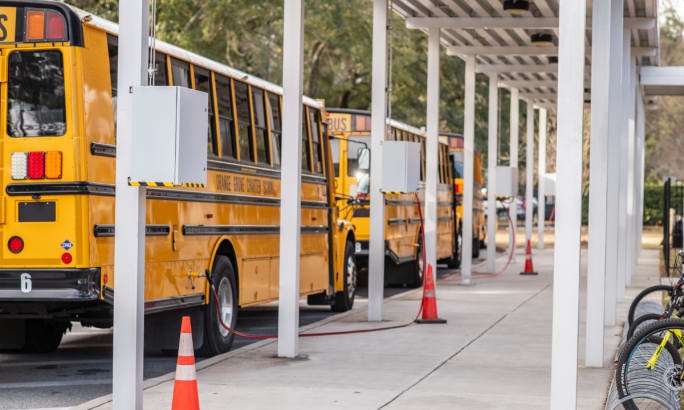
Orange Grove Charter School in South Carolina converted most of its diesel fleet to RNG with Ingevity's CowFartBus retrofit, cutting fuel costs by 25%.
Photo: Ingevity
RNG on the Road: Case Studies From School Bus Fleets
The CowFartBus, Ingevity’s Demi-NeuFuel bus technology, is a partnership between Ingevity and American CNG (ACNG) that converts in-use diesel school buses to run on a blend of RNG and diesel. Fleets of varying sizes use Ingevity's platform, which is currently operational in 12 states.
After piloting Ingevity's RNG retrofit, Orange Grove Charter School in South Carolina converted most of its diesel fleet. Ingevity’s William Sapon reports a 25% cut in fuel costs and 32.6 metric tons of GHG reductions annually, equivalent to nearly 19,000 miles driven by a bus.
In New Jersey, B.R. Williams was the first contractor in the state to adopt the platform. Sapon's early analysis shows that B.R. Williams could save more than 60% on fuel costs related to displaced diesel, while eliminating approximately 1,945 gallons of diesel per year and reducing GHG emissions by 20 metric tons annually.
Palmer Bus, a contractor based in Minnesota, piloted both CNG and RNG technologies. While the CNG pilot demonstrated solid performance, the startup costs proved challenging. RNG, by contrast, offered a more scalable and financially viable option.
According to Shane Johnson, Palmer Bus COO, ROI estimates suggest about four years per bus, aligning better with district budget cycles.
"Palmer Bus is active in the pursuit of environmental impacts, but it has to make financial sense in the long term," Johnson said. "Facility and employee safety is also highly important, which includes added facility engineering and equipment for ventilation and monitoring. We also include the respective school district to have their input as costs are incurred."
Despite its advantages, RNG adoption is not without hurdles:
- Local Availability: Fleets need a reliable RNG supply, and access to natural gas, which can vary by region. While 500 production sites exist nationwide (per King), access can still be uneven. Still, RNG can be injected anywhere into the pipeline.
- Facility Upgrades: Safety remains critical, necessitating regular ventilation system maintenance and vapor monitoring for indoor fueling, and tank inspections every three years.
- Workforce Training: Technicians and drivers must be trained to handle RNG fueling and maintenance protocols, but for Ingevity’s platform, additional training isn’t required.
- Budget Balancing: Even at Ingevity's $12,500 per retrofit, for example, upfront costs require careful planning, especially when compared to heavily subsidized electric options.
Still, many of these barriers are lower than those posed by fully electric or hydrogen, potentially making RNG a more realistic near-term option for fleets.
RNG Emerges as a Strong Alternative for School Transportation
While there is no “silver bullet” in the world of alternative fuels and technologies, industry experts view RNG as a “tool in the toolbox” to enable districts to reduce emissions now, while longer-term investments in electrification continue. King notes the customer base is strong and growing, with more than 79% of all transportation natural gas consumed in the U.S. being RNG. In California, that number jumps to over 99%.
For fleets, the near future may look like a diversified portfolio:
- Electric buses in regions with strong incentives and infrastructure.
- RNG-powered buses for districts seeking immediate carbon reductions without breaking budgets.
- Advanced diesel and gasoline for durability and nationwide fueling access.
As King puts it, RNG is "a game-changer for a fleet customer wanting to reduce their carbon footprint" while still relying on familiar engine technology.
CNG may have lost its momentum in the school bus market, but RNG is rewriting the narrative. "We see the future of school transportation as a mix of solutions, with electric as the long-term goal and other fuel types playing a continued role where they make the most sense," DiFoggio said.
By combining meaningful emissions reductions, cost savings, and compatibility with existing operations, RNG provides school districts with a practical approach to transitioning to cleaner fleets without the infrastructure challenges associated with other technologies.
More Alternative Fuels

CALSTART and Forth Combine to Form Catalyst Mobility
The new name represents a renewed vision for the nonprofit focused on advancing clean, equitable, and affordable transportation solutions that move people and goods.
Read More →
Alt-Fuel Moves: New Buses, Charging Hubs & Real-World EV Testing
Propane and electric school bus deployments continue to grow as districts add new vehicles, expand charging infrastructure, and gather more real-world operating data.
Read More →
Fewer Electric School Bus Models Reshape the U.S. Market
WRI’s latest buyer’s guide points to a consolidating electric school bus market, but fewer options may reflect a maturing industry rather than fewer meaningful choices for school bus operators.
Read More →
The Fuel Budget You Can Actually Predict: How Propane Autogas Keeps Money in the Classroom
Learn how propane autogas helps school districts manage fuel costs with predictable pricing, lower maintenance, and reduced emissions from former transportation director Joel Stutheit.
Read More →
Hendrickson, Driventic Introduce New Electric Powertrain for School Buses
ELECTRAAX, the electrified, lightweight drive axle offers integrated ePowertrain efficiency and modular flexibility for Class 6–7 school bus use.
Read More →
The Mobility House Joins PowerFlex in Fleet Electrification Deal
The acquisition combines intelligent charging software, bidirectional charging expertise, and fleet electrification services to support the growing adoption of electric school buses across North America.
Read More →
Alt-Fuel Moves: Electric School Bus Investments Hit the Road
See which districts across the U.S. are putting electric school buses into service, expanding charging infrastructure, and planning the next phase of fleet electrification.
Read More →
With Fuel Volatility Ahead, School Districts Turn to Propane
While diesel prices peaked above $5 this spring, districts with propane autogas-powered fleets paid under $2 per gallon, according to PERC.
Read More →
EPA Unveils Proposed Changes to 2027 Heavy-Duty Engine Rules
The federal agency has proposed changes to next year’s targets that would eliminate DEF derates, ease warranty requirements, and retain current NOx emissions standards.
Read More →
Alt-Fuel Moves: EV Charging & Infrastructure Projects Gain Momentum
The latest developments include new funding, charging infrastructure, utility investments, and fleet technologies designed to support the transition to electric school buses nationwide.
Read More →