





More from Blue Bird Leadership: Celebrating Black Voices in Student Transportation: Alexander Kevelier
5 Questions: Blue Bird’s John Wyskiel on Safety, Innovation, EVs, Partnerships & Plans
What is the newest president and CEO’s vision for the manufacturer and what does he see as its strengths? Check out this Q&A for his take on industry and company trends.
May 13, 2025
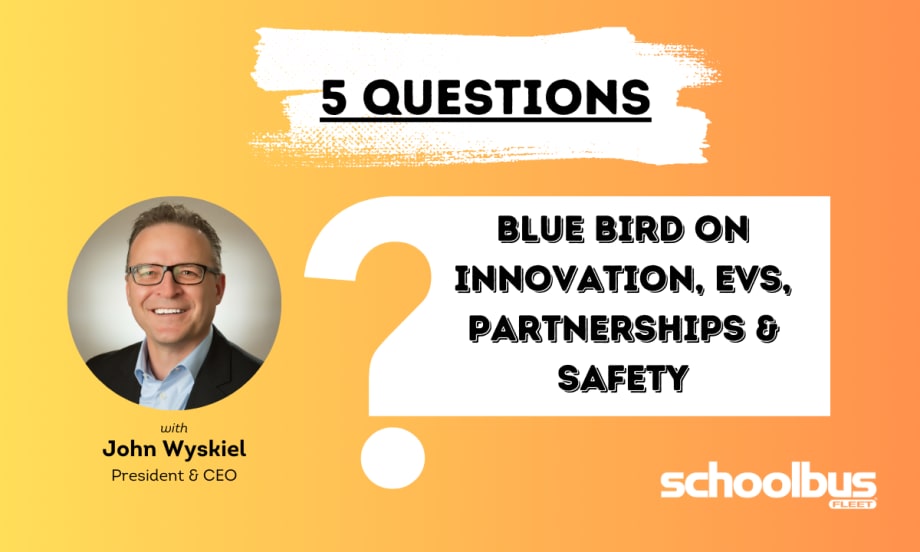
Wyskiel brings automotive and manufacturing experience to his new leadership role at one of the biggest OEMs. He started the role in February.
Photo: Blue Bird/SBF Canva
5 min to read
Last February, a new leader stepped into the driver’s seat at Blue Bird. John Wyskiel now serves as president & CEO, succeeding long-time leader Phil Horlock.
Wyskiel is an automotive industry veteran with over 35 years of experience in manufacturing, operations, and global sales and supply chain management. For the past 20 years, he’s served at Magna International, most recently as president of Magna Seating.
But Wyskiel is certainly not new to the company or to student transportation. From 2002 to 2004, he was Blue Bird Coach’s general manager in Canada, a division that made Type A and Type C school buses.
Prior to his career, Wyskiel was accredited in mechanical engineering from Mohawk College in Hamilton, Ontario and completed an executive development program at the University of Michigan’s Stephen M. Ross School of Business in Ann Arbor.
Let’s learn a little more about his leadership plans and industry observations so far.
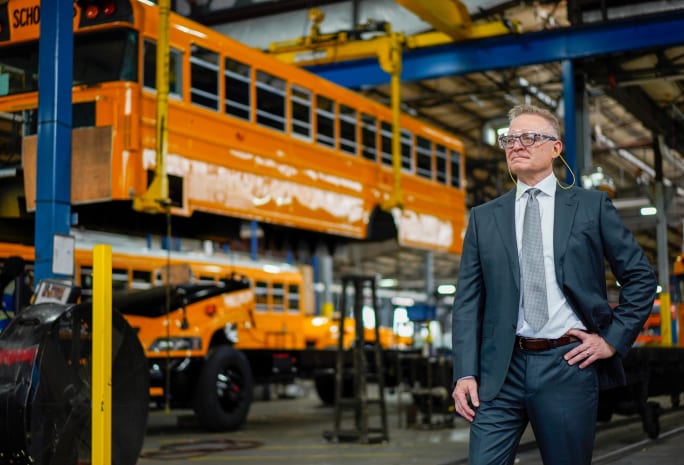
Blue Bird’s new CEO brings a long-term vision focused on innovation, safety, and expanding clean energy solutions to build on the company’s legacy while investing in its future.
Photo: Blue Bird Corporation
What was it like stepping in as president, and what lessons from the automotive industry have applied?
It has been a fantastic and exciting time to join Blue Bird. The company has performed well over the past years, which is a testimony to the entire team. I returned to Blue Bird after a 20-year hiatus. My first stint at this iconic American company transformed my career. I would not have had the success I did professionally without Blue Bird. The people, the product, and the market left a lasting impression on my life and career. So when the opportunity came up to join Blue Bird again, it was an easy decision.
The automotive industry is arguably one of the most complex industries in the world. So it’s natural to be a leading influence on other sectors in transportation. I think trends such as Industry 4.0 and some of the AI applications lend themselves well to our sector. I also think we can capitalize on many lessons learned from the electrification journey in the passenger car industry, including product development and manufacturing.
What does a commitment to innovation and safety look like to you, and how do you deliver this to customers and employees?
Blue Bird is recognized as a technology leader and innovator of school buses since it was founded in 1927. Our dedicated team designs, engineers, and manufactures school buses with a singular focus on safety, reliability, and durability. School buses carry the most precious cargo in the world — 25 million children twice a day — making them the most trusted mode of student transportation.
Our commitment to safety starts with school buses that are purpose-built for the market, not other vehicles simply adapted to fit the student transportation industry. This means that there are no compromises in design, manufacturing, or future developments. It’s a true commitment.
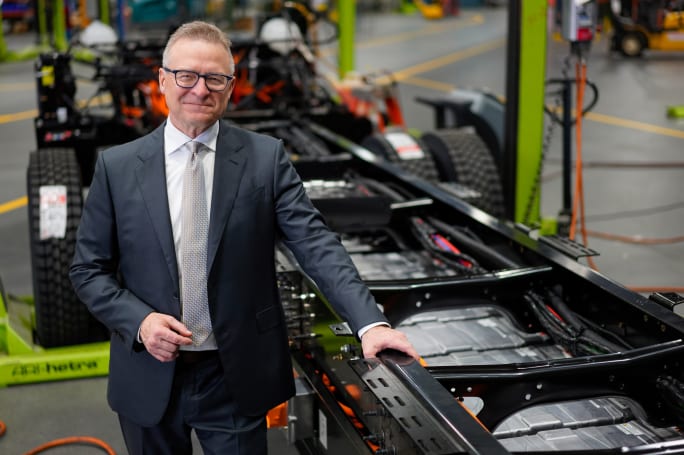
Wyskiel credits his early experience at Blue Bird with setting the foundation for his professional success.
Photo: Blue Bird Corporation
How do you see Blue Bird's role in furthering America's alt-fuel and EV technology network? How does the company steward federal funding?
I think the move to zero emissions will continue to advance in the longer term. It just may take longer to get there. In the school bus market, electrification makes so much sense. The duty cycle fits electrification and charging, range is not an issue since school bus routes are normally shorter, and zero emissions is just positive in terms of student health and performance. Thus far, this direction has had bipartisan support. We have taken our position and history in the market seriously. We were first to market and have the largest fleet with over 2,500 electric buses on the road today. We know we have to plan a lead role in advancing this shift.
School districts and vehicle manufacturers have received meaningful federal funding to advance the adoption of electric school bus technology. This funding has come from the EPA through its $5B Clean School Bus Program, which has enabled school districts to replace old diesel-powered buses with zero- and ultra-low-emission vehicles. In addition, the DoE continues to provide funding support, e.g., its agreement with Blue Bird to provide 50% of the investment required to convert an old plant for diesel-powered motorhomes into a state-of-the-art U.S. manufacturing facility for clean student transportation. We fully support these funding efforts and believe they are essential to help transition the nation’s school bus fleets to clean technology.
We take our role seriously as stewards of public funds used to purchase our products. We work diligently to lower the costs of our clean technology buses. Ultimately, our goal is for our customers to purchase and operate clean school bus fleets at a cost comparable to diesel-powered fleets, without government assistance. However, public funding remains critical to assist school districts and fleet operators during the current transition period.
How do you gather feedback from partners to inform product development?
Our supplier and dealer partners play an integral part in Blue Bird’s success. We are fortunate to have some of the most sophisticated supply partners. It just gives us an edge. Whether it is electric vehicle platforms, propane integration or seat belts, our supply partners have deep expertise that we leverage.
From a dealer perspective, we have been very active using our Dealer Advisory Council for feedback. They work with our customers every day. They provide feedback on current fleets. In addition, we invite the council to contribute to our future planning activities. We always discuss future changes with the council. It’s like having an in-house focus group that is 100% available. The insights of our Dealer Advisory Council are invaluable.
What's new or yet to come from Blue Bird?
Building on our announcements to make seat belts standard on our buses, we will introduce a driver airbag this fall. And we can look forward to other exciting things in the future.
Considering that I have only been back at the company for a few short months, it’s a little too early to talk strategy just yet. However, I think the theme will be to shift to a long-term view for our customers, dealers, team members, and investors. This means investing in facilities, our products, and expanding into adjacent markets where we can.
This great company has been around for almost 100 years, and my objective is to set it up for success for decades to come.
Subscribe to Our Newsletter
More Management

How to Build a Better Driver Training Program
Ready to boost up your school bus instructor training? Here’s how to pick the right talent and improve recruitment, retention, and safety.
Read More →
CALSTART and Forth Combine to Form Catalyst Mobility
The new name represents a renewed vision for the nonprofit focused on advancing clean, equitable, and affordable transportation solutions that move people and goods.
Read More →
What Makes a Great School Bus Driver Trainer?
Choosing the right school bus driver trainer takes more than experience. Learn six keys to selecting and developing trainers and evaluating program effectiveness.
Read More →


School Bus Contractors Expand Through New Deals, Acquisitions & Partnerships
STA's Canadian division acquires Ontario-based G&L Stevenson Transport while Durham School Services adds a new district contract in California, First Student adds a New Jersey contract, and Minnesota Coaches acquires Halo Transportation.
Read More →
Logan Bus Company Rolls Out AI Phone System for NYC School Bus Families
A summer pilot found that AI agents could handle most routine calls, freeing up time for customer service staff to focus on emergencies and complex family concerns.
Read More →
From Intent to Impact: What I Learned About Leadership from TAPT
A Texas transportation supervisor shares lessons on self-awareness, accountability, managing stress and building trust — and why investing in leadership development matters at every stage of your career.
Read More →
NAPT Names 2026 Award Recipients, Hall of Fame Inductee
Who earned national recognition for their work in student transportation? This year, NAPT named five recipients of its 2026 awards for service, safety, and leadership, plus its newest Hall of Famer.
Read More →
Sponsored•September 2, 2026
2026 State of Student Transportation Report
Driver shortages. Rising costs. Growing safety expectations. More data, but not enough time to act on it. The 2026 State of Student Transportation Report reveals what transportation leaders say is putting the most pressure on their operations—and where they’re investing next. See how your priorities compare.
Read More →
How to De-Escalate an Angry Person: 5 Steps for Handling Workplace Conflict
What makes emotions run high, and how should you handle an angry colleague or parent? Follow these steps for staying calm, listening, showing empathy, and resolving conflict.
Read More →
Sponsored•September 1, 2026
What Readiness Looks Like This School Year
Learn about the challenges shaping the 2026–2027 school year, from persistent driver shortages and budget pressure to technology and readiness gaps. See how school districts are responding and adapting in Zonar’s 2026 Back-to-School Readiness Report.
Read More →