




4 Things to Know for Your EPA EV Payment Request
The deadline to submit payment request forms for the first phase of the Clean School Bus Program is April 28. What do you need to know and have at hand so that you're fully prepared to get your rebate?
Among other things, you'll need a SAM.gov UEI, bus purchase order information, and your district's National Center for Education Statistics ID.
Image: Canva
Looking to secure payment for new zero-emission school buses acquired during the first phase of the Environmental Protection Agency’s Clean School Bus Program?
The deadline for submitting payment request forms is 4 p.m. Eastern on April 28. Don't be late!
So what’s required?
Be The Right Kind of Entity
Obviously, you can’t request a rebate payment from the EPA’s Clean School Bus Program unless you were selected for funding. If you were a selectee, you can request payment for new replacement school buses and EV bus charging infrastructure.
Your organization must be registered as an entity within the federal government’s System for Award Management (SAM.gov). Selectees must keep an active SAM.gov entity, including annual renewals, throughout the project period that ends in October 2024. An individual user account does not count as an organization’s entity registration.
Be sure all information in the SAM.gov registration is correct, including bank accounts, addresses, Unique Entity Identifier (UEI), and points of contact.
If you’re submitting on behalf of your organization, make sure your email address is listed as one of the following points of contact in the entity registration:
Electronic business POC.
Alternate electronic business POC.
Government business POC.
Alternate government business POC.
Those who are listed as SAM.gov points of contact will be prompted to use login.gov when they try to get the payment request form. They’ll have to use the same POC email address listed in SAM.gov. If you’ve never used login.gov before, expect to create a new, free account.
Be Ready with New School Bus Information
Before applying for your rebate payment, make sure to have the following available for reference:
12-character SAM.gov UEI for your organization. If your entity registration includes multiple bank accounts, be ready to provide the 4-digit Electronic Funds Transfer (EFT) Indicator for the bank account that should receive disbursements.
Information about the buses from your submitted application and purchase orders. Review your application in the Applicant Dashboard.
Primary contact information for your organization.
Purchase order number and date.
Purchaser information, including name, address, and phone number.
Vehicle or equipment vendor information, including name, address, and phone number.
Estimated remaining life of old buses to be replaced.
The 7-character National Center for Education Statistics (NCES) District ID for the school district served by the old bus during the 2021-2022 school year.
New school bus information, including make, model, model year, gross vehicle weight rating (GVWR), estimated delivery date, and purchase price.
Electric bus charging infrastructure information (if applicable), including the number of Level 2 chargers and hardware costs, number of DC fast chargers and hardware costs, and other eligible charging infrastructure costs.
Files containing images of the purchase order on vendor letterhead in file formats such as PDF, PNG, JPEG, and JPG.
Running Low on Time
What if you don’t think you’ll have everything you need to request payment by April 28?
The EPA indicated that it will consider extension requests on a case-by-case basis if sufficient justification is provided. Applicants are asked to send email to cleanschoolbus@epa.gov to justify the extension and provide a date by which the form and associated purchase orders will be ready for turn-in.
In Case You Need More Help
Does your organization have a finance office? If so, someone there might be familiar with your entity registration status on SAM.gov.
Seeking help on your own? First, check out the SAM.gov help page. Then, for further assistance, the EPA encourages users to seek help from the Federal Service Desk. The FSD is described as “the only official and free government resource for assistance with SAM.gov” by the EPA, which recommends caution with other websites that claim to assist with SAM.gov registrations for a fee.
Review Section 8 of the 2022 Clean School Bus Program Guide for a breakdown about the Payment Request Form, Purchase Order, and Payment. There’s also a Payment Request User Guide that may prove helpful.
If all else fails, reach out to the EPA at cleanschoolbus@epa.gov.
More Alternative Fuels

CALSTART and Forth Combine to Form Catalyst Mobility
The new name represents a renewed vision for the nonprofit focused on advancing clean, equitable, and affordable transportation solutions that move people and goods.
Read More →
Alt-Fuel Moves: New Buses, Charging Hubs & Real-World EV Testing
Propane and electric school bus deployments continue to grow as districts add new vehicles, expand charging infrastructure, and gather more real-world operating data.
Read More →
Fewer Electric School Bus Models Reshape the U.S. Market
WRI’s latest buyer’s guide points to a consolidating electric school bus market, but fewer options may reflect a maturing industry rather than fewer meaningful choices for school bus operators.
Read More →
The Fuel Budget You Can Actually Predict: How Propane Autogas Keeps Money in the Classroom
Learn how propane autogas helps school districts manage fuel costs with predictable pricing, lower maintenance, and reduced emissions from former transportation director Joel Stutheit.
Read More →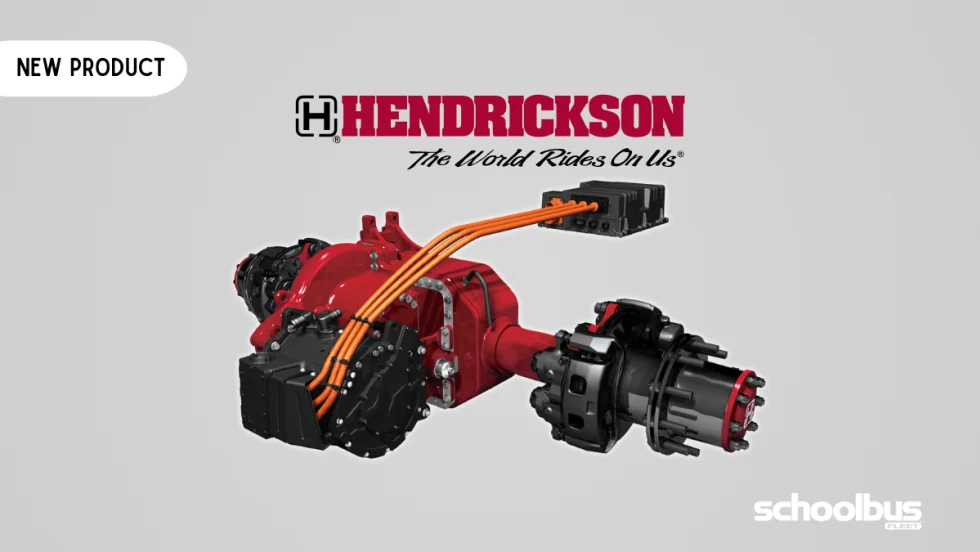
Hendrickson, Driventic Introduce New Electric Powertrain for School Buses
ELECTRAAX, the electrified, lightweight drive axle offers integrated ePowertrain efficiency and modular flexibility for Class 6–7 school bus use.
Read More →
The Mobility House Joins PowerFlex in Fleet Electrification Deal
The acquisition combines intelligent charging software, bidirectional charging expertise, and fleet electrification services to support the growing adoption of electric school buses across North America.
Read More →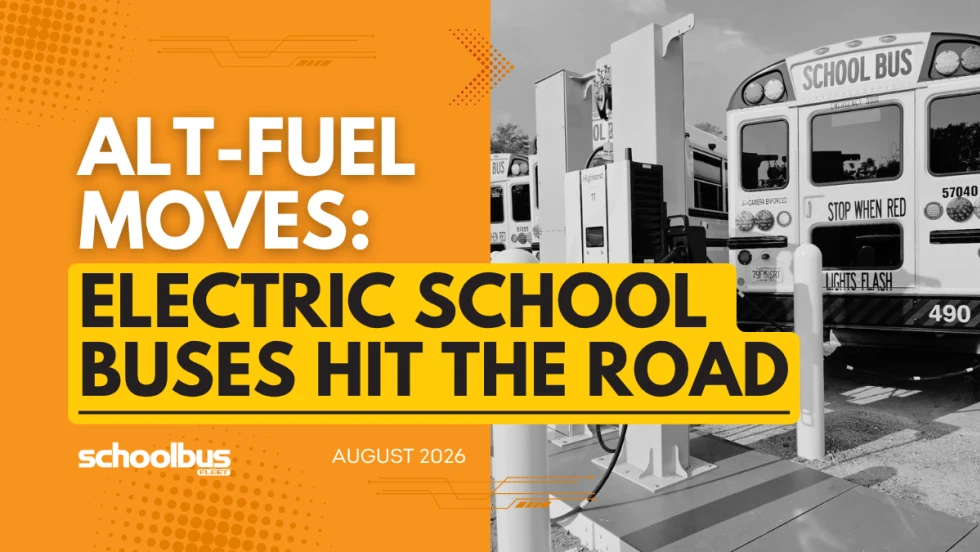
Alt-Fuel Moves: Electric School Bus Investments Hit the Road
See which districts across the U.S. are putting electric school buses into service, expanding charging infrastructure, and planning the next phase of fleet electrification.
Read More →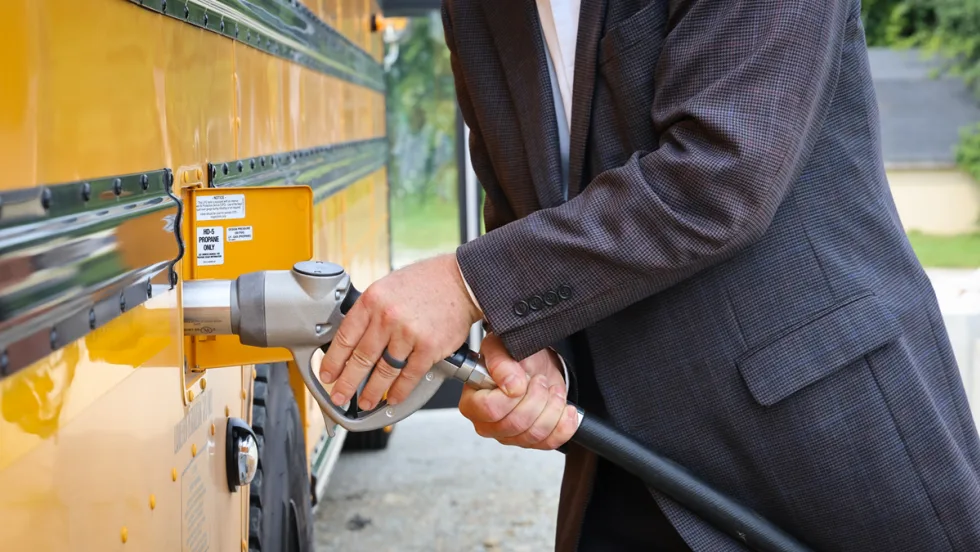
With Fuel Volatility Ahead, School Districts Turn to Propane
While diesel prices peaked above $5 this spring, districts with propane autogas-powered fleets paid under $2 per gallon, according to PERC.
Read More →
EPA Unveils Proposed Changes to 2027 Heavy-Duty Engine Rules
The federal agency has proposed changes to next year’s targets that would eliminate DEF derates, ease warranty requirements, and retain current NOx emissions standards.
Read More →
Alt-Fuel Moves: EV Charging & Infrastructure Projects Gain Momentum
The latest developments include new funding, charging infrastructure, utility investments, and fleet technologies designed to support the transition to electric school buses nationwide.
Read More →