





In 2024, NYC mandated telematics on all city fleet vehicles under Executive Order 39 to improve road safety. It recently reported that crashes are down 28%.
2025 Trend to Watch: Tech & Telematics in Focus
Discover how telematics is revolutionizing school bus operations in 2025, from GPS tracking and video monitoring to preventive maintenance and AI-enabled insights. Learn about telematics’ evolution, challenges to adoption, and what’s next.
January 13, 2025
Telematics can deliver real-time data and actionable insights that boosts safety, efficiency, and decision-making for transportation teams.
Photo: SBF/Canva
6 min to read
Telematics, which should be a term you’re well familiar with by now, combines telecommunications info with informatics, allowing certain vehicle data points to be tracked and analyzed. This is most often used on school buses for:
- GPS tracking
- Routing
- Ridership tracking
- Video (monitoring driver and student behavior, and other vehicles)
- Parent apps
- Driver tablets
- Crash detection
- Preventive maintenance
- Tire pressure, fuel, and engine monitoring
Evolution of Telematics Products
Years ago, telematics was a “nice-to-have,” that early adopters used to replicate what was happening in trucking (an industry that required ELDs in 2016). Now, it’s a must-have for school buses with instant information delivery.
Once groundbreaking innovations, today simple things like directions, reading fuel gauges, and tire pressure feel like child’s play. Telematics’ real value allows admins to evaluate large data sets and make real-time, data-driven decisions, especially as transportation managers must ruthlessly assess the fleet’s time and capacity.
Telematics also now integrates with many other systems, increases safety, and ensures compliance, with data stored in the cloud. With electric bus adoption growing, too, telematics is stepping in to monitor battery health, charging schedules, and energy optimization.
For instance, one benefit of the integration between Zonar and Tyler’s solution is that Tyler provides the planned route, and then Zonar can report on the actual route the driver took. This helps the transportation director track whether a driver followed the planned route or not.
Transfinder Corp., which provides its own hardware and solutions suite, says telematics is critical both on the road — with tracking routing, driver behavior, and attendance data — and in the garage. On the maintenance side, Servicefinder helps detect problem buses in need of repair. Mitch Oney, shop foreman at Ferndale (Wash.) School District, said the data he collects helps drive decisions on bus replacement, as well as inventory management.
To ensure regulatory compliance, telematics can geofence unsafe areas.
On-board WiFi helps students stay connected to complete homework or stay occupied to reduce disruptive behavior.
The telematics providers themselves also continue to diversify.
“The track and trace function, the epitome of any telematics platform, relies on the same basic principles used by sailors and pilots for generations,” said Tim Ammon, VP and GM, Passenger Services at Zonar.
The change now is how the data is captured, the number of products that can integrate, and position and timing information. And AI-enabled dashcams are now providing more information than ever. “Many school bus fleets value the ability to identify potentially dangerous behaviors or activities and exonerate drivers in the event of an incident,” Ammon said.
Peggy Tesdahl, transportation director for. St. Francis (Minn.) Area Schools, says their drivers, especially subs, love having GPS routing and stop-arm cameras. The one thing they don’t yet have but want to add is a live feed for both inside and outside the bus that could help folks back at the office watch something in real-time that a driver reports.
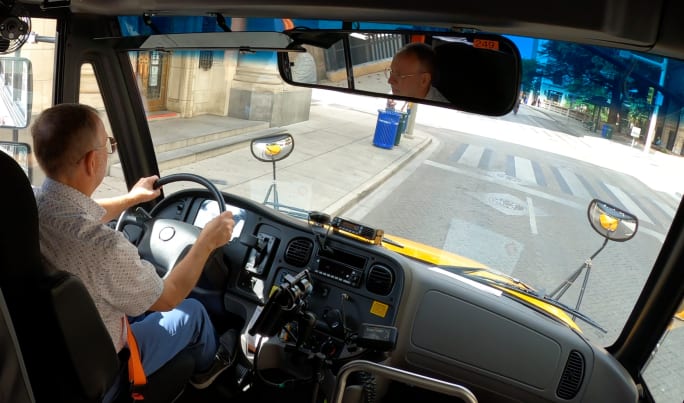
Kirby Lunsford from Goose Creek ISD in Texas uses Transfinder telematics while driving.
Photo: Transfinder
Challenges to Telematics Adoption
“GPS availability has increased as costs have come down, so we are seeing a lot more adoption,” said Antonio Civitella, Transfinder’s president and CEO. “There are a lot more use cases, but now there is an expectation: There has to be a return on investment, and there has to be minimal effort. So there becomes a sense for districts not wanting to be left out when they see neighboring districts have this technology at their fingertips. You have to protect your drivers and have answers handy when called by the school board with questions. You can’t say, ‘Let me go find out for you.’”
Adding an entire suite of software solutions onboard a fleet of buses can be timely and costly. Using a solution hosted by the vendor can reduce IT and related costs. Grants may also exist to support the financial burden of adding new technologies (in Minnesota, the Department of Public Safety introduced a $14.2 million state-funded grant in 2022 for two years. Those funds equipped nearly 7,000 6,998 buses with camera systems, representing about 59% of the eligible school bus fleet in the state).
A good telematics vendor will also provide the training and ongoing support needed to help your team. Make sure to cross-train this information and create a set of best practices to ease any confusion down the road.
“Adoption challenges often revolve around concerns, cost, and capacity,” Ammon said. “Our customers worry about routes making unauthorized stops, non-obvious vehicle maintenance issues, driver behavior, on-time performance, etc. Telematics solutions can alleviate many of these concerns.”
What about data privacy and security? “When evaluating new technology, it is essential to involve IT departments to thoroughly vet vendor solutions,” advised Zach Moren, Transfinder’s manager, sales enablement and engineering. “Transfinder follows industry best practices, such as encrypting data, using secure hosting tools, and implementing robust login features like multi-factor authentication and single sign-on. We encourage districts to ensure these measures are standard with any vendor they partner with.”
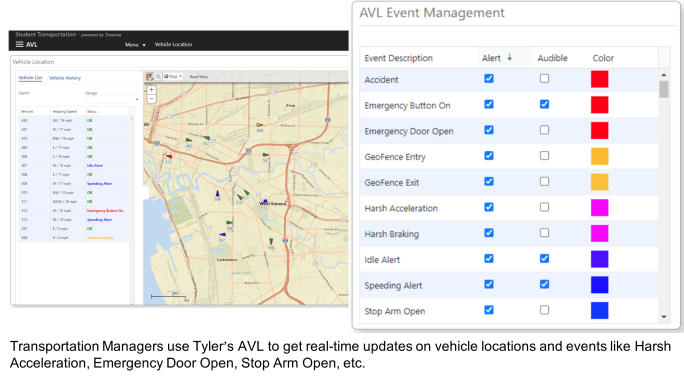
Transportation managers use Tyler’s AVL to get real-time updates on vehicle locations and events like harsh acceleration, emergency door open, stop arm open, etc.
Photo: Tyler Technologies
What’s Next for Telematics?
Bill Westerman, director of integrated solutions at Tyler Technologies, believes what’s next for telematics is requirements for more information, better analytics, and actionable insights, with AI and machine learning continuing to evolve.
Ammon says video telematics will be highly sought after to identify driver training opportunities and provide remote coaching to improve new driver safety and performance.
Safety Vision mentions a shift toward cellular connectivity, which will become more cost-effective with 5G technology and will improve real-time video access and incident response rates.
Both Tyler and Transfinder believe transportation directors want fewer vendors offering broader solutions, meaning solution suppliers will continue to expand their product lines. “What we are finding more and more is that schools want companies that provide all-in-one solutions,” Civitella said. “They do not want to have to deal with multiple technology companies for multiple solutions. That’s over.”
One other telematics technology that has hit other markets is weather telematics. This provides critical information on road conditions and extreme weather, which dispatchers find invaluable. Predictive weather intelligence alerts can be prompted in advance of an extreme weather event or atmospheric threat.
“As expectations continue to rise, it’s inevitable that transportation departments will be expected to provide even more information about activities within shorter timeframes,” Ammon said. “However, it’s clear that as acquisition costs decrease, adoption will continue to surge across sectors. Telematics remains the only tool available to transportation providers to meet these expectations.”
Telematics has already changed the game, and in 2025, it will continue to help address pain points across the entire school transportation landscape.
Editor's Note: This article is part of our 2025 trends analysis exploring key issues to watch this year, from telematics to safety, alt fuels, the driver shortage, and school bus ridership.
Check out the other articles in this series:
Subscribe to Our Newsletter
More Technology

Summit School Services to Complete Fleetwide Samsara Technology Rollout
The company said outfitting its entire fleet with AI-powered safety and fleet management technology will strengthen student safety and operational efficiency across its local brands.
Read More →
AI Tools Roundup: New Fleet Tools Aim to Turn Data Into Faster Decisions
The latest AI-powered platforms could help student transportation teams analyze fleet performance, manage maintenance, and uncover operational insights using natural-language queries.
Read More →
From Overwhelmed to Optimized: How AI Is Transforming School Transportation Leadership
Artificial intelligence is quickly becoming one of the most practical tools in today’s transportation office. Here’s how it is improving parent communication, board reporting, training development, and overall efficiency — without replacing professional judgment.
Read More →
How GPS Tracking Helps School Bus Fleets Improve On-Time Performance Without Adding Routes
Struggling with late buses? GPS data can help fleets cut delays, fix route bottlenecks, and improve on-time performance without adding routes.
Read More →
Where Is All This Tech Taking Us in 2026?
AI and industry technology shifts from reports to real-time coordination in 2026, unifying platforms, boosting safety tech, and making parent transparency the norm.
Read More →
Planning Before Purchasing: A 10-Step Framework for Vetting Tech
New tech tools can drive real impact or real frustration. Here’s how pupil transportation leaders can make smarter, safer, and budget-friendly tech decisions using a vetting process.
Read More →
Driving Made Safer: AI Cameras as a Bus Driver’s Co-Pilot
See how AI-powered driver assistance technology works as a partner on the road, offering timely alerts and coaching to keep students and drivers safe.
Read More →
Inside Parent Routing Apps: How Digital Tools Are Transforming School Transportation
From real-time tracking to instant alerts, technology is reshaping how districts communicate bus routes and changes with parents. Yet, as districts and vendors reveal, successful transportation hinges not just on apps, but also on the people and partnerships behind the screens.
Read More →
How Creative Routing Can Keep You Prepared for the Unexpected
Flexible routing, using routing tools, and easily communicable routes can help you keep ahead of any potential roadblocks when transporting students. Here are some tips for keeping the bus rolling and getting students to school on time, regardless of what the day brings.
Read More →