




Plugged In? First Clean School Bus Recipients Announced
Maryland School District Celebrates Electric Bus Transformation
Montgomery County Public Schools has partnered with Highland Electric Fleets to convert 326 school buses to electric by 2025.
by SBF Staff
October 27, 2022
Maryland's Montgomery County Public Schools this week celebrated its partnership with Highland Electric Fleets, with a goal of transforming its entire school bus fleet.
Photo: Montgomery County Public Schools
2 min to read
The country's single largest deployment of electric school buses is underway in Maryland's Montgomery County Public Schools. The district has partnered with Highland Electric Fleets to transform to all-electric by 2025.
The district hosted a ribbon-cutting ceremony this week in Bethesda at Walter Johnson High School.
During the 2021-2022 school year, MCPS installed electric charging infrastructure at a transportation depot and received its first 25 electric buses. It's expected that another 61 buses will come this school year, along with infrastructure installations at three more depots.
"Moving to electric transportation is not only a necessary response to climate change, but it is also something students have asked for at Board of Education meetings," said Brenda Wolff, president of the district's Board of Education. "My Board colleagues and I are pleased to support this effort and thank all MCPS staff who work to support environmental sustainability in the school system."
Superintendent Monifa B. McKnight shared similar sentiments: "Moving to an electrified school bus fleet makes sense and is the future of transportation for all of us. The school bus is the first and last contact with our students each day, and a new, modern school bus reflects our commitment to an excellent experience for students."
According to an MCPS news release, the district's diesel school buses use about 17,000 gallons of fuel during a typical school day, emitting greenhouse gases and other harmful matter. "Replacing the diesel bus fleet with electric buses brings MCPS one step closer to its pledge of cutting greenhouse gas emissions 80% by 2027 and 100% by 2035," the release stated.
The collaboration with Highland Electric Fleets is expected to deliver cleaner, healthier transportation for students and local communities, and support electric grid reliability with vehicle-to-grid (V2G) services.

MCPS got its first 25 electric school buses during the 2021-2022 school year. Another 61 buses are expected during this school year.
Photo: Montgomery County Public Schools
Said Maryland House Delegate David Fraser-Hidalgo: "Toxic pollutants can be as much as 2.5 times more prevalent inside a typical diesel school bus than inside an electric school bus. Considering this, along with the carbon emissions caused by the 17,000 gallons of fuel that MCPS diesel buses use daily, electrifying our school bus fleets is an imperative public health, climate change, and environmental priority. MCPS's work to electrify their bus fleet will improve health outcomes for children today and protect our air quality for years to come."
"School buses will not be a symbol of safe and sustainable student transportation," said U.S. Rep. Jamie Raskin. "We don't need our school buses to emit diesel fumes dangerous for our children and everyone else. School buses can embody and actualize the new green era we are entering."
More Alternative Fuels
Bipartisan Bill Seeks to Extend Clean School Bus Program Through 2031
The proposed legislation would renew federal support for cleaner school buses as districts navigate funding uncertainty, rising fuel and infrastructure costs, and fleet replacement needs.
Read More →
Alt-Fuel Moves: Electric Bus Rollouts, Bidirectional Charging & Propane Growth
See which fleets are adding electric and propane school buses as districts and operators invest in charging infrastructure, bidirectional technology, and alternative-fuel expansion.
Read More →
Nobody Told Diesel Prices They Were Supposed to Come Down
With diesel prices surging, school bus fleets have new reason to stress-test fuel costs, consider diversification, and calculate what each route really costs to operate.
Read More →
Why Gasoline School Buses Are Making a Comeback
Gasoline is gaining ground in full-size school buses. See how today’s options stack up against diesel on cost, maintenance, emissions, performance, and more.
Read More →
EPA Opens $180M DERA Funding Round for Diesel Upgrades
The 2026 Diesel Emissions Reduction Act program seeks applications from eligible organizations to accelerate the retirement of legacy diesel vehicles.
Read More →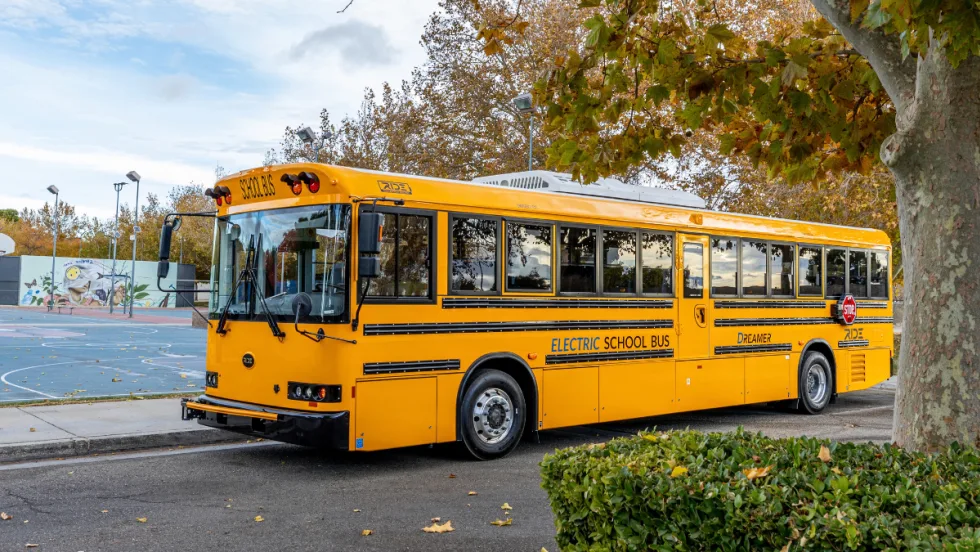
The Secret Life of an Electric School Bus Battery
Batteries change throughout years of daily routes, but degradation doesn’t necessarily mean the end. Here’s what operators should know about performance, safety, and second life.
Read More →
CALSTART and Forth Combine to Form Catalyst Mobility
The new name represents a renewed vision for the nonprofit focused on advancing clean, equitable, and affordable transportation solutions that move people and goods.
Read More →
Alt-Fuel Moves: New Buses, Charging Hubs & Real-World EV Testing
Propane and electric school bus deployments continue to grow as districts add new vehicles, expand charging infrastructure, and gather more real-world operating data.
Read More →
Fewer Electric School Bus Models Reshape the U.S. Market
WRI’s latest buyer’s guide points to a consolidating electric school bus market, but fewer options may reflect a maturing industry rather than fewer meaningful choices for school bus operators.
Read More →
The Fuel Budget You Can Actually Predict: How Propane Autogas Keeps Money in the Classroom
Learn how propane autogas helps school districts manage fuel costs with predictable pricing, lower maintenance, and reduced emissions from former transportation director Joel Stutheit.
Read More →