




West Virginia district testing electrical extended school bus stop arm
Kanawha County Schools is testing an electric-powered extended stop arm that may become a more consistent upgrade to the current air-powered version it uses on 10 of its buses.

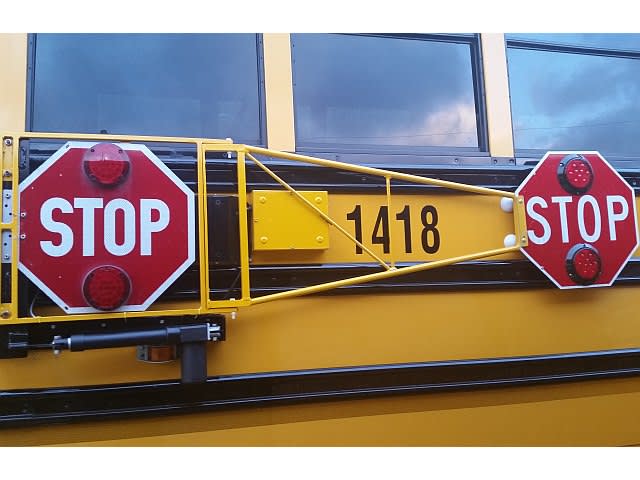
Kanawha County Schools is testing an electric-powered extended stop arm that may become a more consistent upgrade to the current air-powered version it uses on 10 of its buses.
KANAWHA COUNTY, W.Va. — School transportation officials here are testing an electric-powered extended school bus stop arm that may become a more consistent upgrade to the current air-powered version used on some of its buses.
On Monday, workers replaced the air-powered extended stop arm on a Kanawha County Schools Safety Bus, a teaching tool for drivers, with the electric version of the product, called Bus Crossing Guard. This new type of stop arm may perform more consistently than the current version that is used on 10 Kanawha County Schools buses, said Brette Fraley, the executive director of transportation for the district.
As previously reported, in April, Guilford County (N.C.) Schools began testing Bus Crossing Guard, which was developed by BL Solutions.
West Virginia state inspectors were slated to test Bus Crossing Guard on Thursday, and then the district will conduct additional testing, including on hillsides and in inclement weather, situations in which the air-powered version has opened at a slower speed, Fraley said.
“We want to make sure that this is what we want before we go to the state director and say this is the product we want and why,” he added.
Still, there is an urgent need for an upgrade. When the district participated in the National Association of State Directors of Pupil Transportation Services' national survey on stop-arm running earlier this year, it saw 90 illegal passing incidents in one day.
Additionally, in the current school year alone, since Aug. 10, Kanawha County has nearly exceeded 1,000 violations, Fraley said.
Officials told WSAZ the current extended stop arms have been effective when they have worked. In a pilot that Kanawha County Schools conducted with Cabell County and Greenbrier County, using the extended stop arms appeared to reduce illegal passing incidents by nearly half on a year-over-year basis, Fraley explained.
Extended stop arms generally bring a greater awareness to the bus, Fraley added.
“For some reason, people don’t see that 40-foot yellow bus, but when [a motorist] gets to a two-lane road, and an extended stop arm goes out to the other lane, it brings more awareness, more of a presence. I have seen people stop on the yellows; we see people stop 15, 20 feet back. There’s not that urgency to get through the bus.”
The Bus Crossing Guard is designed to reliably open in under three seconds, and local transportation supervisors saw it do just that in a demonstration on Monday, Fraley said.
If the stop arm passes inspection, all of the air-powered extended arms would be replaced with the electrical version in the coming weeks. However, West Virginia Department of Education officials said that even if the upgraded extended stop arm passes inspection, participation will vary in the state from county to county, depending on road size and school budgets, WSAZ reports.
More Safety

Geotab Expands Fleet Safety Tools With Video Coaching, Risk Insights
New safety and video capabilities aim to help fleet managers assess risk, support drivers, and take targeted action through video coaching, red-light violation detection, and more.
Read More →
How to Build a Better School Bus Driver Training Program
Is it time to strengthen your driver training? Here’s how to pick the right talent and improve recruitment, retention, and safety. This video is brought to you by IC Bus.
Read More →
Recent School Bus Accidents Leave 2 Dead, 2 Injured
Four school bus crashes in Florida, Illinois, and Georgia highlight risks in transportation lots, at bus stops, and during student loading and unloading.
Read More →

When Every Second Matters, Clarity Keeps Routes Moving
From routine delays to urgent incidents, strong communication practices help drivers, dispatchers, schools, and families respond with confidence.
Read More →
What Happens When a School Bus Catches Fire — and What Can Help
School bus fires are rare but can be devastating. Learn how advances in fire suppression and asset protection help fleets detect fires earlier, reduce damage, and improve safety.
Read More →
Geotab Launches Tool to Help Fleets Investigate Road Incidents
Geotab Investigations combines telematics data, video, documents, and other evidence to help fleets reconstruct incidents, resolve claims, and determine what happened.
Read More →
Texas Sixth Grader Wins 2026 National School Bus Safety Poster Contest
Sai Darshana Yekolu of Moseley Middle School in Prosper, Texas, was named the newest winner for her artwork, bringing the theme of “Safe Rides, Everyday Heroes” to life.
Read More →
Doing More With Less: How Transportation Directors Can Prioritize Safety Amid Budget Uncertainty
With diesel prices soaring and nearly one-third of transportation directors expecting budget cuts, maintaining student safety has never been more challenging. Download this guide to learn how leading districts are prioritizing risk, funding critical safety technology, and building stronger budget cases with data.
Read More →
Walton County Schools Adds Gatekeeper Stop-Arm Enforcement System
The Florida district will deploy Gatekeeper’s updated Student Protector technology, which now incorporates AI to improve video evidence.
Read More →
How To Build a More Secure School Bus Yard During and After Hours
As thefts and overnight security threats continue, school transportation leaders are combining stronger operational practices with AI-enabled surveillance to better protect buses, facilities, and staff.
Read More →