




Virginia Lawmakers Consider School Bus Driver Training Requirements and Ads, Reject Seat Belts
One bill would cut training hours needed for CDL holders and those approved to operate a school bus. Another would allow bus ads.

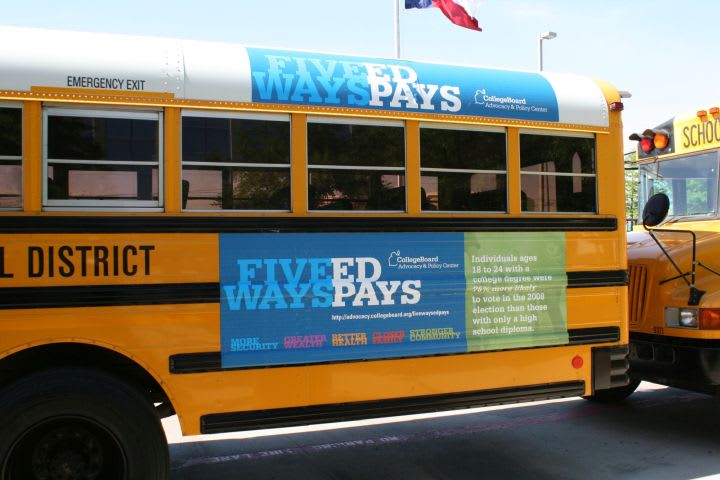
A Virginia bill would let school boards display ads on school buses between the rear wheels and the rear of the bus. Shown in this file photo is a Houston (Texas) Independent School District bus displaying an ad.
A Virginia bill would let school boards display ads on school buses between the rear wheels and the rear of the bus. Shown in this file photo is a Houston (Texas) Independent School District bus displaying an ad.
RICHMOND, Va. — State lawmakers are considering bills that would reduce training time requirements for some drivers and allow advertising on parts of school buses, and they rejected a bill that would require seat belts on new buses.
SB 557 would cut down on the number of training hours needed by some experienced bus drivers to operate a school bus in the state.
Instead of the current 24 hours of classroom training and 24 hours of behind-the-wheel training required by the Virginia Department of Education, the bill would require four hours of classroom training and three hours of behind-the-wheel training for drivers who already have a commercial driver’s license (CDL) or were previously trained and approved to operate a school bus (which would include having a valid CDL and P and S endorsements). Applicants without a CDL would be required to undergo at least 24 hours of classroom training and six hours of behind-the-wheel training.
The bill, proposed by Sen. Emmett Hanger, passed unanimously in the Senate last week and is currently under review by the House Education Committee. SB 557 and its companion bill in the House, HB 914, were created to address a statewide driver shortage while maintaining safety standards, Hanger’s office told WHSV. The office also told the news source that training requirements were decreased for experienced drivers with a valid CDL and bus driving experience in an effort to eliminate duplication of coursework in the licensing process.
Meanwhile, HB 809 would permit school boards in Virginia to display advertisements on school buses between the rear wheels and the rear of the bus, as long as the material doesn’t obstruct the name of the school division or number of the bus; is not sexually explicit; and is not related to gambling, politics, tobacco, or alcohol. Advertising for food or beverages that don’t meet nutrition standards set by the Healthy, Hunger-Free Kids Act of 2010 would also be prohibited.
The bus ad bill, sponsored by Republican Del. Israel O’Quinn, is aimed at helping to close budget gaps, according to WTOP. O’Quinn told the news source that school divisions could use the money as they see fit.
The proposed bill has failed in the past, The Virginian-Pilot reports, but this time it is more focused on what types of ads would be allowed. The newspaper also noted that the group Campaign for Commercial Free Childhood has opposed similar measures in other states, arguing that the effects are detrimental and that the revenue from the ads only covers a fraction of school budgets.
The House Education Committee approved HB 809 on Friday, and it was assigned to the Senate Public Education Committee on Wednesday.
Additionally, lawmakers rejected HB 224, which would have required lap-shoulder belts on new school buses in Virginia.
Under the proposed bill, school boards would have been required to ensure that every school bus was equipped with lap-shoulder belts in every seat no later than July 1, 2036.
Those opposed to the seat belt bill referred to it as an unfunded mandate, and House members questioned whether the belts would make loading and unloading students take longer, placing an extra burden on drivers, according to The Virginian-Pilot.
More Safety

How to Build a Better School Bus Driver Training Program
Is it time to strengthen your driver training? Here’s how to pick the right talent and improve recruitment, retention, and safety. This video is brought to you by IC Bus.
Read More →
Recent School Bus Accidents Leave 2 Dead, 2 Injured
Four school bus crashes in Florida, Illinois, and Georgia highlight risks in transportation lots, at bus stops, and during student loading and unloading.
Read More →
When Every Second Matters, Clarity Keeps Routes Moving
From routine delays to urgent incidents, strong communication practices help drivers, dispatchers, schools, and families respond with confidence.
Read More →

What Happens When a School Bus Catches Fire — and What Can Help
School bus fires are rare but can be devastating. Learn how advances in fire suppression and asset protection help fleets detect fires earlier, reduce damage, and improve safety.
Read More →
Geotab Launches Tool to Help Fleets Investigate Road Incidents
Geotab Investigations combines telematics data, video, documents, and other evidence to help fleets reconstruct incidents, resolve claims, and determine what happened.
Read More →
Texas Sixth Grader Wins 2026 National School Bus Safety Poster Contest
Sai Darshana Yekolu of Moseley Middle School in Prosper, Texas, was named the newest winner for her artwork, bringing the theme of “Safe Rides, Everyday Heroes” to life.
Read More →
Doing More With Less: How Transportation Directors Can Prioritize Safety Amid Budget Uncertainty
With diesel prices soaring and nearly one-third of transportation directors expecting budget cuts, maintaining student safety has never been more challenging. Download this guide to learn how leading districts are prioritizing risk, funding critical safety technology, and building stronger budget cases with data.
Read More →
Walton County Schools Adds Gatekeeper Stop-Arm Enforcement System
The Florida district will deploy Gatekeeper’s updated Student Protector technology, which now incorporates AI to improve video evidence.
Read More →
How To Build a More Secure School Bus Yard During and After Hours
As thefts and overnight security threats continue, school transportation leaders are combining stronger operational practices with AI-enabled surveillance to better protect buses, facilities, and staff.
Read More →
FMCSA Names New Chief Safety Officer: What School Bus Operators Should Know
Steve Dowling is set to lead the federal agency's efforts to advance commercial motor vehicle safety and reduce crashes, fatalities, and injuries on the nation's roadways.
Read More →