




Utah District Rolls Out 4 Electric School Buses
Salt Lake City School District purchases the Micro Bird electric buses using funding from the Utah Department of Environmental Quality.

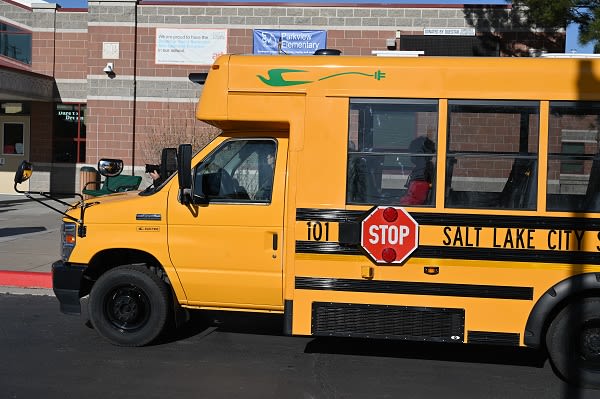
Salt Lake City (Utah) School District has added four Micro Bird electric school buses to its fleet with the help of funding from the Utah Department of Environmental Quality.
Photo courtesy Salt Lake City School District
Salt Lake City School District (SLCSD) recently rolled out four Micro Bird electric school buses to replace some of its aging diesel buses.
The electric school buses, which are reportedly the first for the district and the state, were partially funded through the Utah Department of Environmental Quality’s (DEQ’s) Volkswagen settlement program and Utah Clean Diesel Program (UCDP), according to a news release from the agency.
The DEQ awarded SLCSD two grants, totaling $1.5 million, to purchase the electric buses, Yandary Chatwin, the district’s executive director of communications and community relations, told School Bus Fleet.
“With the money from the first grant, [which the district applied for in November 2018], we were able to purchase four electric buses,” Chatwin said. “Four more buses will be on their way to our district next year with the funds from the second grant.”
New to Electric School Bus Adoption? Experienced Operators Share 6 Tips
Ken Martinez, interim transportation supervisor for SLCSD, said in the DEQ’s news release that the district “has been looking into all alternative-fuel school buses for several years, but when we were made aware of the grants available through DEQ, it gave us a shot of motivation to move forward with the electric buses.”
Martinez added that he watched costs for full-size electric buses drop from $550,000 in 2017 to $400,000 six months ago, with current costs being close to $380,000. He attributed the fall in prices to the cost of batteries going down and more electric buses being sold nationwide, according to the DEQ. The district reportedly chose to test electric vehicle technology on its smaller buses — which are used to transport special-needs students on shorter routes — to test the range of the battery.
“When we first got bids for the smaller buses 14 months ago, the costs were $270,000, but the costs have dropped to $233,000, and this was during the COVID-19 pandemic, so I’m looking forward to seeing how the industry changes in the next year,” Martinez said in the news release.
Report Details Ways to Expedite Transition to Electric School Buses
SLCSD announced in a post on its Facebook page that the first four electric buses will be used to transport students on the west side of Salt Lake City. This specific area was chosen based on environmental studies that show that city’s west side has some of the highest levels of pollution in the state, according to the district.
Currently, SLCSD has a total of 100 buses in their fleet and intends to convert 20% to 25% of those buses to electric, with an eventual goal of converting 70% to 75% of its fleet to electric, according to the DEQ. The agency said that the district is also updating its bus depot to accommodate charging stations for the new electric buses. The charging stations will reportedly be housed under canopies equipped with solar panels that may eventually be used to provide part of the power to the buses.
Moving to Full Fleet Electrification: A Look at 3 Districts' Plans
View additional photos of SLCSD's electric school buses, posted on the district's Facebook page, below.
More Alternative Fuels

CALSTART and Forth Combine to Form Catalyst Mobility
The new name represents a renewed vision for the nonprofit focused on advancing clean, equitable, and affordable transportation solutions that move people and goods.
Read More →
Alt-Fuel Moves: New Buses, Charging Hubs & Real-World EV Testing
Propane and electric school bus deployments continue to grow as districts add new vehicles, expand charging infrastructure, and gather more real-world operating data.
Read More →
Fewer Electric School Bus Models Reshape the U.S. Market
WRI’s latest buyer’s guide points to a consolidating electric school bus market, but fewer options may reflect a maturing industry rather than fewer meaningful choices for school bus operators.
Read More →
The Fuel Budget You Can Actually Predict: How Propane Autogas Keeps Money in the Classroom
Learn how propane autogas helps school districts manage fuel costs with predictable pricing, lower maintenance, and reduced emissions from former transportation director Joel Stutheit.
Read More →
Hendrickson, Driventic Introduce New Electric Powertrain for School Buses
ELECTRAAX, the electrified, lightweight drive axle offers integrated ePowertrain efficiency and modular flexibility for Class 6–7 school bus use.
Read More →
The Mobility House Joins PowerFlex in Fleet Electrification Deal
The acquisition combines intelligent charging software, bidirectional charging expertise, and fleet electrification services to support the growing adoption of electric school buses across North America.
Read More →
Alt-Fuel Moves: Electric School Bus Investments Hit the Road
See which districts across the U.S. are putting electric school buses into service, expanding charging infrastructure, and planning the next phase of fleet electrification.
Read More →
With Fuel Volatility Ahead, School Districts Turn to Propane
While diesel prices peaked above $5 this spring, districts with propane autogas-powered fleets paid under $2 per gallon, according to PERC.
Read More →
EPA Unveils Proposed Changes to 2027 Heavy-Duty Engine Rules
The federal agency has proposed changes to next year’s targets that would eliminate DEF derates, ease warranty requirements, and retain current NOx emissions standards.
Read More →
Alt-Fuel Moves: EV Charging & Infrastructure Projects Gain Momentum
The latest developments include new funding, charging infrastructure, utility investments, and fleet technologies designed to support the transition to electric school buses nationwide.
Read More →