




School District Pilots Tech Created to Predict Stop-Arm Running Incidents
Hopkins (Minn.) Public Schools is testing Safe Fleet’s Predictive Stop-Arm. It uses radar technology and predictive analytics to notify bus drivers and students when risk is detected outside the bus.


Hopkins (Minn.) Public Schools is testing Safe Fleet’s Predictive Stop-Arm. Shown here are Derrick Agate, the district's transportation supervisor (left), and Tom Brodsky, vice president of the advanced technology group at Safe Fleet.
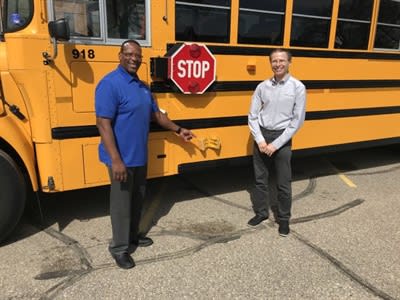
Hopkins (Minn.) Public Schools is testing Safe Fleet’s Predictive Stop-Arm. Shown here are Derrick Agate, the district's transportation supervisor (left), and Tom Brodsky, vice president of the advanced technology group at Safe Fleet.
HOPKINS, Minn. — A school district here is testing a new solution designed to analyze when a vehicle is likely to illegally pass a stopped school bus.
Hopkins Public Schools is conducting a pilot test with the Predictive Stop-Arm (PSA) system from Safe Fleet. Using radar technology and predictive analytics, the PSA aims to enhance student safety outside the bus, notify bus drivers and students directly when risk is detected, and mitigate driver distraction with reduced false alerts, according to a news release from Safe Fleet.
Tom Brodsky, vice president of the advanced technology group at Safe Fleet, said that the safety solution supplier’s approach to the longtime problem of vehicles passing stopped school buses uses active alerts to students as well as bus drivers, referring to the use of predictive analytics as “the essential ingredient to the safety solution mix.”
The school district has been running the pilot for a month and plans to continue testing it over the course of the next year, KARE 11 reports.
Derrick Agate, the district's transportation supervisor, told the news source that he heard about the technology at a conference.
"Our number-one responsibility is to keep the kids safe and this technology helps us to do that," Agate, who is also the president of the Minnesota Association of Pupil Transportation, added.
Agate also noted that the PSA is more appealing to him than just using cameras on the bus and focusing on drivers who break the law, according to the news source. He also likes that there is an audio warning for the student not to cross the street when the system detects imminent danger, telling KARE 11 “We have the video … but more importantly, the child never stepped out into the street to begin with.”
“The school bus industry has been trying to effectively address the school bus danger zone for years,” Brodsky added. “The use of mirrors, stop arms, video surveillance, operator training, public safety announcements, and policies and procedures have helped increase safety outside the bus. But more must be done if we want to reduce the number of school bus related injuries and fatalities to zero.”
Another school district, St. Lucie (Fla.) Public Schools, has had the PSA operating live on regular routes on 10 buses since August 2018, Safe Fleet told SBF, and expects to officially roll it out in May or June.
Watch the complete video coverage from KARE 11 below.
Safe Fleet will hold a live demonstration showcasing the Intelligent Perimeter Safety Solutions, including the Predictive Stop-Arm, on June 9 at the STN EXPO Indy. For more information, go here.
More Safety

Geotab Expands Fleet Safety Tools With Video Coaching, Risk Insights
New safety and video capabilities aim to help fleet managers assess risk, support drivers, and take targeted action through video coaching, red-light violation detection, and more.
Read More →
How to Build a Better School Bus Driver Training Program
Is it time to strengthen your driver training? Here’s how to pick the right talent and improve recruitment, retention, and safety. This video is brought to you by IC Bus.
Read More →
Recent School Bus Accidents Leave 2 Dead, 2 Injured
Four school bus crashes in Florida, Illinois, and Georgia highlight risks in transportation lots, at bus stops, and during student loading and unloading.
Read More →

When Every Second Matters, Clarity Keeps Routes Moving
From routine delays to urgent incidents, strong communication practices help drivers, dispatchers, schools, and families respond with confidence.
Read More →
What Happens When a School Bus Catches Fire — and What Can Help
School bus fires are rare but can be devastating. Learn how advances in fire suppression and asset protection help fleets detect fires earlier, reduce damage, and improve safety.
Read More →
Geotab Launches Tool to Help Fleets Investigate Road Incidents
Geotab Investigations combines telematics data, video, documents, and other evidence to help fleets reconstruct incidents, resolve claims, and determine what happened.
Read More →
Texas Sixth Grader Wins 2026 National School Bus Safety Poster Contest
Sai Darshana Yekolu of Moseley Middle School in Prosper, Texas, was named the newest winner for her artwork, bringing the theme of “Safe Rides, Everyday Heroes” to life.
Read More →
Doing More With Less: How Transportation Directors Can Prioritize Safety Amid Budget Uncertainty
With diesel prices soaring and nearly one-third of transportation directors expecting budget cuts, maintaining student safety has never been more challenging. Download this guide to learn how leading districts are prioritizing risk, funding critical safety technology, and building stronger budget cases with data.
Read More →
Walton County Schools Adds Gatekeeper Stop-Arm Enforcement System
The Florida district will deploy Gatekeeper’s updated Student Protector technology, which now incorporates AI to improve video evidence.
Read More →
How To Build a More Secure School Bus Yard During and After Hours
As thefts and overnight security threats continue, school transportation leaders are combining stronger operational practices with AI-enabled surveillance to better protect buses, facilities, and staff.
Read More →