




School bus officials cite concerns on flammability lobbying
Chemical companies are reportedly funding a nonprofit group that is lobbying state legislatures to adopt additional flammability standards for school buses. A new position paper from NASDPTS explains that the standards being proposed aren't suited for pupil transportation — and the industry's own national specifications are actually more stringent.

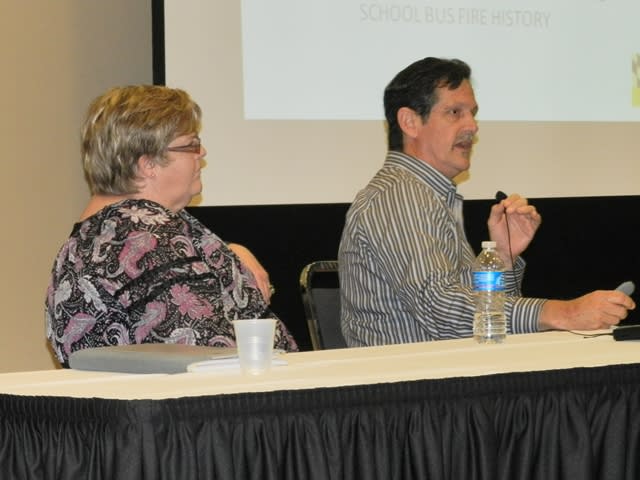
A NASDPTS position paper explains that flammability standards being proposed in lobbying efforts aren't suited for pupil transportation. Nevada state director Diana Hollander and Maryland state director Leon Langley have already contended with such legislation.
At the state pupil transportation directors conference on Saturday, an alarming development was discussed: Chemical companies are reportedly funding a nonprofit group that is lobbying state legislatures to adopt additional flammability standards for school buses.
A new position paper from the National Association of State Directors of Pupil Transportation Services (NASDPTS) explains that the standards being proposed aren't suited for pupil transportation — and the industry's own national specifications are actually more stringent.
The paper, developed by NASDPTS' School Bus Manufacturers Technical Council, details the fire-related federal standards that apply to school buses, including FMVSS 302 — Flammability of Interior Materials.
The paper notes that flammability standards are also included in the industry's National School Transportation Specifications and Procedures. A maximum burn rate is specified for floor covering, and passenger seats are to meet the criteria of the School Bus Seat Upholstery Fire Block Test.
One of the standards being proposed in the lobbying efforts — which Maryland state director Leon Langley and Nevada state director Diana Hollander have already contended with — is to require that school bus seats meet ASTM International Standard E1537, “Standard Test Method for Fire Testing of Upholstered Furniture.” But the School Bus Seat Upholstery Fire Block Test is more stringent and more reliable, the NASDPTS paper points out.
Another of the lobbyists' proposed standards, the paper explains, is to require that each plastic component in school bus engine compartments meets a V-0 classification when tested in accordance with the Underwriters Laboratories (UL) Inc. Standard 94, “Standard for Safety of Flammability of Plastic Materials for Parts in Devices and Appliances Testing.” But the chemicals that would be used to meet that standard could be problematic.
"In addition to major concerns regarding durability and performance of plastic components made to meet the UL 94 V-0 classification, there are also concerns with the chemicals that could be required to treat the plastics," the paper says. "Brominated Flame Retardant (BFR) chemicals are typically used to meet UL 94 V-0 classification, and it is unknown what effect these BFR chemicals could have on plastic components in the engine compartment environment."
At the NASDPTS conference, Bruce Miles, chair of the School Bus Manufacturers Technical Council, said that many of these flame retardant chemicals have been banned in Europe as toxins.
The position paper finds that neither ASTM E1537 nor UL 94 were developed for motor vehicles, "and there are significant concerns with the negative effects of these standards on pupil transportation."
NASDPTS and the technical council "do not recommend that these standards be used to govern flammability on school buses. For states and school districts that want enhanced flammability performance, we recommend adopting the School Bus Seat Upholstery Fire Block Test that is a part of the National School Transportation Specifications and Procedures."
The technical council suggests considering fire-suppression systems on special-needs buses, and both NASDPTS and the technical council support "required passenger evacuation drills that ensure students know what to do in the event of an emergency."
NASDPTS President Mike Simmons distributed the paper to association members on Friday, and he said that it will be available in the position papers section of the NASDPTS website.
"We felt that it was imperative to get this into the hands of our members as soon as possible," Simmons said.
More Safety
Illegal School Bus Passing Drops 24% in New York Districts
With fewer than 5% of citations involving repeat offenders, Westchester County officials said enforcement, education, and community partnerships are helping change driver behavior.
Read More →
School's Back. Here's What Happened to Traffic, Speeding & Distraction
What happens to traffic when school resumes? New data analysis examines changes in distracted driving, congestion, and speeding around schools.
Read More →
Geotab Expands Fleet Safety Tools With Video Coaching, Risk Insights
New safety and video capabilities aim to help fleet managers assess risk, support drivers, and take targeted action through video coaching, red-light violation detection, and more.
Read More →

How to Build a Better School Bus Driver Training Program
Is it time to strengthen your driver training? Here’s how to pick the right talent and improve recruitment, retention, and safety. This video is brought to you by IC Bus.
Read More →
Recent School Bus Accidents Leave 2 Dead, 2 Injured
Four school bus crashes in Florida, Illinois, and Georgia highlight risks in transportation lots, at bus stops, and during student loading and unloading.
Read More →
When Every Second Matters, Clarity Keeps Routes Moving
From routine delays to urgent incidents, strong communication practices help drivers, dispatchers, schools, and families respond with confidence.
Read More →
What Happens When a School Bus Catches Fire — and What Can Help
School bus fires are rare but can be devastating. Learn how advances in fire suppression and asset protection help fleets detect fires earlier, reduce damage, and improve safety.
Read More →
Geotab Launches Tool to Help Fleets Investigate Road Incidents
Geotab Investigations combines telematics data, video, documents, and other evidence to help fleets reconstruct incidents, resolve claims, and determine what happened.
Read More →
Texas Sixth Grader Wins 2026 National School Bus Safety Poster Contest
Sai Darshana Yekolu of Moseley Middle School in Prosper, Texas, was named the newest winner for her artwork, bringing the theme of “Safe Rides, Everyday Heroes” to life.
Read More →
Doing More With Less: How Transportation Directors Can Prioritize Safety Amid Budget Uncertainty
With diesel prices soaring and nearly one-third of transportation directors expecting budget cuts, maintaining student safety has never been more challenging. Download this guide to learn how leading districts are prioritizing risk, funding critical safety technology, and building stronger budget cases with data.
Read More →