




School bus fleets may get more time to meet clean air rule
Amendments to the school bus provisions of the California Air Resources Board's Truck and Bus Regulation that the agency is considering include adding an optional two-year deferral for public fleets to comply. A public meeting to discuss the changes will be held on July 28 in Sacramento.

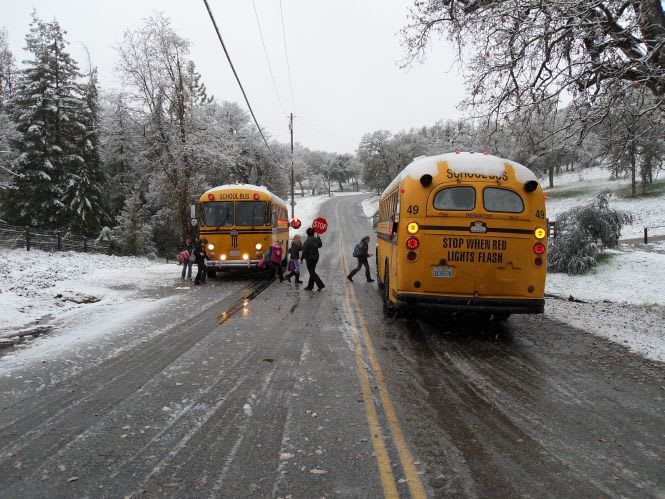
California pupil transportation operations may get more time to comply with the requirements of the Air Resources Board’s Truck and Bus Regulation, which was drafted to reduce emissions generated by diesel-powered buses, like these operated by Kings Canyon Unified School District. The agency has proposed changes to the regulation’s school bus provisions.
SACRAMENTO, Calif. — The California Air Resources Board (CARB) will hold a public meeting on Wednesday, July 28, to discuss proposed changes to the school bus provisions of its Truck and Bus Regulation.
SBF reported on the regulation and how it will impact the school bus industry last month.
The regulation was drafted to reduce diesel-powered bus and truck emissions, and one of the requirements was that all diesel-fueled school buses must be retrofitted with the highest level Verified Diesel Emission Control System available by Jan. 1, 2014. (To read about all of the school bus provisions, click here.)
The aforementioned requirement was concerning to John Clements, director of transportation at Kings Canyon Unified School District in Reedley, Calif. Clements runs eight Crown Coach school buses equipped with large-block Cummins engines. Diesel particulate filter (DPF) manufacturers and installers have told him that if he retrofitted his Crown buses with DPFs, the buses would not make it through a day of service without plugging up with particulates.
“This is a serious safety concern for me as a director of transportation if students are stranded on a mountain or valley roadway,” Clements said in June.
Changes to the school bus provisions that the CARB staff are considering include:
• Adding an optional two-year deferral for public fleets to comply.
• Allowing school buses owned and operated by a sectarian or denominational school not under the exclusive control of the offices of the public schools to comply in 2015-18 instead of in 2013-14.
• Reducing the reporting requirements for a school bus fleet.
Mary Fricke, public information officer for the CARB, told SBF that the agency recognizes the economic impacts to the state whenever a regulation is adopted.
"With the recent economic downturn, the staff was directed to look for opportunities to provide some regulatory relief while still meeting the required emission reductions and continuing to safeguard health benefits,” she said. “The proposed revisions to the school bus portion of the regulation were designed to provide relief without increasing the complexity of the regulation."
The changes to the school bus provisions are scheduled to be proposed to the CARB board at a meeting on Sept. 23 and 24. The public meeting on July 28 to discuss the changes will be held from 10 a.m. to 12 p.m. in conference room 720 at the Cal/EPA Headquarters Building in Sacramento.
Clements told SBF on Thursday that he plans to attend the public meeting. “I am hopeful this may buy us some time until we can obtain another school bus replacement grant funding source,” he said.
Those unable to attend the meeting in person can participate via conference call at (866) 917-4579. The participant passcode is 7167787.
Contact Janet Page, air pollution specialist, at (916) 324-1988 or jpage@arb.ca.gov with questions.
More Safety

Illegal School Bus Passing Drops 24% in New York Districts
With fewer than 5% of citations involving repeat offenders, Westchester County officials said enforcement, education, and community partnerships are helping change driver behavior.
Read More →
School's Back. Here's What Happened to Traffic, Speeding & Distraction
What happens to traffic when school resumes? New data analysis examines changes in distracted driving, congestion, and speeding around schools.
Read More →
Geotab Expands Fleet Safety Tools With Video Coaching, Risk Insights
New safety and video capabilities aim to help fleet managers assess risk, support drivers, and take targeted action through video coaching, red-light violation detection, and more.
Read More →

How to Build a Better School Bus Driver Training Program
Is it time to strengthen your driver training? Here’s how to pick the right talent and improve recruitment, retention, and safety. This video is brought to you by IC Bus.
Read More →
Recent School Bus Accidents Leave 2 Dead, 2 Injured
Four school bus crashes in Florida, Illinois, and Georgia highlight risks in transportation lots, at bus stops, and during student loading and unloading.
Read More →
When Every Second Matters, Clarity Keeps Routes Moving
From routine delays to urgent incidents, strong communication practices help drivers, dispatchers, schools, and families respond with confidence.
Read More →
What Happens When a School Bus Catches Fire — and What Can Help
School bus fires are rare but can be devastating. Learn how advances in fire suppression and asset protection help fleets detect fires earlier, reduce damage, and improve safety.
Read More →
Geotab Launches Tool to Help Fleets Investigate Road Incidents
Geotab Investigations combines telematics data, video, documents, and other evidence to help fleets reconstruct incidents, resolve claims, and determine what happened.
Read More →
Texas Sixth Grader Wins 2026 National School Bus Safety Poster Contest
Sai Darshana Yekolu of Moseley Middle School in Prosper, Texas, was named the newest winner for her artwork, bringing the theme of “Safe Rides, Everyday Heroes” to life.
Read More →
Doing More With Less: How Transportation Directors Can Prioritize Safety Amid Budget Uncertainty
With diesel prices soaring and nearly one-third of transportation directors expecting budget cuts, maintaining student safety has never been more challenging. Download this guide to learn how leading districts are prioritizing risk, funding critical safety technology, and building stronger budget cases with data.
Read More →