




Revised clean air rule still concerns pupil transporters
Among the changes to the California Air Resources Board’s Truck and Bus Regulation is the amount of time that school bus operations have to get their buses to comply with emissions-control technology percentage limits. A member of the state’s School Transportation Coalition discusses with SBF the organization’s problems with the regulation, including its view that it creates an unfunded mandate for school districts.

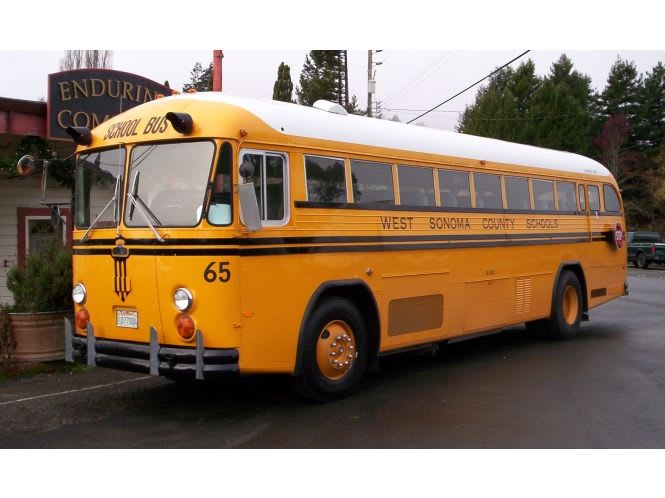
West County Transportation Agency (WCTA) in Santa Rosa, Calif., has a large number of spare buses and has therefore been able to park many of its older buses, like the 1987 Crown bus pictured, without affecting its service to students. However, WCTA Executive Director Michael Rea still has problems with the California Air Resources Board's revised Truck and Bus Regulation, saying it creates an unfunded mandate for school districts.
SACRAMENTO, Calif. — The California Air Resources Board (CARB) recently amended its Truck and Bus Regulation, including some of the provisions that apply to school buses.
The regulation was drafted to reduce diesel-powered bus and truck emissions throughout the state, and over the last year, CARB staff held 20 public workshops to solicit stakeholder input and discuss options for revising diesel control measures that affect commercially owned trucks, buses, port trucks, tractor trailers and off-road vehicles, including construction and large-spark ignition equipment (e.g., forklifts).
CARB officials report that the recent amendments are designed to provide some flexibility for these entities.
“No other state, and no other nation has such an extensive set of rules to slash pollution from diesel engines. The diesel rules for vehicles cover almost everything that moves on or off the road, from trucks and buses to off-road construction equipment, and over the next 12 years they will prevent 3,900 premature deaths by removing thousands of tons of diesel soot from the air we breathe,” CARB Chairman Mary Nichols said. “The changes we set in place today [on Dec. 17] will continue those public health benefits while reducing the cost of compliance by more than 60 percent.”
Among the changes to the school bus provisions is the amount of time that operations have to get their buses with gross vehicle weight ratings (GVWR) of 26,000 lbs. or more to comply with particulate matter (PM) Best Available Control Technology (BACT) percentage limits.
Previously, 25 percent of an operation’s fleet had to be retrofitted with emissions-control devices by Jan. 1, 2011; 50 percent had to be retrofitted by Jan. 1, 2012; 75 percent had to be retrofitted by Jan. 1, 2013; and 100 percent had to be retrofitted by Jan. 1, 2014.
Under the revised regulation, 33 percent of an operation’s fleet must comply by Jan. 1, 2012; 66 percent must comply by Jan. 1, 2013; and 100 percent must comply by Jan. 1, 2014.
Also included is an option that could provide some relief for operations that have downsized their fleets, according to CARB. Until Jan. 1, 2014, an operation that has fewer school buses with a GVWR greater than 14,000 lbs. on Jan. 1 of the compliance year than it had in the 2006 baseline year may reduce the percentage requirement by the same percentage that the fleet has downsized.
For example, a fleet that is 20 percent smaller than it was in 2006 would subtract 20 percent from the annual compliance requirement. If the compliance requirement for the year is 33 percent, the operation would need to demonstrate that it has PM filters on 13 percent of its existing fleet.
A provision that has not changed in the regulation is the requirement that if older buses cannot be retrofitted with emission-control devices, operations have until 2018 to replace them with buses outfitted with a 2010 model year engine or emissions equivalent. (To read the Truck and Bus Regulation provisions for school buses in full, click here and scroll down to page 33.)
SBF has been following proposed changes to the regulation since last year. At that time, John Clements, director of transportation at Kings Canyon Unified School District in Reedley, Calif., expressed concerns about the regulation and how it will affect his operation.
Despite the amendments made in December, many in the school bus community continue to feel that it will be burdensome and a struggle to adhere to the rules.
“Those of us in school transportation have been discussing with CARB that this creates an unfunded mandate for school districts in California, and certainly is burdensome for contractors and private schools. Not that it isn’t burdensome for other kinds of fleets, but school transportation is funded by the state, and very poorly so,” Michael Rea, executive director of West County Transportation Agency in Santa Rosa, Calif., told SBF in an interview. “The regulation just makes it more difficult for us to provide transportation. Even without the regulation, school districts in California have been reducing and eliminating regular-ed home-to-school transportation because it’s not mandated in California.”
Rea also noted that while the amendments delay compliance to BACT percentage limits by a year, the percentage of buses that must comply each year has increased, so it still puts pressure on school districts. And the requirement to replace buses that can’t be retrofitted by 2018 is an “even more expensive option,” he said.
Rea serves as a representative of the California Association of School Transportation Officials on the executive committee of the School Transportation Coalition. The coalition has worked with CARB officials to try to find other solutions that would help school bus operations adhere to the emissions reduction requirements.
“Our argument has been, if they’re truly concerned about air quality and the health of the students that are riding on buses, then they’d really be concerned about getting those oldest buses off the road rather than allowing them to continue to run. Our proposal to CARB has always been: delay the rules and let’s work together to find funding to replace buses rather than putting particulate filters on older buses,” Rea explained.
The School Transportation Coalition outlined the specifications of its proposal to CARB Chairman Nichols in a letter on Dec. 14, which included two recommendations:
• Do not pass any regulations impacting school districts unless funds are available. At minimum, these regulations should be postponed to when school districts have a level of funding that is at least equal to their funding level in 2007-08.
• The first priority should be to replace pre-1987 buses. The proposed regulations state that all school buses that do not have filters should be replaced by 2018. At minimum, these regulations should be changed to say that all pre-1987 school buses should be replaced by 2018.
The letter goes on to say that because there are no additional state funds for the proposed regulation, adhering to it will cost school districts $650 million, which will increase the state’s deficit by $650 million.
Moreover, because school districts would be forced to park older buses if they can't retrofit or replace them, some students would have to find other, less-safe modes of transportation to and from school. Therefore, “the regulations may have the unintended consequence of increasing a child’s risk of death,” the coalition wrote.
Rea said that the CARB staff appreciated the school bus community’s plight. “They met with pupil transportation folks on a couple of occasions, and I think they really understood where we were coming from, but the direction that they were getting was from the highest levels of CARB, and as much as we tried to argue that the regulation is burdensome, it really didn’t matter,” he said.
In addition to the problems school bus operations throughout the state will face in complying to the rules of the Truck and Bus Regulation due to a lack of funding, Rea anticipates that enforcing them could be difficult.
“The problem that CARB faces is that, as far as I’m aware, they don’t have a program or a plan in place for enforcing these rules,” he said. “There are over 970 school districts in California that provide some form of school transportation. I don’t know the exact amount, but of those districts, probably more than 60 percent operate fleets that are less than 20 buses. There are a lot of small operations out there that are not even aware of this regulation, so you’re going to have a number of school districts that won’t be in compliance, not because they don’t want to be but because they don’t know about it.”
More Safety

Illegal School Bus Passing Drops 24% in New York Districts
With fewer than 5% of citations involving repeat offenders, Westchester County officials said enforcement, education, and community partnerships are helping change driver behavior.
Read More →
School's Back. Here's What Happened to Traffic, Speeding & Distraction
What happens to traffic when school resumes? New data analysis examines changes in distracted driving, congestion, and speeding around schools.
Read More →
Geotab Expands Fleet Safety Tools With Video Coaching, Risk Insights
New safety and video capabilities aim to help fleet managers assess risk, support drivers, and take targeted action through video coaching, red-light violation detection, and more.
Read More →

How to Build a Better School Bus Driver Training Program
Is it time to strengthen your driver training? Here’s how to pick the right talent and improve recruitment, retention, and safety. This video is brought to you by IC Bus.
Read More →
Recent School Bus Accidents Leave 2 Dead, 2 Injured
Four school bus crashes in Florida, Illinois, and Georgia highlight risks in transportation lots, at bus stops, and during student loading and unloading.
Read More →
When Every Second Matters, Clarity Keeps Routes Moving
From routine delays to urgent incidents, strong communication practices help drivers, dispatchers, schools, and families respond with confidence.
Read More →
What Happens When a School Bus Catches Fire — and What Can Help
School bus fires are rare but can be devastating. Learn how advances in fire suppression and asset protection help fleets detect fires earlier, reduce damage, and improve safety.
Read More →
Geotab Launches Tool to Help Fleets Investigate Road Incidents
Geotab Investigations combines telematics data, video, documents, and other evidence to help fleets reconstruct incidents, resolve claims, and determine what happened.
Read More →
Texas Sixth Grader Wins 2026 National School Bus Safety Poster Contest
Sai Darshana Yekolu of Moseley Middle School in Prosper, Texas, was named the newest winner for her artwork, bringing the theme of “Safe Rides, Everyday Heroes” to life.
Read More →
Doing More With Less: How Transportation Directors Can Prioritize Safety Amid Budget Uncertainty
With diesel prices soaring and nearly one-third of transportation directors expecting budget cuts, maintaining student safety has never been more challenging. Download this guide to learn how leading districts are prioritizing risk, funding critical safety technology, and building stronger budget cases with data.
Read More →