




In the Market? How to Find Funding for Alt-Fuel School Buses
Omnibus Spending Amendments Bring Wanted Clean School Bus Changes
Private school bus operators can now apply directly for EPA funds under the Clean School Bus Program, as urged by the National School Transportation Association.
by SBF Staff
December 23, 2022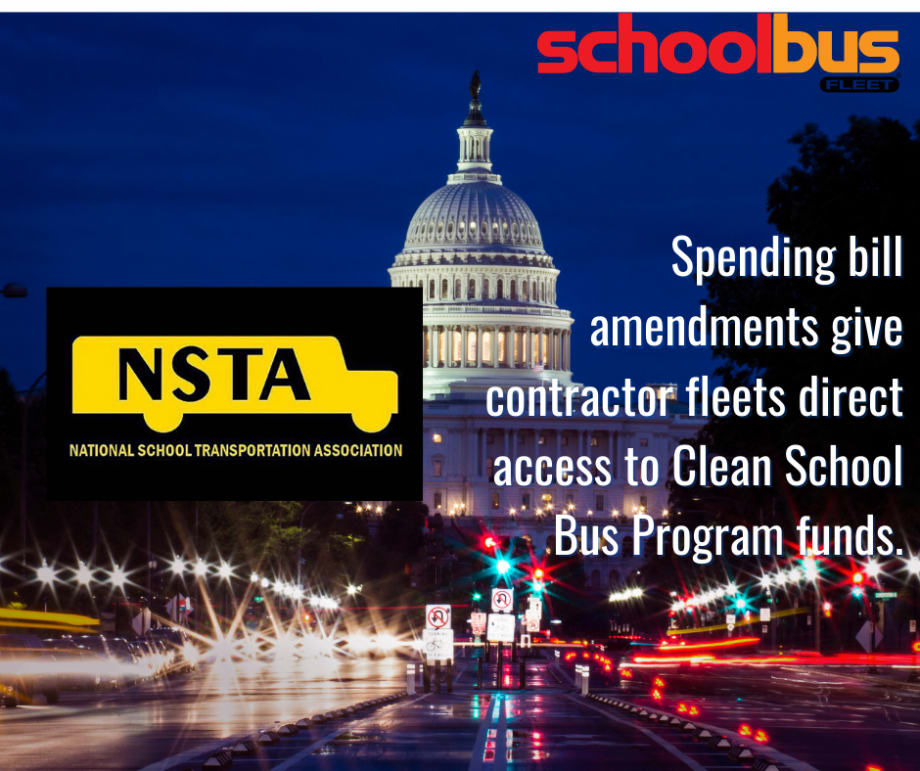
The Omnibus Appropriations Act for fiscal year 2023 also provides flexibility to the requirement to keep a school bus in-district for five years.
Image: Canva/NSTA
2 min to read
Contractor fleets and school districts got some welcome news with the passage of the Omnibus Appropriations Act for fiscal year 2023.
The National School Transportation Association (NSTA) praised inclusion of two amendments based on concerns the organization raised to the Environmental Protection Agency (EPA) and U.S. Congress about some aspects of the Clean School Bus Program’s implementation.
Opening Funds Directly to Contractors
First, private school bus operators who provide about 40% of the nation’s school bus transportation now have direct access to the $4 billion remaining in the EPA’s Clean School Bus Program. The program was created as part of the Infrastructure Investment and Jobs Act (IIJA) and is intended to replace existing school buses with zero- and low-emission models.
The IIJA originally defined “contractor” in its text without encompassing private school bus operators who contract with school districts to provide student transportation services.
Private contractors “had to work with their school districts or dealers to apply for the funds, which proved to be cumbersome and a deterrent to contractor participation,” the NSTA stated in a news release.
A More Flexible Service Requirement
The other amendment dealt with a requirement that a bus purchased under the program must remain in the district for at least five years.
“As most have state statutory limits on transportation contracts with school districts, and private operators have no control over when a contract gets bid or rebid or for how long,” the NSTA said in its release. “Private school bus operators could be penalized for being unable to fill the five-year requirement. These two technical changes allow for greater and less complicated access to CSB funding for private school bus operators.”
The service amendment now indicates that, if the contract ends before the five-year service period, the buses “may be operated as part of another local educational agency eligible for the same or higher priority consideration.”
Curt Macysyn, NSTA executive director, thanked U.S. senators Tom Carper (Delaware) and Shelley Moore Capito (West Virginia), as well as U.S. representatives Frank Pallone (New Jersey) and Cathy McMorris Rodgers (Washington) “for coming together to support these amendments and work for their inclusion in the FY 23 Omnibus Appropriations Act.”
More Alternative Fuels

CALSTART and Forth Combine to Form Catalyst Mobility
The new name represents a renewed vision for the nonprofit focused on advancing clean, equitable, and affordable transportation solutions that move people and goods.
Read More →
Alt-Fuel Moves: New Buses, Charging Hubs & Real-World EV Testing
Propane and electric school bus deployments continue to grow as districts add new vehicles, expand charging infrastructure, and gather more real-world operating data.
Read More →
Fewer Electric School Bus Models Reshape the U.S. Market
WRI’s latest buyer’s guide points to a consolidating electric school bus market, but fewer options may reflect a maturing industry rather than fewer meaningful choices for school bus operators.
Read More →
The Fuel Budget You Can Actually Predict: How Propane Autogas Keeps Money in the Classroom
Learn how propane autogas helps school districts manage fuel costs with predictable pricing, lower maintenance, and reduced emissions from former transportation director Joel Stutheit.
Read More →
Hendrickson, Driventic Introduce New Electric Powertrain for School Buses
ELECTRAAX, the electrified, lightweight drive axle offers integrated ePowertrain efficiency and modular flexibility for Class 6–7 school bus use.
Read More →
The Mobility House Joins PowerFlex in Fleet Electrification Deal
The acquisition combines intelligent charging software, bidirectional charging expertise, and fleet electrification services to support the growing adoption of electric school buses across North America.
Read More →
Alt-Fuel Moves: Electric School Bus Investments Hit the Road
See which districts across the U.S. are putting electric school buses into service, expanding charging infrastructure, and planning the next phase of fleet electrification.
Read More →
With Fuel Volatility Ahead, School Districts Turn to Propane
While diesel prices peaked above $5 this spring, districts with propane autogas-powered fleets paid under $2 per gallon, according to PERC.
Read More →
EPA Unveils Proposed Changes to 2027 Heavy-Duty Engine Rules
The federal agency has proposed changes to next year’s targets that would eliminate DEF derates, ease warranty requirements, and retain current NOx emissions standards.
Read More →
Alt-Fuel Moves: EV Charging & Infrastructure Projects Gain Momentum
The latest developments include new funding, charging infrastructure, utility investments, and fleet technologies designed to support the transition to electric school buses nationwide.
Read More →