





Check Out: The Route: Big Decision in the Big Apple
New York, Federal Transportation Agencies Team for School Bus Safety
The New York Citywide Administrative Services, NYC Department of Education, and the U.S. Department of Transportation are working to improve the design and operation of school buses to reduce crashes and boost safety.
September 12, 2022
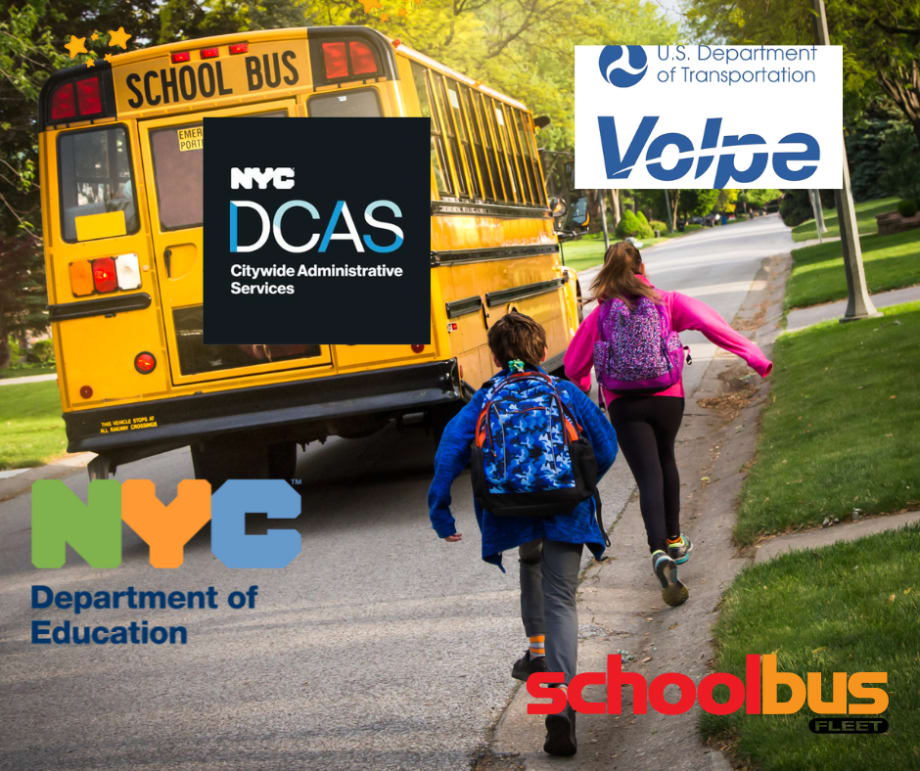
The multi-agency initiative in New York City is especially focused on electric buses as the city transitions its fleet by 2035.
Image: Canva
5 min to read
New York City's Department of Citywide Administrative Services (DCAS), the city Department of Education (DOE), and the U.S. Department of Transportation Volpe National Transportation Systems Center (USDOT Volpe) have launched a joint effort to improve school bus safety.
Working in partnership, DCAS, DOE, and USDOT Volpe will study ways to improve the design and operation of school buses in New York City to reduce crashes and increase safety. The effort will have a particular focus on electric school buses as the city transitions all school buses to electric by 2035. The study will result in a Safe Fleet Transition Plan to be published by the end of the year.
"Traffic safety is public safety — and nothing is more vital than the safety of our children," said New York City Mayor Eric Adams. "Developing and implementing our Safe Street Transition Plan will ensure our school buses are equipped with state-of-the-art safety features. Coupled with our recent announcement on installing Intelligent Speed Assistance in 50 city vehicles, this announcement shows that New York City is leading on creative ways to make our streets safer."
“The implementation of the Safe Fleet Transition Plan is integral in enhancing the safety of our city’s students, who rely on school buses daily,” said DCAS Commissioner Dawn M. Pinnock. “It is a collective responsibility to explore and implement new safety measures that protect our children on school buses. We are proud to lend our expertise to devising this plan which will improve bus operations and increase sustainability.”
“Whether in the classroom or on the way to school, student safety is at the core of all we do in the Department of Education,” said Schools Chancellor David C. Banks. “As our schools, city, and methods of transportation transition towards environmental sustainability, I am thrilled to be partnering with DCAS and USDOT Volpe to continue to prioritize student safety and protect our youngest commuters.”
“We are pleased to be working with the Department of Citywide Administrative Services, the USDOT Volpe Center, and DOE Office of Pupil Transportation in reviewing collisions and other incidents in the school bus industry both in the city and nationally,” said Matt Berlin, CEO of NYC School Bus Umbrella Services. ”Based on the city’s Safe Fleet Transition Plan, the work we are doing jointly regarding telematics, and pilot programs such as intelligent speed assistance (ISA) we are confident that our joint work will find additional technologies and vehicle design changes that will make our industry and drivers safer and prevent serious injuries and fatalities on our roadways.”
The plan will lay the foundation for critical safety improvements including the potential to adopt high vision buses, determine the viability of intelligent speed assistance and automatic braking, and consider employing audible turn signals and alerts similar to those used by the Metropolitan Transportation Authority. In addition to exploring these features, the plan will also gauge the efficacy of surround cameras on buses, improve and implement new ways to utilize telematics, assess the use of backup alerts and cameras, expand the DCAS safety training to school bus operators, and more.
Upon completion of the study, DCAS will work closely with the DOE and school bus companies to develop short-term retrofit proposals and identify funding sources, reevaluate and develop specifications and requirements for future school bus contracts, and urge school bus suppliers to invest in electric vehicles with standard safety features.
Through Executive Order 53 of 2020, DCAS is called on to promote and implement safe and electric fleets of the future for the city and for private fleets and other public fleets operating within the five boroughs.
In partnership with USDOT Volpe, DCAS will prepare Safe and Clean Fleet Transition Plans (SFTP and CFTP) for the broader fleet industry to outline the state of the market and technology to achieve safer and more sustainable fleet. DCAS and Volpe have already published four reports. The first report on truck side-guards has now inspired two NYC local laws and the nation’s largest side-guard implementation. The two published SFTPs for the City fleet from 2017 and 2018-2019 have resulted in over 63,000 safety improvements so far.
In December 2021, DCAS, the Business Integrity Commission, and USDOT Volpe also published a Safe Fleet Transition Plan for the commercial waste industry. The waste industry report will be a model as they launch a similar effort with private school bus companies serving New York City children. This fall, on Oct. 25, DCAS will also host an in-person Fleet Safety Forum at the Queens Theatre. This will be the first in-person forum since 2019. In conjunction with Together for Safer Roads (TSR), DCAS has hosted a series of online safety fleet forums since 2020. DCAS will present initial findings for the school bus report at the forum.
“As we transition to electric school buses, we can also make our buses safer,” said DCAS Deputy Commissioner and NYC Chief Fleet Officer Keith Kerman. “High-vision buses, surround cameras, improved implementation of telematics, and pedestrian avoidance and warning systems can all be part of the school bus designs of the future. We look forward to examining these options with the Department of Education, school bus vendors, and USDOT Volpe.”
In addition to the Safe Fleet Transition Plan, DCAS has implemented a wide variety of safety measures as part of Vision Zero. Other measures include the City’s fleet first CRASH management system, the nation’s largest rollout of live vehicle tracking devices managed through our Fleet Office of Real Time Tracking (FORT), the nation’s leading program of truck safety guards, barring hands-free phone use by fleet operators, and providing safety training to over 76,000 City employees.
More Safety

How to Build a Better School Bus Driver Training Program
Is it time to strengthen your driver training? Here’s how to pick the right talent and improve recruitment, retention, and safety. This video is brought to you by IC Bus.
Read More →
Recent School Bus Accidents Leave 2 Dead, 2 Injured
Four school bus crashes in Florida, Illinois, and Georgia highlight risks in transportation lots, at bus stops, and during student loading and unloading.
Read More →
Sponsored•September 8, 2026
When Every Second Matters, Clarity Keeps Routes Moving
From routine delays to urgent incidents, strong communication practices help drivers, dispatchers, schools, and families respond with confidence.
Read More →

What Happens When a School Bus Catches Fire — and What Can Help
School bus fires are rare but can be devastating. Learn how advances in fire suppression and asset protection help fleets detect fires earlier, reduce damage, and improve safety.
Read More →
Geotab Launches Tool to Help Fleets Investigate Road Incidents
Geotab Investigations combines telematics data, video, documents, and other evidence to help fleets reconstruct incidents, resolve claims, and determine what happened.
Read More →
Texas Sixth Grader Wins 2026 National School Bus Safety Poster Contest
Sai Darshana Yekolu of Moseley Middle School in Prosper, Texas, was named the newest winner for her artwork, bringing the theme of “Safe Rides, Everyday Heroes” to life.
Read More →
Sponsored•August 27, 2026
Doing More With Less: How Transportation Directors Can Prioritize Safety Amid Budget Uncertainty
With diesel prices soaring and nearly one-third of transportation directors expecting budget cuts, maintaining student safety has never been more challenging. Download this guide to learn how leading districts are prioritizing risk, funding critical safety technology, and building stronger budget cases with data.
Read More →
Walton County Schools Adds Gatekeeper Stop-Arm Enforcement System
The Florida district will deploy Gatekeeper’s updated Student Protector technology, which now incorporates AI to improve video evidence.
Read More →
How To Build a More Secure School Bus Yard During and After Hours
As thefts and overnight security threats continue, school transportation leaders are combining stronger operational practices with AI-enabled surveillance to better protect buses, facilities, and staff.
Read More →
FMCSA Names New Chief Safety Officer: What School Bus Operators Should Know
Steve Dowling is set to lead the federal agency's efforts to advance commercial motor vehicle safety and reduce crashes, fatalities, and injuries on the nation's roadways.
Read More →