




NASDPTS supports feds’ new 3-point belt policy
After NHTSA Administrator Mark Rosekind states that school bus passengers should have three-point belts, the state directors association says that the statement backs their own position.

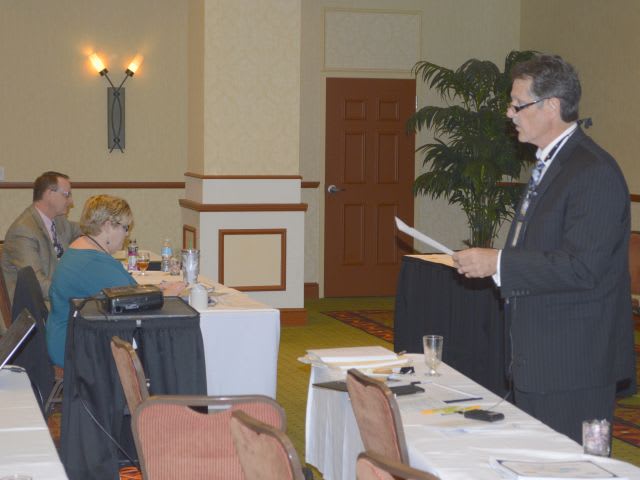
NASDPTS President Leon Langley said that his association is encouraged by NHTSA’s statement that school bus passengers should have three-point belts.
RICHMOND, Va. — State pupil transportation directors here expressed support for the National Highway Traffic Safety Administration (NHTSA)’s new position on three-point seat belts for school buses.
As previously reported, NHTSA Administrator Mark Rosekind gave an address to industry groups gathered in Richmond on Sunday, saying that the agency now believes that “every child on every school bus should have a three-point seat belt.”
Rosekind also said that while school buses are still the safest form of student transportation, seat belts can make them safer. “The position of the National Highway Traffic Safety Administration is that seat belts save lives,” he said. “That is true whether in a passenger car or in a big, yellow bus.”
On Monday, Leon Langley, president of the National Association of State Directors of Pupil Transportation Services (NASDPTS), responded to Rosekind’s remarks in a statement from NASDPTS.
“We are encouraged by the administrator’s remarks about the agency’s position,” Langley said. “It supports our position paper, ‘The Equipping and Use of Passenger Lap/Shoulder Belts in School Buses, February 2014,’ and is consistent with it.”
In that position paper, NASDPTS endorsed three-point belts for school buses, saying that they “should be encouraged as an option when considering new bus original equipment specifications.”
On Monday, NASDPTS also highlighted Rosekind’s pledge that “NHTSA will seek to use all the tools at our disposal to help achieve” the goal of three-point belts for all school bus passengers.
“We believe this support from NHTSA will trigger discussions by federal, state and local agencies about how resources can be allocated to begin putting three-point belts in new school buses throughout the nation,” Langley said.
“We know that parents can be confident in the world’s safest form of student transportation, the yellow school bus,” Langley added. “We also know that three-point lap/shoulder belts are a proven safety technology that has saved thousands of lives in nearly all forms of surface transportation vehicles for over 40 years.”
The NASDPTS conference also offered presentations by other federal officials, including David Cooper from the Transportation Security Administration, Larry Minor from the Federal Motor Carrier Safety Administration, Jennifer Keller from the Environmental Protection Agency and Thomas Barth from the National Transportation Safety Board.
Also among the NASDPTS sessions were discussions on such safety topics as student dragging incidents, bus fires and stop-arm violations.
Next year’s NASDPTS conference will be held in Kansas City, Missouri, in November.
More Safety

Geotab Expands Fleet Safety Tools With Video Coaching, Risk Insights
New safety and video capabilities aim to help fleet managers assess risk, support drivers, and take targeted action through video coaching, red-light violation detection, and more.
Read More →
How to Build a Better School Bus Driver Training Program
Is it time to strengthen your driver training? Here’s how to pick the right talent and improve recruitment, retention, and safety. This video is brought to you by IC Bus.
Read More →
Recent School Bus Accidents Leave 2 Dead, 2 Injured
Four school bus crashes in Florida, Illinois, and Georgia highlight risks in transportation lots, at bus stops, and during student loading and unloading.
Read More →

When Every Second Matters, Clarity Keeps Routes Moving
From routine delays to urgent incidents, strong communication practices help drivers, dispatchers, schools, and families respond with confidence.
Read More →
What Happens When a School Bus Catches Fire — and What Can Help
School bus fires are rare but can be devastating. Learn how advances in fire suppression and asset protection help fleets detect fires earlier, reduce damage, and improve safety.
Read More →
Geotab Launches Tool to Help Fleets Investigate Road Incidents
Geotab Investigations combines telematics data, video, documents, and other evidence to help fleets reconstruct incidents, resolve claims, and determine what happened.
Read More →
Texas Sixth Grader Wins 2026 National School Bus Safety Poster Contest
Sai Darshana Yekolu of Moseley Middle School in Prosper, Texas, was named the newest winner for her artwork, bringing the theme of “Safe Rides, Everyday Heroes” to life.
Read More →
Doing More With Less: How Transportation Directors Can Prioritize Safety Amid Budget Uncertainty
With diesel prices soaring and nearly one-third of transportation directors expecting budget cuts, maintaining student safety has never been more challenging. Download this guide to learn how leading districts are prioritizing risk, funding critical safety technology, and building stronger budget cases with data.
Read More →
Walton County Schools Adds Gatekeeper Stop-Arm Enforcement System
The Florida district will deploy Gatekeeper’s updated Student Protector technology, which now incorporates AI to improve video evidence.
Read More →
How To Build a More Secure School Bus Yard During and After Hours
As thefts and overnight security threats continue, school transportation leaders are combining stronger operational practices with AI-enabled surveillance to better protect buses, facilities, and staff.
Read More →