




PHOTOS: State Pupil Transportation Directors Through the Years
NASDPTS Leader Charlie Hood to Retire
The association’s executive director is stepping down after serving in the role for seven years. His career in pupil transportation spans nearly four decades.

Nicole Schlosser・Former Executive Editor

Charlie Hood, the executive director of the National Association of State Directors of Pupil Transportation Services, will retire at the end of March.
Photo courtesy Charlie Hood
4 min to read
After nearly four decades in student transportation, Charlie Hood, the executive director of the National Association of State Directors of Pupil Transportation Services (NASDPTS), is retiring in March.
Hood began his career on the maintenance side: for six years, he worked as an automotive and truck service technician for a couple of dealers in Tallahassee, Florida. His manager encouraged him to obtain National Institute for Automotive Service Excellence (ASE) certification as a master auto/truck technician, which he did.
“I still believe in and promote the value of ASE certification,” Hood told School Bus Fleet.
That drove him in a slightly different direction, though he still stuck with transportation. Soon after, he spent a year developing instructional manuals for auto mechanics at Florida State University, his alma mater. Meanwhile, in 1981, a colleague let him know about a fleet maintenance specialist position in the student transportation office at the Florida Department of Education (DOE). Despite his lack of school bus experience, he was hired by Larry McEntire, the state director at the time.
McEntire supported his growth in the position, Hood said, as he traveled throughout the state to work with and learn from school district service managers and transportation directors, which led to him becoming manager of the fleet management subsection within two years.
“I was very fortunate to have Larry as my supervisor,” Hood said. “I still describe him as the best boss I ever had.”
Several years later, he was selected to be the state director of student transportation, a role he served in for 24 years, before being elected president of NASDPTS and eventually becoming the executive director for the association in 2014.
Out of many successful achievements throughout his career, Hood is most proud, at the state level, of bolstering drug and alcohol testing, as well as overseeing the development of a school bus inspection manual and bus inspector and certification testing.
After the passage of federal regulations for drug and alcohol testing of commercial drivers in 1991, the Florida DOE teamed up with the Florida Association for Pupil Transportation to establish one of the first statewide bids for testing services, Hood said, and the statewide contract for those services is still in place today.
That team, which Hood played a key role in supervising, also developed guidance and specifications for the lap seat belt requirement for school buses that Florida adopted starting in 2001. That allowed for a seamless transition for new buses to be introduced into the statewide fleet.
At the national level, Hood said that he takes pride in NASDPTS having adopted a position favoring the installation of three-point lap-shoulder belts in school buses in 2014 and updating and strengthening it in 2020 by more clearly calling upon states to mandate their installation and use. He also points to the association’s response to the National Transportation Safety Board recommendations after the fatal crashes in Baltimore and Chattanooga, Tennessee, in 2016, and in 2018 the adoption of a position paper on the qualifications, training, performance, and oversight of school bus drivers.
Over the years, Hood said, he has seen the technology in school buses, components, and related services yield significant benefits, including for safety and accountability to parents. Additionally, commercial driver licensing requirements and other regulations have also become more stringent over the years. Conversely, these advances make student transportation more complicated in some ways.
“School bus drivers, technicians, procurement personnel, and transportation administrators have a much more demanding and complex job in fulfilling the requirements of their jobs and in weighing all the options available to them,” he said. “Together with increasing expectations among parents and others for transparency, accountability, and real-time communication, we are all adapting to the new array of requirements and solutions.”
More pressing challenges these days, he noted, have been those posed by the COVID-19 pandemic.
“As transporters, we pride ourselves on dealing with everything thrown at us, but it goes without saying that the past year has been a real doozie,” he said.
The most important lesson he has learned over the course of his career, Hood said, is how to recognize and respect the talents of colleagues.
“Whether they are subordinates, superiors, or other professional colleagues, everyone brings strengths to one’s table,” Hood said. “A good manager works to help others succeed and encourages subordinates to take his or her job.”
As for taking the mantle from Hood after he retires on March 31, NASDPTS is currently determining his replacement.
In retirement, Hood and his wife Della plan to travel when it is safe, do more hiking and fishing, and catch up on home projects.
He also intends to stay in touch with friends and colleagues in the industry, he said.
More Management

How to Build a Better Driver Training Program
Ready to boost up your school bus instructor training? Here’s how to pick the right talent and improve recruitment, retention, and safety.
Read More →
CALSTART and Forth Combine to Form Catalyst Mobility
The new name represents a renewed vision for the nonprofit focused on advancing clean, equitable, and affordable transportation solutions that move people and goods.
Read More →
What Makes a Great School Bus Driver Trainer?
Choosing the right school bus driver trainer takes more than experience. Learn six keys to selecting and developing trainers and evaluating program effectiveness.
Read More →


School Bus Contractors Expand Through New Deals, Acquisitions & Partnerships
STA's Canadian division acquires Ontario-based G&L Stevenson Transport while Durham School Services adds a new district contract in California, First Student adds a New Jersey contract, and Minnesota Coaches acquires Halo Transportation.
Read More →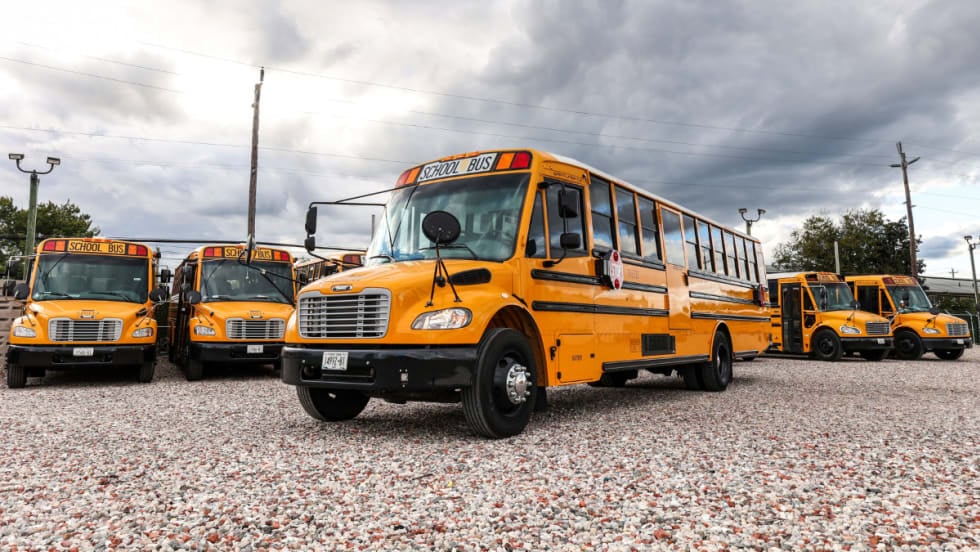
Logan Bus Company Rolls Out AI Phone System for NYC School Bus Families
A summer pilot found that AI agents could handle most routine calls, freeing up time for customer service staff to focus on emergencies and complex family concerns.
Read More →
From Intent to Impact: What I Learned About Leadership from TAPT
A Texas transportation supervisor shares lessons on self-awareness, accountability, managing stress and building trust — and why investing in leadership development matters at every stage of your career.
Read More →
NAPT Names 2026 Award Recipients, Hall of Fame Inductee
Who earned national recognition for their work in student transportation? This year, NAPT named five recipients of its 2026 awards for service, safety, and leadership, plus its newest Hall of Famer.
Read More →
Sponsored•September 2, 2026
2026 State of Student Transportation Report
Driver shortages. Rising costs. Growing safety expectations. More data, but not enough time to act on it. The 2026 State of Student Transportation Report reveals what transportation leaders say is putting the most pressure on their operations—and where they’re investing next. See how your priorities compare.
Read More →
How to De-Escalate an Angry Person: 5 Steps for Handling Workplace Conflict
What makes emotions run high, and how should you handle an angry colleague or parent? Follow these steps for staying calm, listening, showing empathy, and resolving conflict.
Read More →
Sponsored•September 1, 2026
What Readiness Looks Like This School Year
Learn about the challenges shaping the 2026–2027 school year, from persistent driver shortages and budget pressure to technology and readiness gaps. See how school districts are responding and adapting in Zonar’s 2026 Back-to-School Readiness Report.
Read More →