




Want More? Report: Nearly $3 Billion Allocated for Clean School Buses Over Two Years
EPA Inspector General Flags Concerns Over Clean School Bus Program Recipient Selection
The Office of Inspector General warned that if the EPA does not follow all requirements for selecting recipients of the Clean School Bus Program funds, there is an increased risk of potential fraud, waste, and abuse. A look at the recommendations, and response from the agency.

Christy Grimes・Former Senior Editor
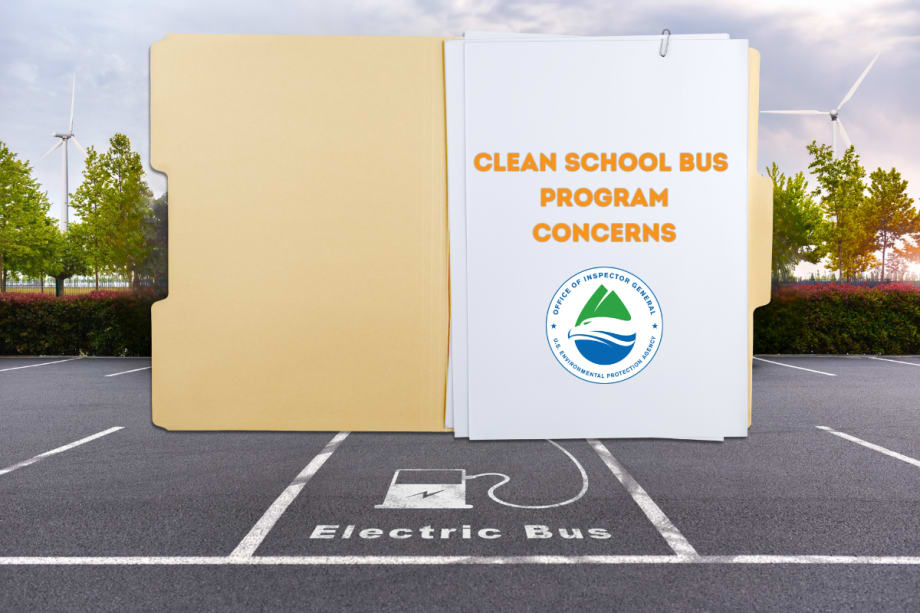
The EPA Office of Inspector General is concerned that the agency's process for selecting program recipients provides an increased risk of potential fraud, waste, and abuse.
Photo: EPA Office of Inspector General/School Bus Fleet
4 min to read
For the second time in less than a year, the Office of the Inspector General for the Environmental Protection Agency is raising concerns about the Clean School Bus Program.
The Bipartisan Infrastructure Law allocated $5 billion for the EPA to issue grants and rebates for the purchase of clean or zero-emission school buses, which are operated using either an alternative fuel or electricity.
School Bus Fleet reported that in its Dec. 2023 findings, the Office of Inspector General (OIG) stated that the way the statutory text governing the program is written doesn't require applicants to “expressly attest to the accuracy and truthfulness of their Clean School Bus applications.” The EPA also has no mechanism for verifying an applicant’s supplied information.
Now, the OIG is concerned that the EPA's process for selecting program recipients provides an increased risk of potential fraud, waste, and abuse.
The Inspector General's Report At a Glance
In a July 31 report, the OIG stated that while the EPA followed six of the seven requirements to select recipients of Clean School Bus Program funds, the agency did not have sufficient internal controls in place to ensure that it selected recipients with eligible school buses.
The EPA did not require sufficient documentation to demonstrate that recipients’ existing school buses met the fuel, weight, and operational status requirements or that the replacement buses would provide a school district with bus service for at least five years, according to the report.
The OIG believes the agency would mitigate the potential for fraud, waste, and abuse by first requiring and then verifying this documentation before awarding program funds.
Additionally, the report stated that the EPA did not provide oversight to verify that applicants requesting funds specifically for zero-emission school buses have school districts with suitable local conditions for these types of buses.
The EPA did not require these applicants to conduct a suitability analysis or submit one as part of their applications.
"Without such information, the EPA cannot provide assurance that the zero-emission school buses funded by the Clean School Bus Program would suitably and effectively operate in the recipient school districts," the report continued.
What the OIG Recommends and how the EPA Responded
Below are the four recommendations from the OIG for the assistant administrator for Air and Radiation, followed by the EPA's responses to those recommendations.
Recommendation 1: Issue guidance to Clean School Bus Program rebate and grant applicants on the types of documentation needed to support that their existing school buses are eligible for replacement and that replacement school buses will provide bus service for five years.
EPA Response: Agreed with the recommendation; it is resolved with corrective action pending.
Recommendation 2: Require future Clean School Bus Program rebate and grant applicants to provide sufficient documentation to support their applications, including documentation that their existing school buses are eligible for replacement and that replacement school buses will provide bus service for five years.
EPA Response: Agreed with the recommendation; unresolved. The Office of Air and Radiation said it would instruct potential applicants about what materials to maintain — such as bus logs — to demonstrate school bus eligibility in the event of an EPA audit. The agency said it would be burdensome to applicants to require them to provide bus logs, and reviewing bus logs as part of the EPA’s audits of recipients would yield more accurate results.
Recommendastion 3: Update the standard operating procedures and trainings for Clean School Bus Program application reviewers. They should address confirming — before the EPA awards funds — the eligibility of applicants and their school buses, including that their existing school buses are eligible for replacement and that replacement school buses will provide bus service for five years.
EPA Response: Agreed with the recommendation; stated that it had already completed the recommendation. The OIG reviewed the Office of Air and Radiation’s updated standard operating procedures for application reviewers and found that the corresponding recorded trainings do not fully meet the intent of the recommendation. While the updated SOPs required application reviewers to verify these requirements, they do not require application reviewers to verify that existing school buses meet other requirements.
Recommendation 4:Establish procedures to verify that if an applicant is requesting Clean School Bus Program funds to replace existing school buses with zero-emission school buses, zero-emission school buses are suitable for the applicant’s school district.
EPA Response: Disagreed; unresolved. The Office of Air and Radiation stated that fleet owners are best positioned to know their unique needs, including routes and terrains. The agency has developed a webpage for technical assistance and provided resources for conducting fleet and route analyses.
Resolution efforts are underway on recommendations 2, 3, and 4.
More Alternative Fuels

CALSTART and Forth Combine to Form Catalyst Mobility
The new name represents a renewed vision for the nonprofit focused on advancing clean, equitable, and affordable transportation solutions that move people and goods.
Read More →
Alt-Fuel Moves: New Buses, Charging Hubs & Real-World EV Testing
Propane and electric school bus deployments continue to grow as districts add new vehicles, expand charging infrastructure, and gather more real-world operating data.
Read More →
Fewer Electric School Bus Models Reshape the U.S. Market
WRI’s latest buyer’s guide points to a consolidating electric school bus market, but fewer options may reflect a maturing industry rather than fewer meaningful choices for school bus operators.
Read More →
The Fuel Budget You Can Actually Predict: How Propane Autogas Keeps Money in the Classroom
Learn how propane autogas helps school districts manage fuel costs with predictable pricing, lower maintenance, and reduced emissions from former transportation director Joel Stutheit.
Read More →
Hendrickson, Driventic Introduce New Electric Powertrain for School Buses
ELECTRAAX, the electrified, lightweight drive axle offers integrated ePowertrain efficiency and modular flexibility for Class 6–7 school bus use.
Read More →
The Mobility House Joins PowerFlex in Fleet Electrification Deal
The acquisition combines intelligent charging software, bidirectional charging expertise, and fleet electrification services to support the growing adoption of electric school buses across North America.
Read More →
Alt-Fuel Moves: Electric School Bus Investments Hit the Road
See which districts across the U.S. are putting electric school buses into service, expanding charging infrastructure, and planning the next phase of fleet electrification.
Read More →
With Fuel Volatility Ahead, School Districts Turn to Propane
While diesel prices peaked above $5 this spring, districts with propane autogas-powered fleets paid under $2 per gallon, according to PERC.
Read More →
EPA Unveils Proposed Changes to 2027 Heavy-Duty Engine Rules
The federal agency has proposed changes to next year’s targets that would eliminate DEF derates, ease warranty requirements, and retain current NOx emissions standards.
Read More →
Alt-Fuel Moves: EV Charging & Infrastructure Projects Gain Momentum
The latest developments include new funding, charging infrastructure, utility investments, and fleet technologies designed to support the transition to electric school buses nationwide.
Read More →