




Durham, Lytx Partner on School Bus Driver Safety Program
Durham School Services has seen improvements in driver behavior since deploying Lytx’s event recorders across its full fleet of 15,000 buses in December 2018.

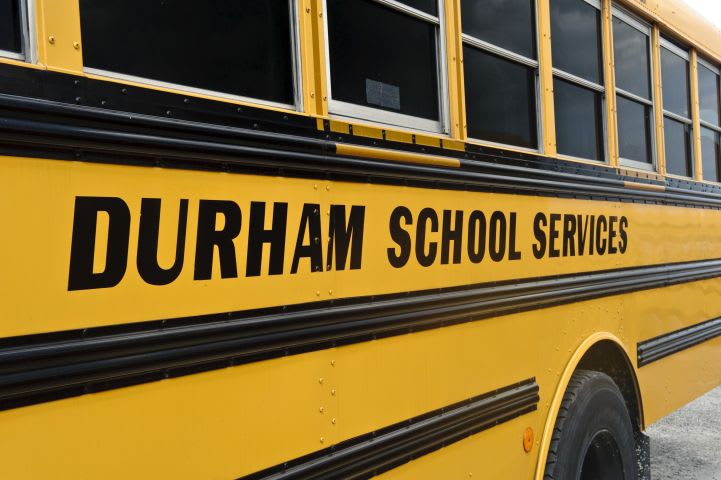
Durham School Services has seen improvements in driver behavior since deploying Lytx’s event recorders across its full fleet of 15,000 buses in December 2018. Photo courtesy Durham School Services
Durham School Services has seen improvements in driver behavior since deploying Lytx’s event recorders across its full fleet of 15,000 buses in December 2018. Photo courtesy Durham School Services
SAN DIEGO — School bus company Durham School Services recently saw improvements in driver behavior as a result of deploying a video telematics system on its buses.
Durham completed installation of video telematics supplier Lytx’s event recorders across its entire fleet of 15,000 buses in December 2018, according to a news release from the supplier.
As a result, the company experienced a significant reduction in its coachable events and risk scores from June 2019 to August 2019 compared to the same time period in 2018.
Since the bus company’s trial with the Lytx Driver Safety Program in 2014 and the full deployment last year, National Express, Durham’s parent company, has been working to equip every bus in the larger National Express family, which includes Petermann Bus and Stock Transportation, with the Lytx system, due to the improvements Durham has seen in drivers' overall safety.
"Safety has always been at the heart of our business and we pride ourselves on going above and beyond the state requirements for driver screening and selection, training and coaching our drivers," said Bob Ramsdell, chief safety officer at National Express and National School Transportation Association board member and safety and security committee chair. "The adoption of Lytx's technology into our proactive safety management program has helped us to further strengthen our commitment to safety by addressing unsafe driving behavior before it results in an accident. Now, rather than manage safety reactively, we can better focus on proactively identifying and lowering risk for each driver."
Particularly with such a large and widespread fleet, Durham School Services has found the Lytx Driver Safety Program valuable in focusing on specific unsafe behaviors, assessing driver performance and in coaching employees to be better drivers.
By supporting a new, standardized definition for risk and system for coaching drivers, Lytx's program has been not only a tool to record driver safety, but the core ingredient of Durham's holistic approach to companywide safety management, according to the supplier.
"Lytx technology has enabled us to notice critical details in driving behavior, like failing to come to a complete stop at stop signs," Ramsdell said. "This sort of attention to detail allows us to identify not just when dangerous driving occurs but to understand how it happens, so that we can better prevent risk before it leads to an accident."
Like many transportation companies, without video telematics, Durham School Services was only able to quantify individual risk by the number of accidents a driver had, according to Lytx. With the Lytx Driver Safety Program, the company has created a new definition of risk, built around instances of behaviors like seat belt violations, late responses, or unsafe following distance.
Lytx combines machine vision and artificial intelligence with professional review, designed to present a customized and accurate view of risk with greater than 95% accuracy across more than 60 risky driving behaviors. The result is actionable, personalized insights about each driver, including opportunities to improve driving habits.
Working with Lytx to design policies around its program that would help support a strong safety culture, Durham School Services implemented a new companywide approach to coaching drivers. The company also designed a proprietary driver safety scorecard that outlines each driver's record and improvements, enabling the managers to see a full snapshot of all drivers' performance.
More Safety

How to Build a Better School Bus Driver Training Program
Is it time to strengthen your driver training? Here’s how to pick the right talent and improve recruitment, retention, and safety. This video is brought to you by IC Bus.
Read More →
Recent School Bus Accidents Leave 2 Dead, 2 Injured
Four school bus crashes in Florida, Illinois, and Georgia highlight risks in transportation lots, at bus stops, and during student loading and unloading.
Read More →
When Every Second Matters, Clarity Keeps Routes Moving
From routine delays to urgent incidents, strong communication practices help drivers, dispatchers, schools, and families respond with confidence.
Read More →

What Happens When a School Bus Catches Fire — and What Can Help
School bus fires are rare but can be devastating. Learn how advances in fire suppression and asset protection help fleets detect fires earlier, reduce damage, and improve safety.
Read More →
Geotab Launches Tool to Help Fleets Investigate Road Incidents
Geotab Investigations combines telematics data, video, documents, and other evidence to help fleets reconstruct incidents, resolve claims, and determine what happened.
Read More →
Texas Sixth Grader Wins 2026 National School Bus Safety Poster Contest
Sai Darshana Yekolu of Moseley Middle School in Prosper, Texas, was named the newest winner for her artwork, bringing the theme of “Safe Rides, Everyday Heroes” to life.
Read More →
Doing More With Less: How Transportation Directors Can Prioritize Safety Amid Budget Uncertainty
With diesel prices soaring and nearly one-third of transportation directors expecting budget cuts, maintaining student safety has never been more challenging. Download this guide to learn how leading districts are prioritizing risk, funding critical safety technology, and building stronger budget cases with data.
Read More →
Walton County Schools Adds Gatekeeper Stop-Arm Enforcement System
The Florida district will deploy Gatekeeper’s updated Student Protector technology, which now incorporates AI to improve video evidence.
Read More →
How To Build a More Secure School Bus Yard During and After Hours
As thefts and overnight security threats continue, school transportation leaders are combining stronger operational practices with AI-enabled surveillance to better protect buses, facilities, and staff.
Read More →
FMCSA Names New Chief Safety Officer: What School Bus Operators Should Know
Steve Dowling is set to lead the federal agency's efforts to advance commercial motor vehicle safety and reduce crashes, fatalities, and injuries on the nation's roadways.
Read More →