




Driver Fitness, Fire Suppression Hot Topics at NASDPTS Conference
Federal officials join pupil transporters in the nation’s capital to discuss fitness testing, fire suppression, seat belts, and other recommendations based on recent crashes, and share resources.


U.S. Sen. Tammy Duckworth (D-IL) talked about the School Bus Safety Act of 2019 (H.R. 3959) that she co-sponsored with Rep. Steve Cohen (TN-09).
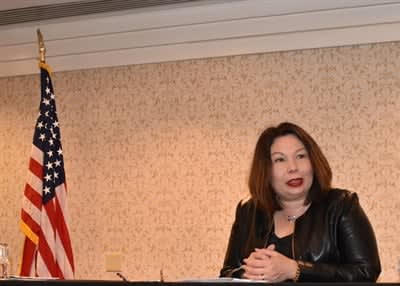
U.S. Sen. Tammy Duckworth (D-IL) talked about the School Bus Safety Act of 2019 (H.R. 3959) that she co-sponsored with Rep. Steve Cohen (TN-09).
WASHINGTON, D.C. — Federal officials joined pupil transporters here in the nation’s capital this week to discuss fitness testing, fire suppression, seat belts, and other recommendations based on recent crashes, and share resources.
On Tuesday and Wednesday, representatives from federal transportation safety agencies detailed these issues for attendees of the National Association of State Directors of Pupil Transportation Services (NASDPTS) annual conference.
David Cooper, the section chief industry engagement manager of the highway surface policy division at the Transportation Security Administration (TSA), provided the latest details on security issues related to student transportation and outlined available training resources.
Cooper reviewed strategies for responding to threats such as active shooters, vehicle ramming, explosives, and ransomware attacks.
Over the last few years, cyber threats are increasingly occurring in the field of transportation, Cooper said. Password updates and access controls can help mitigate incidents. Additionally, the TSA’s Surface Transportation Cybersecurity Toolkit, and the cybersecurity awareness guide offer tips.
Cooper also listed tips for security on the bus, noting that there is an abundance of guidance on school building security but not necessarily for school buses. He covered maintaining situational awareness; recognizing suspicious behaviors and items and providing a plan for how to report them.
TSA training tools, all of which are free of charge, include Baseline Assessment for Security Enhancement (BASE); the Transportation Security Template and Assessment and Review Toolkit (T-START); the First Observer Plus program; counterterrorism guides; Security Planning Workshops (HMC Toolkit); and the agency’s now annual Vehicle Ramming Report. TSA officials can visit district and school bus companies' facilities and work on plans customized to their needs, or they can use the tools themselves.
“You can’t prevent everything but you can defend yourself and your students a lot better if you plan [ahead],” Cooper advised.
Officials from the National Transportation Safety Board (NTSB) went over safety recommendations, such as for physical performance testing, evacuation training, and lap-shoulder belts, which have stemmed from recent school bus crash investigations.
Bruce Landsberg, the agency’s vice chairman, kicked off the discussion by noting that in "accidents" the cause is not known, but with "crashes," there are no surprises and they often could have been prevented.
Crashes keep happening because people tend to think “it can’t happen to me” and that they are immune to medical events, fatigue, and distraction behind the wheel. He recommended that attendees encourage their employees to be open about close calls they have had, and figure out what went wrong and how to prevent it from happening again.
One other suggestion from Landsberg included preparing to eventually include autonomous vehicles in pupil transportation to avoid human error.
“It’s not perfect every time, but it’s more reliable than humans,” Landsberg said. “We hope you will start to embrace [the technology.]”
Landsberg pointed to the Oakland, Iowa, school bus fire in 2017 that killed the driver and a student, and emphasized the importance of physical performance testing. The driver could barely walk and wasn’t able to exit the bus himself, let alone assist the student. Landsberg added that the school district’s transportation director that the driver worked for had eliminated the annual physical performance test due to the driver shortage.
Underscoring the NTSB’s recommendation for fire suppression systems on school buses, Landsberg said that there is at least one school bus fire a day in the U.S.
Regarding the fire suppression recommendation, said Sheryl Harley, supervisory highway accident investigator for the office of highway safety at the NTSB, in the Iowa bus fire, the fire extinguisher was located behind the mirror and unmarked. In a fatal school bus fire in Mesquite, Texas, in 2018, the driver was able to evacuate all but one of the 54 students aboard safely. The student who died in the fire got her foot caught in the bus.
Fire suppression systems that, at minimum, address engine fires, are being recommended because they detect and extinguish fires without any effort from the driver, prevent reignition, reduce heat, and provide a fire-retardant barrier.
“We are looking at anything to provide additional time to get out of the bus,” Harley said.
Max Christensen, an executive officer for school transportation at the Iowa Department of Education, gave a moving presentation on the timeline of the challenges involved in learning of the tragic Oakland, Iowa, school bus fire, responding to it, and working with various teams, including NTSB staff members.
“I can’t say enough good about [the NTSB],” he said. “They were great to work with.”
He also described how several people, from pupil transportation organizations such as NASDPTS to a local school bus contractor, pulled together and supported one another.
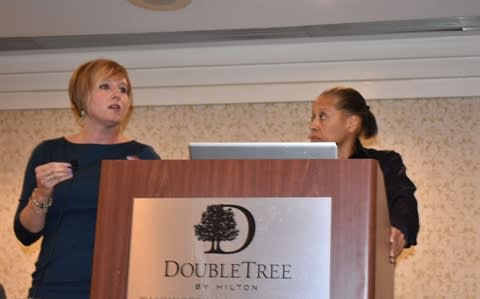
Stephanie Shaw, an NTSB safety specialist (shown left), and Sheryl Harley, an NTSB supervisory highway accident investigator, shared the details of bus crashes that prompted the agency's safety recommendations.
Of the recommendation to states to require lap-shoulder belts on school buses after the fatal Baltimore crash in 2016, Stephanie Shaw, a safety specialist with the safety advocacy division for the NTSB, said that a crash in Anaheim, Calif., which had no fatalities, demonstrated the benefits of seat belts, thanks to interior cameras.
“We recognize the significant benefit of compartmentalization in school buses,” Shaw said. “Seat belts are an added benefit.”
Harley stressed the need for drivers to not only be medically able but also physically able to drive a bus and assist students in the event of an emergency. In the Baltimore crash, the driver, Glenn Chappell, struck a car, a pillar, and a transit bus, and cited the health issues and incidents that should have disqualified him from driving a school bus.
Chappell had a history of seizures and lost control of buses he had driven before. The contractor he worked for was aware of a crash he had had after having a seizure behind the wheel, but allowed Chappell to keep driving. Chappell also had a seizure in front of his employer, who told him to supply a doctor’s note that said he was fit enough to drive. He didn’t supply a note but was still allowed to keep driving.
The employer should have also known that after having a seizure, a driver has to go through a hearing with the Department of Motor Vehicles, Harley said.
Meanwhile, the Chattanooga, Tenn., crash in 2016 that killed six students, demonstrated the need for a set procedure for routing and resolving complaints, Harley said. Parents had filed several complaints about the driver in the months leading up to that crash, but some were going to the bus company and others to the transportation director, and they weren’t being addressed.
The recommendations for evacuation training and drills and ensuring students are educated on operating the manual release handle for front-loading doors and providing pre-trip safety briefings were based, in addition to the Iowa fire, on motorcoach crashes in Alabama and California, and many students were not wearing seat belts, suffered injuries, and didn’t know how to get out of the vehicle.
The NTSB made another recommendation to standardize training on using the onboard 911 button in an emergency, because in the Iowa fire, the driver didn’t use the 911 button. He called the dispatcher, who misunderstood the situation and didn’t call 911.
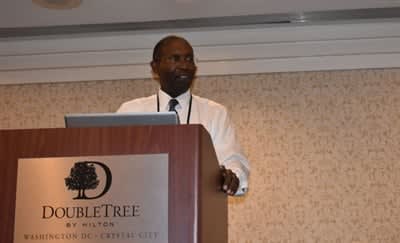
Larry Minor, an FMCSA administrator and officer, notified attendees that the entry level driver training certification final rule deadline has been pushed back from 2020 to 2022.
Larry Minor, the associate administrator for policy and designated federal officer for the Federal Motor Carrier Safety Administration (FMCSA), notified attendees that the entry level driver training (ELDT) certification training final rule deadline has been pushed back from Feb. 7, 2020 to Feb. 7, 2022, because of IT challenges that would interfere with commercial driver’s license (CDL) training providers registration.
He added that attendees can still move forward with putting together their training programs if they haven’t done so already.
Minor also said that the Drug and Alcohol Clearinghouse is now open for registration, and that the compliance deadline is Jan. 6, 2020.
Meanwhile, the FMCSA has changed medical standards for diabetes, seizures, and vision issues, he announced. Drivers who are dependent on insulin are no longer required to obtain an exemption from FMCSA. The healthcare professional who treats the driver’s diabetes must provide an assessment to the certified medical examiner indicating that the driver maintains proper control of their diabetes.
As of 2020, drivers with vision issues can still receive a medical card as long as the vision is stable in their better eye.
Drivers who have suffered seizures in the past can apply for a waiver as long as they can have a physician verify they haven’t had a seizure in several years.
The FMCSA is also providing a form for drivers to disclose the use of certain medications to be shared with a medical examiner and on the federal registry.
“We are trying to get better communication between examiner and physician,” Minor said. “This loops into the clearinghouse because a driver may test positive and they didn’t disclose [the medications] on form.”
U.S. Sen. Tammy Duckworth (D-IL) talked with attendees about the School Bus Safety Act of 2019 (H.R. 3959) that she has co-sponsored with Rep. Steve Cohen (TN-09).
Duckworth, a former U.S. Army lieutenant colonel, recounted how when she was in combat, protection gear and a stability system kept her safe.
“I take this approach toward technology: If you plan for the worst-case scenario, you have the best chance of success,” she said.
Duckworth added that her 4-year-old daughter is begging her to ride the school bus, but what she has heard about the Chattanooga and Baltimore crashes has her “terrified.”
“For me it comes down to this: a parent should not have to worry about their child coming home from school. I know school buses are safest [mode of transportation], but there’s no reason we can’t move that bar a few notches higher,” she said. “That’s why I introduced the School Bus Safety Act.”
Plus, it’s a mixed message, Duckworth added. Her daughter doesn’t think their car turns on unless everyone’s seat belts are buckled.
Duckworth recently added a grant program tied to the number of students on subsidized school lunch programs to boost the chances of the act, which is being included in the Highway Bill, being passed.
“I think parents would agree to spend a little more money today to protect our children tomorrow,” she said. “I am so honored to have your help in this fight."
Additionally, Andrew Wheeler the Environmental Protection Agency (EPA) administrator shared the success of the agency’s Diesel Emission Reduction Act (DERA) program in honor of Children’s Health Month.
DERA awarded $29 million to “clean up dirty engines” between 2008 and 2016, which accounts for 43% of engines, Wheeler said. Of that percentage, nearly 30,000 school buses have been made cleaner due to DERA funding, he added.
More Management
Inside NAPT ACTS 2026: Highlights from Louisville
From federal updates and student behavior strategies to new school bus technology and industry awards, see highlights from NAPT ACTS 2026 in Louisville.
Read More →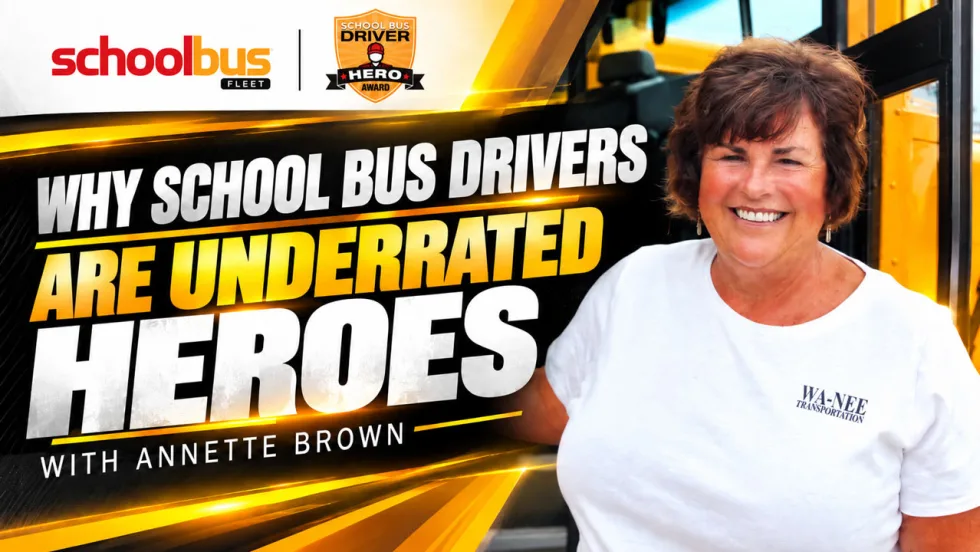
Meet the 2025 School Bus Driver Hero Winner: Annette Brown
We caught up with Wa-Nee Community Schools' Annette Brown on site at SBFX, where she was named the 2026 School Bus Driver Hero Award winner. Hear about her reaction, what she loves most about being a school bus driver, and more!
Read More →
Predictability Is Like Ketchup (According to 6-Year-Olds)
To students, a different school bus can feel like a full-blown crisis. One driver reflects on why familiar routines, showing up on time, and being reliably boring matter more than we think.
Read More →
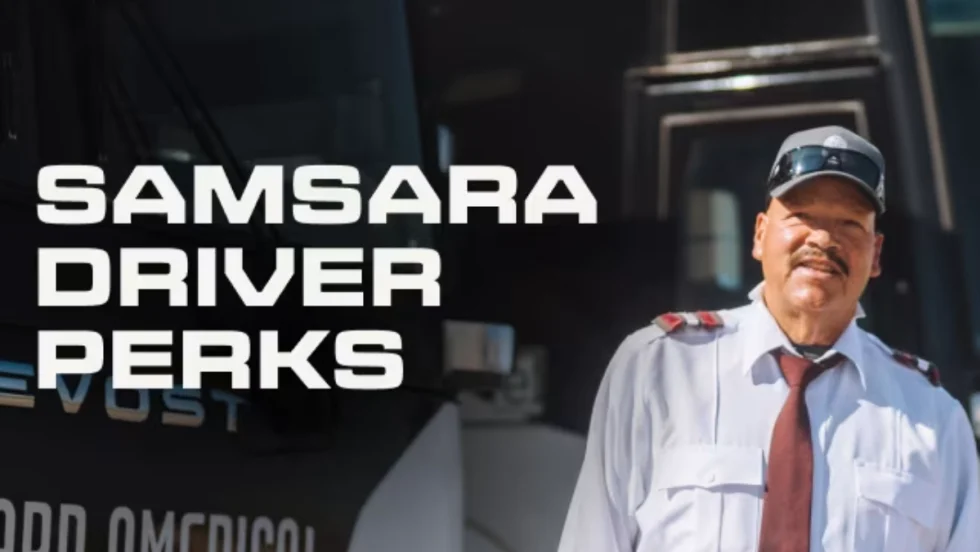
Samsara Launches Free Driver Rewards Program
The new Driver Perks program gives eligible professional drivers access to discounts and offers without adding a cost for participating fleets.
Read More →
How Tax-Exempt Municipal Leases Can Help Finance School Buses
Let’s explore school bus financing options, including municipal leases, vendor payable accounts, and balloon payments, and how they can help stretch fleet budgets.
Read More →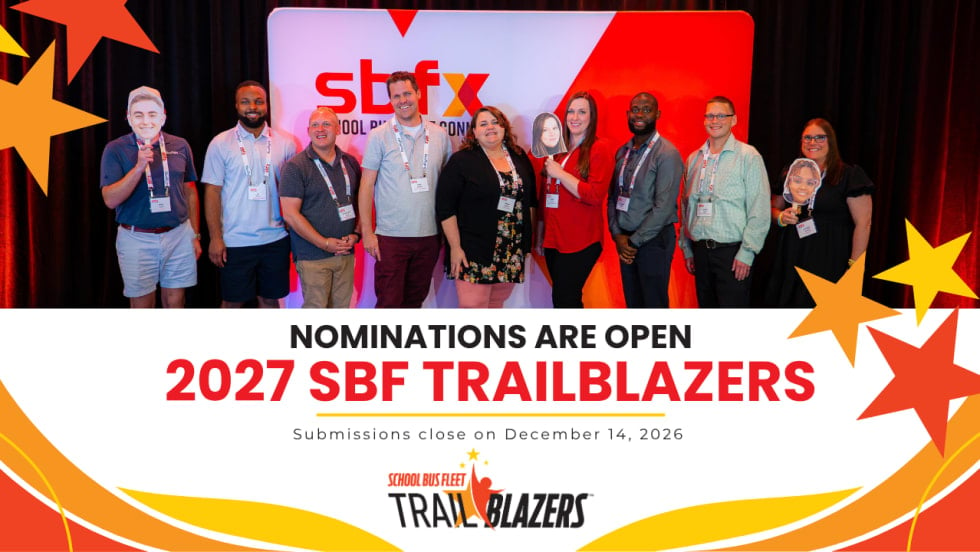
Nominate Rising School Transportation Pros Under 40!
We’re searching for the next generation of leaders making an impact across the K-12 student transportation industry to recognize as SBF’s 2027 Trailblazers. Nominations are open now!
Read More →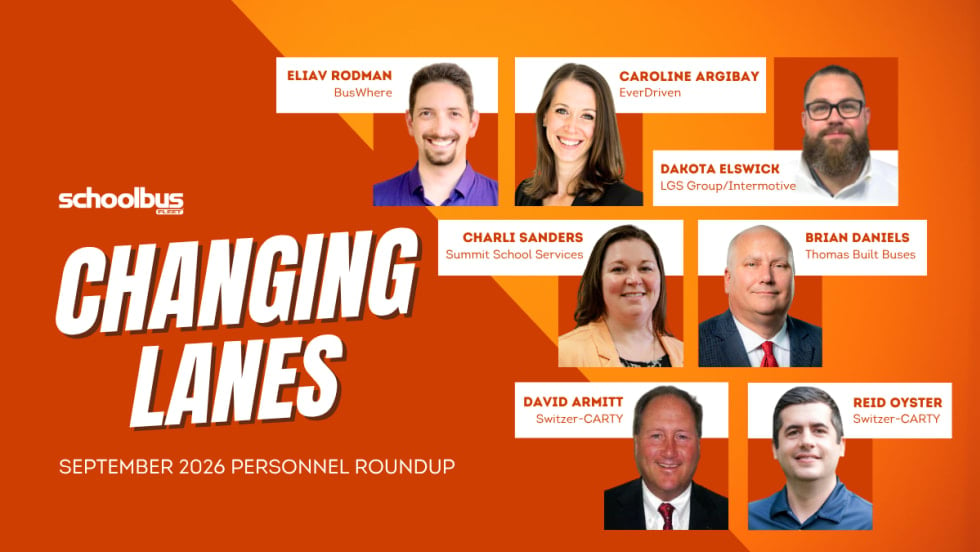
Changing Lanes: BusWhere, EverDriven, InterMotive, Summit School Services, Switzer-Carty & Thomas Built Buses
Check out who's been hired, promoted, and appointed to leadership positions at various school transportation suppliers, contractors, and manufacturers.
Read More →
The Most Expensive Thing You Do Before Selling a School Bus: Wait
When should you sell an aging school bus? Learn how maintenance, mileage, corrosion, specifications, and timing can affect resale value long before the auction.
Read More →
American Student Transportation Partners Acquires AJ Myers and Sons
A new deal brings a 75-year Pennsylvania student transportation provider into one of the nation’s largest private school bus contracting groups.
Read More →
What I Brought Home From SBFX: Relationships, Leadership, and Preparing What's Next
Who could lead your transportation operation tomorrow if you couldn't? Bernando Brown explores succession planning, mentorship, and preparing emerging leaders to step up.
Read More →