




Related: Virginia Approves $20M in VW Funds for Electric School Buses
NASDPTS Kicks Off Annual Conference in D.C.
Electric buses, onboard technology, seat belts, and illegal passing were key points of discussion on the first full day.

Nicole Schlosser・Former Executive Editor
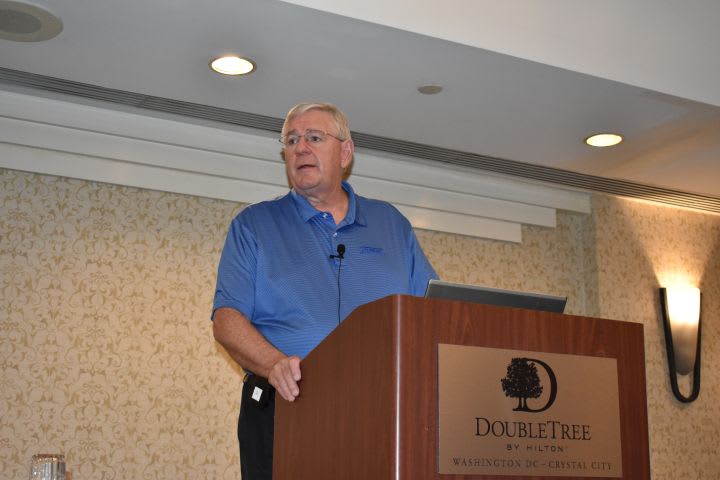
Ken Hedgecock, the vice president of sales, marketing, and service for Thomas Built Buses, discussed electric school buses among other topics at the annual NASDPTS conference in Washington, D.C.
4 min to read
Ken Hedgecock, the vice president of sales, marketing, and service for Thomas Built Buses, discussed electric school buses among other topics at the annual NASDPTS conference in Washington, D.C.
WASHINGTON, D.C. — The National Association of State Directors of Pupil Transportation Services (NASDPTS) kicked off its annual conference here for the first time on Monday with lively discussions about electric buses, seat belts, illegal bus passing, and onboard technology.
Representatives from school bus manufacturers Blue Bird, IC Bus, The Lion Electric Co., and Thomas Built Buses discussed the growing market demand for electric school buses, driven in part by the availability of Volkswagen (VW) settlement funds and interest from electric companies.
In addition to the benefits of near-zero emissions, lower total cost of ownership, and quieter operation, said Marc Riccio, alternative fuels manager for Blue Bird, school districts will also be able to sell power back to electric companies through vehicle-to-grid (V2G) technology.
“Power companies have realized that school buses have value as huge electricity farms,” added Ken Hedgecock, the vice president of sales, marketing, and service for Thomas Built Buses.
Navistar, the parent company of IC Bus, has projected that half of all school bus sales could be electric by 2035, said Trish Reed, vice president and general manager of IC Bus. However, battery costs will decrease significantly and the technology will improve considerably by 2025, she added.
IC Bus and Thomas Built Buses added that they are also continuing to invest in diesel technology, as that propulsion method will still be more appropriate for buses running on some routes.
Reed also discussed how changing demographics, including more Generation Xers and Millennials moving into higher-level positions, is driving an increasing demand for more safety technology, such as collision mitigation, on school buses.
“We get asked more often than not why we don’t have this technology on all of our buses,” Reed said.
Also growing in acceptance is school buses equipped with lap-shoulder belts. Longtime supporters Max Christensen, an executive officer for school transportation at the Iowa Department of Education and a NASDPTS past president, and Chris Darling, executive director of the Iowa Pupil Transportation Association, walked attendees through their journey to getting the state to require lap-shoulder belts, also known as three-point belts, on all new school buses.
Christensen and Darling pointed to multiple turning points over the past 12 years. Those included when flexible seating was introduced in school buses in 2007; in 2013 when Christensen observed in a school bus crash demonstration that one of the unbelted dummies was about the size of his young daughter at the time and worked with NASDPTS to change its position to supporting seat belts on buses, regardless of whether there was funding for them; a list of pros and cons from members in a 2017 IPTA newsletter; and changing the messaging in the state on the benefits of seat belts in 2019 from preventing fatalities, since there hadn’t been any related to school buses in the state in many years to reducing injuries and better behavior, which could help with driver retention.
Then, in September, the Iowa State Board of Education adopted a rule to require lap-shoulder belts in all new school buses in the state.
“If someone tells you it can’t be done, it can,” Christensen said.
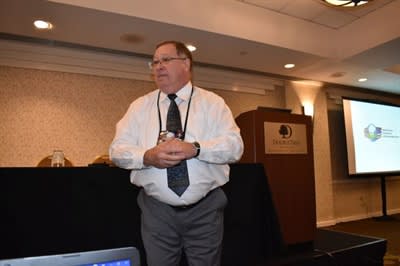
Mike LaRocco, president of NASDPTS and Indiana state director, welcomed attendees to the NASDPTS conference, which was held in Washington, D.C. for the first time.
Soon after, the conversation turned to recent data on illegal bus passing incidents and fatalities. Keith Dreiling, the director of the Kansas Department of Education’s School Bus Safety Unit and NASDPTS central region director, highlighted some data from the department’s annual National School Bus Loading and Unloading Survey.
Findings include, Dreiling said, that there were eight fatalities over the last year: three in Indiana, and one each in Georgia, Mississippi, Maryland, Missouri, and Wyoming; and that children 9 years of age and younger are still in the majority of fatalities.
Additionally, the survey found that 87.5% of fatalities were attributed to other vehicles. Three-quarters, or six, of the fatalities occurred in October, and there was a close to even split as to what the lighting conditions were (three fatalities occurred both during dawn and in the dark, and two took place in daylight). Weather conditions were clear in seven of the eight fatalities and weather-related road conditions were dry when all fatalities occurred.
More Management

How to Build a Better Driver Training Program
Ready to boost up your school bus instructor training? Here’s how to pick the right talent and improve recruitment, retention, and safety.
Read More →
CALSTART and Forth Combine to Form Catalyst Mobility
The new name represents a renewed vision for the nonprofit focused on advancing clean, equitable, and affordable transportation solutions that move people and goods.
Read More →
What Makes a Great School Bus Driver Trainer?
Choosing the right school bus driver trainer takes more than experience. Learn six keys to selecting and developing trainers and evaluating program effectiveness.
Read More →


School Bus Contractors Expand Through New Deals, Acquisitions & Partnerships
STA's Canadian division acquires Ontario-based G&L Stevenson Transport while Durham School Services adds a new district contract in California, First Student adds a New Jersey contract, and Minnesota Coaches acquires Halo Transportation.
Read More →
Logan Bus Company Rolls Out AI Phone System for NYC School Bus Families
A summer pilot found that AI agents could handle most routine calls, freeing up time for customer service staff to focus on emergencies and complex family concerns.
Read More →
From Intent to Impact: What I Learned About Leadership from TAPT
A Texas transportation supervisor shares lessons on self-awareness, accountability, managing stress and building trust — and why investing in leadership development matters at every stage of your career.
Read More →
NAPT Names 2026 Award Recipients, Hall of Fame Inductee
Who earned national recognition for their work in student transportation? This year, NAPT named five recipients of its 2026 awards for service, safety, and leadership, plus its newest Hall of Famer.
Read More →
Sponsored•September 2, 2026
2026 State of Student Transportation Report
Driver shortages. Rising costs. Growing safety expectations. More data, but not enough time to act on it. The 2026 State of Student Transportation Report reveals what transportation leaders say is putting the most pressure on their operations—and where they’re investing next. See how your priorities compare.
Read More →
How to De-Escalate an Angry Person: 5 Steps for Handling Workplace Conflict
What makes emotions run high, and how should you handle an angry colleague or parent? Follow these steps for staying calm, listening, showing empathy, and resolving conflict.
Read More →
Sponsored•September 1, 2026
What Readiness Looks Like This School Year
Learn about the challenges shaping the 2026–2027 school year, from persistent driver shortages and budget pressure to technology and readiness gaps. See how school districts are responding and adapting in Zonar’s 2026 Back-to-School Readiness Report.
Read More →