




District Conducts Active Shooter Training for School Bus Security
A training program shows Canastota Central (N.Y.) School District transportation staff how to respond to active shooters and what signs to look for in students.
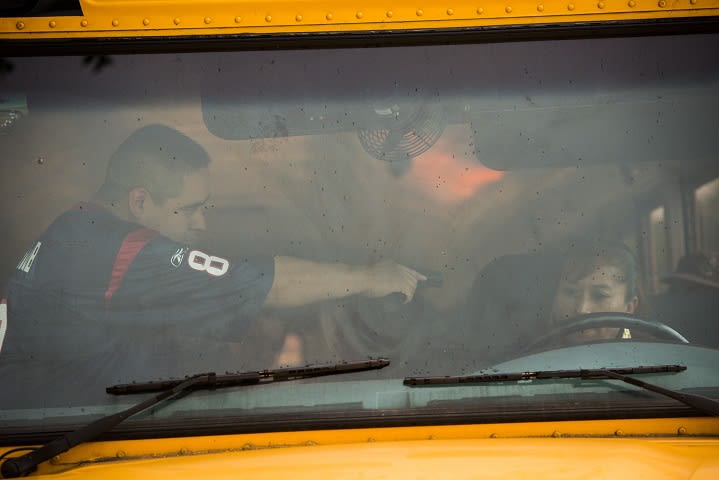
The training for Canastota Central (N.Y.) School District included a presentation from Armoured One and a hands-on mock active shooter incident. File photo from a Houston Independent School District active shooter training
The training for Canastota Central (N.Y.) School District included a presentation from Armoured One and a hands-on mock active shooter incident. File photo from a Houston Independent School District active shooter training
CANASTOTA, N.Y. — School transportation staff here recently took part in a hands-on active shooter training conducted by school safety and security company Armoured One.
Cynthia Clark, the transportation supervisor for Canastota Central School District, told School Bus Fleet that she first came across the Armoured One training program when she attended the New York Association for Pupil Transportation Conference in Albany, New York, in July.
“They [NYAPT] had a session there,” Clark said. “I took down the name, and that’s when I began my little investigation to see what they had to offer.”
Armoured One provides products, trainings, assessments, and preparedness plans to help school administration and transportation staff be proactive against major attacks and shootings, according to the company’s website.
The training event took place on Oct. 19, and was held for 37 of the district’s transportation staff, which consisted of office clerks, drivers, and bus attendants.
Armoured One representatives discussed in a presentation during the three-hour training how to respond to active shooters and what warning signs to look for in students. They also showed videos of previous mock active shooter incidents.
After the presentation, the transportation staff and the Armoured One representatives headed out on one of the district's buses and drove to a vacant roadway to conduct the hands-on portion of the training.
“The hands-on aspect was phenomenal,” Clark said. “They actually brought replicas of guns and tennis balls to show us that if somebody has a gun [on the bus], they showed us what we can do and use to distract that person.”
The intent with the tennis balls, Clark said, was to show how students on board the bus could throw objects, such as water bottles or backpacks, at the active shooter to distract them.
Armoured One also offered the transportation staff vehicle operation and control techniques for instances in which an active shooter is present while the bus is in motion.
“It’s very enlightening because you wouldn’t think that the driving techniques would help,” Clark said, "[but] I had a couple of people getting nauseated because of the maneuvers we did to distract [the active shooter] on the bus.”
A week after the training, Clark and her transportation staff held a meeting to discuss the pros and cons of the training process. Clark said that she felt like the training was “well-executed,” and that her staff felt more capable of responding to “high-stress” active shooter incidents.
Canastota Central School District currently transports about 600 to 750 students daily to three district buildings, and Clark said student safety is the district’s number-one priority.
“We’re always preparing, always thinking outside of the box for training,” she said. “You want to take it one step further and keep yourself abreast of different techniques.”
More Safety

How to Build a Better School Bus Driver Training Program
Is it time to strengthen your driver training? Here’s how to pick the right talent and improve recruitment, retention, and safety. This video is brought to you by IC Bus.
Read More →
Recent School Bus Accidents Leave 2 Dead, 2 Injured
Four school bus crashes in Florida, Illinois, and Georgia highlight risks in transportation lots, at bus stops, and during student loading and unloading.
Read More →
When Every Second Matters, Clarity Keeps Routes Moving
From routine delays to urgent incidents, strong communication practices help drivers, dispatchers, schools, and families respond with confidence.
Read More →

What Happens When a School Bus Catches Fire — and What Can Help
School bus fires are rare but can be devastating. Learn how advances in fire suppression and asset protection help fleets detect fires earlier, reduce damage, and improve safety.
Read More →
Geotab Launches Tool to Help Fleets Investigate Road Incidents
Geotab Investigations combines telematics data, video, documents, and other evidence to help fleets reconstruct incidents, resolve claims, and determine what happened.
Read More →
Texas Sixth Grader Wins 2026 National School Bus Safety Poster Contest
Sai Darshana Yekolu of Moseley Middle School in Prosper, Texas, was named the newest winner for her artwork, bringing the theme of “Safe Rides, Everyday Heroes” to life.
Read More →
Doing More With Less: How Transportation Directors Can Prioritize Safety Amid Budget Uncertainty
With diesel prices soaring and nearly one-third of transportation directors expecting budget cuts, maintaining student safety has never been more challenging. Download this guide to learn how leading districts are prioritizing risk, funding critical safety technology, and building stronger budget cases with data.
Read More →
Walton County Schools Adds Gatekeeper Stop-Arm Enforcement System
The Florida district will deploy Gatekeeper’s updated Student Protector technology, which now incorporates AI to improve video evidence.
Read More →
How To Build a More Secure School Bus Yard During and After Hours
As thefts and overnight security threats continue, school transportation leaders are combining stronger operational practices with AI-enabled surveillance to better protect buses, facilities, and staff.
Read More →
FMCSA Names New Chief Safety Officer: What School Bus Operators Should Know
Steve Dowling is set to lead the federal agency's efforts to advance commercial motor vehicle safety and reduce crashes, fatalities, and injuries on the nation's roadways.
Read More →