




Related: Student in Coma After Being Hit by Truck While Exiting School Bus
District Adds Extended Stop Arms to School Buses After Student Struck by Car
Bigfork (Mont.) School District 38 is prompted by a recent illegal passing incident that severely injured a 6-year-old student at a nearby district to install the longer stop arms on all its buses.

Nicole Schlosser・Former Executive Editor
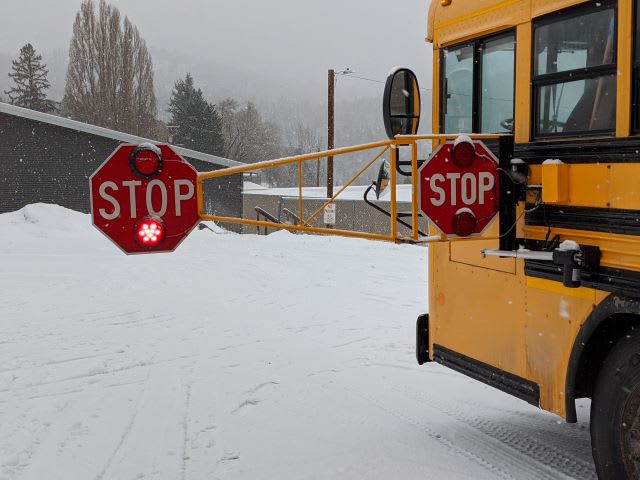
Bigfork (Mont.) School District 38 was spurred by a recent illegal passing incident that severely injured a student at a nearby district to install extended stop arms on all its buses. Photo courtesy Rob Tracy
3 min to read
Bigfork (Mont.) School District 38 was spurred by a recent illegal passing incident that severely injured a student at a nearby district to install extended stop arms on all its buses. Photo courtesy Rob Tracy
BIGFORK, Mont. — A school district here has equipped its school buses with extended stop arms after a student in a nearby district was struck and severely injured by a car while she was exiting her bus.
On Nov. 12 at approximately 4:44 p.m., as students got off their school bus at a designated stop on Highway 93 just west of Whitefish, Jordana Hubble, 6, was hit by a vehicle. The motorist failed to stop for the bus, which had its stop arm extended and red warning lights activated, Olney-Bissell School District #58, where Hubble is a student, stated in a news release posted on its Facebook page.
The motorist was driving 25 mph, Montana Highway Patrol Captain Chad Dever told KPAX. Charges were pending at the time of the crash and the motorist was not arrested.
Hubble was hospitalized and received treatment for a traumatic brain injury she sustained during the crash, according to a post on the Olney Fire & Ambulance Facebook page on Nov. 14. (The fire department also raised funds from the community to help Hubble and her family.) She continues to recover and was recently admitted to a coma emergence program in Houston, Texas, ABC Fox Montana reports.
Meanwhile, Bigfork School District 38, which is located about 70 miles southeast of Olney-Bissell School District #58, was prompted by the crash to add extended stop arms to its school buses.
“The incident in Olney did bring the issue to focus for us to make a decision, and we didn't hesitate to move forward,” Rob Tracy, the transportation director for Bigfork School District 38, told School Bus Fleet.
Over the district’s Christmas break, the transportation department installed 10 extended stop arms — one on each of its eight route buses and on each of its two spare buses — from Bus Safety Solutions.
However, the transportation department was working to combat stop-arm running before the crash that injured Hubble, Tracy said. The installation of the extended stop arms is the result of a pilot program that the department began in September 2018. After experiencing several illegal passing incidents on one route, Tracy installed the extended stop arm on the bus driving that route. Since then, the bus driver on that route has only experienced one stop-arm running incident, Tracy told Bigfork Eagle.
Tracy also said that the district had initially mounted cameras on its school buses to capture images of motorists violating stop arms, according to the newspaper. The video footage enabled them to identify the make and model of the vehicle involved in the violation, but the cameras were unable to clearly capture the license plate, he said. Then, bus monitor Kathy Standley conducted research, Tracy told the newspaper, and came across the extended stop arm that the transportation department ended up using.
View a photo of Hubble at Nexus Children’s Hospital in Houston, shared on the Olney Fire & Ambulance Facebook page, below.
More Safety

How to Build a Better School Bus Driver Training Program
Is it time to strengthen your driver training? Here’s how to pick the right talent and improve recruitment, retention, and safety. This video is brought to you by IC Bus.
Read More →
Recent School Bus Accidents Leave 2 Dead, 2 Injured
Four school bus crashes in Florida, Illinois, and Georgia highlight risks in transportation lots, at bus stops, and during student loading and unloading.
Read More →
Sponsored•September 8, 2026
When Every Second Matters, Clarity Keeps Routes Moving
From routine delays to urgent incidents, strong communication practices help drivers, dispatchers, schools, and families respond with confidence.
Read More →

What Happens When a School Bus Catches Fire — and What Can Help
School bus fires are rare but can be devastating. Learn how advances in fire suppression and asset protection help fleets detect fires earlier, reduce damage, and improve safety.
Read More →
Geotab Launches Tool to Help Fleets Investigate Road Incidents
Geotab Investigations combines telematics data, video, documents, and other evidence to help fleets reconstruct incidents, resolve claims, and determine what happened.
Read More →
Texas Sixth Grader Wins 2026 National School Bus Safety Poster Contest
Sai Darshana Yekolu of Moseley Middle School in Prosper, Texas, was named the newest winner for her artwork, bringing the theme of “Safe Rides, Everyday Heroes” to life.
Read More →
Sponsored•August 27, 2026
Doing More With Less: How Transportation Directors Can Prioritize Safety Amid Budget Uncertainty
With diesel prices soaring and nearly one-third of transportation directors expecting budget cuts, maintaining student safety has never been more challenging. Download this guide to learn how leading districts are prioritizing risk, funding critical safety technology, and building stronger budget cases with data.
Read More →
Walton County Schools Adds Gatekeeper Stop-Arm Enforcement System
The Florida district will deploy Gatekeeper’s updated Student Protector technology, which now incorporates AI to improve video evidence.
Read More →
How To Build a More Secure School Bus Yard During and After Hours
As thefts and overnight security threats continue, school transportation leaders are combining stronger operational practices with AI-enabled surveillance to better protect buses, facilities, and staff.
Read More →
FMCSA Names New Chief Safety Officer: What School Bus Operators Should Know
Steve Dowling is set to lead the federal agency's efforts to advance commercial motor vehicle safety and reduce crashes, fatalities, and injuries on the nation's roadways.
Read More →