





Check Out: Report: U.S. Electric School Bus Deployment Over 1,700 and Climbing
California Clean Bus Voucher Process Reopens March 30
The Public School Set-Aside for this year, managed by the California Air Resource Board (CARB), includes $122 million for electric school buses.
March 24, 2022

4 min to read
California’s Hybrid and Zero-Emission Truck and Bus Voucher Incentive Project (HVIP) is set to reopen for voucher request applications on March 30.
The Public School Set-Aside of $122 million for school buses, managed by the California Air Resource Board, is intended to cover most, if not all, of the full cost of new electric school buses for eligible applicants.
According to the HVIP website, eligible applicants in small and medium air districts must serve K-12 students and may include:
California public school districts
California public charter schools
California Joint Power Authorities (JPAs)
California County Offices of Education (COEs)
Division of State Special Schools of the California Department of Education
About Those Buses, Old and New
When applicants make their initial funding request, they must identify any buses that they want to scrap, but aren’t immediately required to know which buses they may purchase to replace them. Old school buses can be any internal combustion engine (ICE) using any fuel type. It doesn’t have to be the same bus type or vehicle weight class as the planned new bus.
Old bus eligibility requirements include:
Chassis must be 2007 model year or older. Bus chassis age is verified by the model year listed on the DMV registration form.
Bus must be owned by the applicant. It can’t have a lienholder listed on the DMV registration form.
Bus must have a gross vehicle weight rating (GVWR) greater than 14,000 pounds.
Bus must be compliant with the California Truck and Bus Regulation to receive a full voucher amount.
To receive funds from the set-aside, applicants select an HVIP-eligible vehicle with vehicle-to-grid (V2G) functionality, but aren’t required to use V2G.
Who Can Provide the New Buses?
Approved school bus manufacturers under the HVIP guidelines include:
Blue Bird
BYD Motors
GreenPower Motor Company
Navistar/IC Bus
Lightning Systems
Lion Electric
Micro Bird
Motiv Power Systems
Phoenix
Thomas Built Buses
In a news release, GreenPower’s director of contracts and grants, Michael Perez, said the company looks forward “to leveraging this year’s funding to put even more vehicles on the road.”
“Purchasers who partner with GreenPower to obtain HVIP vouchers seize a rare opportunity to acquire best-in-class battery-electric vehicles at dramatically discounted prices,” said Ryne Shetterly, vice president of sales and marketing for GreenPower.
In a statement last month, Sam Kang, BYD’s head of total solutions for North America, said that “BYD can offer parents something no other school bus manufacturer can top – peace of mind. BYD’s lithium iron phosphate batteries have been put through rigorous testing and proved to be safe when burned, overheated, dropped, perforated, and crushed.”
What Happens Next?
The set-aside follows a two-step application process, starting with the completion and submission of the application by the applicant.
After HVIP team review, the applicant may advance to Application Part B, selecting a V2G-capable vehicle and communicating with an HVIP-approved dealer selling the vehicle. The dealer will submit Application Part B on the applicant’s behalf in the form of an HVIP voucher request. Those selected to proceed to Application Part B will be contacted directly by HVIP staff and have 30 calendar days to submit Part B.
Within 90 days of the start of Part A submissions, HVIP will prioritize funds to applicants located in a disadvantaged community and within what’s known as a “small-sized air district,” as defined by the California Air Pollution Control Officers Association. After the 90-day application window, any remaining funds would be allocated to requests received during the window in the following order:
Applicants in small air districts but not in disadvantaged communities.
Applicants in medium-sized air districts and in disadvantaged communities.
Applicants in medium-sized air districts but not in disadvantaged communities.
After that initial 90-day window, requests are first-come, first-served for all eligible applicants in small- and medium-sized air districts, pending availability of funds.
Small Air Districts
Amadar County APCD
Antelope Valley AQMD
Butte County AQMD
Calaveras County APCD
Colusa County APCD
El Dorado County AQMD
Feather River AQMD
Glenn County APCD
Great Basin Unified APCD
Imperial County APCD
Lake County AQMD
Lassen County APCD
Mariposa County APCD
Mendocino County AQMD
Modoc County APCD
North Coast Unified AQMD
Northern Sonoma APCD
Shasta County AQMD
Siskiyou County AQMD
Tehama County APCD
Tuolumne County APCD
Medium Air Districts
Eastern Kern APCD
Mojave Desert AQMD
Monterey Bay Unified APCD
Placer County APCD
San Luis Obispo County APCD
Santa Barbara County APCD
Ventura County APCD
Yolo-Solano AQMD
Preparing for Part A
Eligible applicants getting ready for March 30 opening day should prepare by gathering the following information:
Applicant information, including name, mailing address, and air district.
Old bus data: make, model, model year, vehicle identification number, GVWR, engine serial number, name of DMV-registered owner, California Highway Patrol certification information.
Supporting documentation, such as a letter of intent signed by an authorized applicant representative stating intent to participate.
More Alternative Fuels

CALSTART and Forth Combine to Form Catalyst Mobility
The new name represents a renewed vision for the nonprofit focused on advancing clean, equitable, and affordable transportation solutions that move people and goods.
Read More →
Alt-Fuel Moves: New Buses, Charging Hubs & Real-World EV Testing
Propane and electric school bus deployments continue to grow as districts add new vehicles, expand charging infrastructure, and gather more real-world operating data.
Read More →
Fewer Electric School Bus Models Reshape the U.S. Market
WRI’s latest buyer’s guide points to a consolidating electric school bus market, but fewer options may reflect a maturing industry rather than fewer meaningful choices for school bus operators.
Read More →
The Fuel Budget You Can Actually Predict: How Propane Autogas Keeps Money in the Classroom
Learn how propane autogas helps school districts manage fuel costs with predictable pricing, lower maintenance, and reduced emissions from former transportation director Joel Stutheit.
Read More →
Hendrickson, Driventic Introduce New Electric Powertrain for School Buses
ELECTRAAX, the electrified, lightweight drive axle offers integrated ePowertrain efficiency and modular flexibility for Class 6–7 school bus use.
Read More →
The Mobility House Joins PowerFlex in Fleet Electrification Deal
The acquisition combines intelligent charging software, bidirectional charging expertise, and fleet electrification services to support the growing adoption of electric school buses across North America.
Read More →
Alt-Fuel Moves: Electric School Bus Investments Hit the Road
See which districts across the U.S. are putting electric school buses into service, expanding charging infrastructure, and planning the next phase of fleet electrification.
Read More →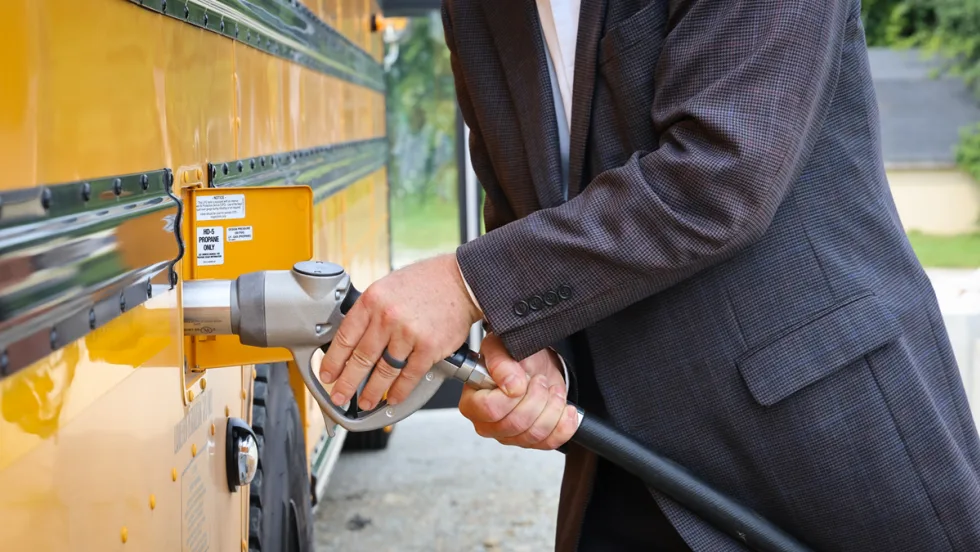
With Fuel Volatility Ahead, School Districts Turn to Propane
While diesel prices peaked above $5 this spring, districts with propane autogas-powered fleets paid under $2 per gallon, according to PERC.
Read More →
EPA Unveils Proposed Changes to 2027 Heavy-Duty Engine Rules
The federal agency has proposed changes to next year’s targets that would eliminate DEF derates, ease warranty requirements, and retain current NOx emissions standards.
Read More →
Alt-Fuel Moves: EV Charging & Infrastructure Projects Gain Momentum
The latest developments include new funding, charging infrastructure, utility investments, and fleet technologies designed to support the transition to electric school buses nationwide.
Read More →