Net sales came in at $303 million for the fourth quarter in fiscal 2023, up about 17.6% compared to the same period in 2022.
Image: Canva/Blue Bird
6 min to read
Blue Bird Q4 Financial Report
On Dec. 11, school bus manufacturer Blue Bird released the fourth quarter and full year financial results for the company, reporting annual net sales of $1.13 billion, up 41% compared to 2022.
“I am incredibly proud of our team’s progress in transforming our business in 2023, and the outcome of all the hard work is evident in our record financial results,” said Phil Horlock, CEO of Blue Bird Corporation. “The Blue Bird team executed a rigorous transformational plan over the past two years to improve operations and throughput, control fixed costs, recover economics through pricing, and expand our leadership position in alternative-powered buses. The market demand for Blue Bird’s school buses remains very strong with approximately 4,600 units in our order backlog."
Ad Loading...
“We are very pleased with the FY2023 results, with record Revenues and Adj. EBITDA coming in above guidance,” said Razvan Radulescu, CFO of Blue Bird Corporation. “Our business transformation is already generating record levels of profitability compared with historical levels, and more improvements are still to come.
In the fourth quarter, net sales amounted to $404 million, up $45.3 million from the same period in 2022. The average sales price per unit was up 12.1%, reflecting product and mix changes, "as well as pricing actions taken by management in response to increased inventory purchase costs," according to a news release.
The third quarter saw the company rally to complete its turnaround toward historic profitability, according to CFO Razvan Radulescu.
Image: Canva/Blue Bird
Blue Bird Q3 Financial Report
Georgia-based Blue Bird Corporation on Aug. 9 released the results of its 2023 fiscal third quarter, with net sales up 43% to $294.3 million and 2,137 buses sold, completing the company's turnaround and beating guidance.
"I am incredibly proud of the progress by our team in completing our business turnaround, and the outcome of all the hard work is evident in our financial results," said CEO Phil Horlock. "The Blue Bird team has been executing a rigorous planb for over 18 months to improve operations, reduce fixed costs, and recover economics through pricing. The market demand for Blue Bird's school buses remains very strong, with nearly 5,200 units in our order backlog."
The company also expanded its leadership position in zero-emission school buses, Horlock said, with electric vehicle bookings up nearly 150% compared to Q3 2022.
Ad Loading...
"We have seen steady growth in EV orders from the EPA's 2022 Clean School Bus Rebate Program, which awarded nearly $1 billion in funding from Phase 1 of the program," Horlock said. "This funding alone will generate orders for at least 550 Blue Bird buses. In addition, we are excited to see further progress with the announcement of Phase 2 of the program, offering a $400M competitive grant program for electric school buses."
Razvan Radulescu, Blue Bird's chief financial officer, noted that the company's "turnaround is completed and we have returned to historical profitability, and expect further increased performance for fiscal Q4."
The second quarter led to net sales of $299.8 million, according to the company, with net revenue for 2023 now projected at just over $1.1 billion.
Image: Canva
Blue Bird Q2 Financial Report
Blue Bird Corporation (NASDAQ: BLBD) unveiled its second quarter 2023 results this week, reporting net sales of $299.8 million with 2,304 buses sold and a robust backlog of $775 million and nearly 5,800 units.
“I am incredibly proud of the progress that the team has made and we are finally seeing the results of all the hard work in the financials. The team has been executing on a rigorous plan for over 18 months to improve operations, reduce fixed costs, and recover economics through pricing," said Matthew Stevenson, Blue Bird's president and CEO. "The market demand for Blue Bird’s best-in-class school buses continues to remain strong with nearly 5,800 units in the backlog. We also expanded our leadership position in zero-emission school buses, realizing exceptional growth in electric school bus bookings, up 176%, and our firm order backlog, of more than 620 electric school buses, as of the end of April, continues to grow. We have seen steady growth in electric school bus orders from the EPA’s 2022 Clean School Bus Rebate Program, which awarded nearly $1 billion in funding. This funding alone will generate orders for an estimated 500-700 Blue Bird electric buses translating into a minimum of $200 million of additional revenue. Plus we are excited to see progress with the announcement of Phase 2 of the program, offering a $400M competitive grant program for electric school buses.”
Razvan Radulescu, CFO of Blue Bird, stated that the company's "turnaround is working ahead of schedule and we returned to historical profitability already in Q2, and expect further increased performance each quarter." The company expects net revenue for 2023 of more than $1.1 billion.
Ad Loading...
Net sales were $299.8 million for the second quarter of fiscal 2023, an increase of $92.2 million, or 44.4%, from prior year period. Bus sales increased $85 million, reflecting a 21.6% increase in average sales price per unit, resulting from pricing actions taken by management as well as product and customer mix change, and a 19.3% increase in units booked. In the second quarter of fiscal 2023, 2,304 units were booked compared to 1,931 units booked for the same period in fiscal 2022. The increase in units sold was primarily due to constraints in Blue Bird's ability to produce and deliver buses due to shortages of critical components in the second quarter of fiscal 2022.
Also, parts sales increased $7.2 million, or 37.4%, for the second quarter of fiscal 2023 compared to the second quarter of fiscal 2022. This increase is primarily attributed to pricing actions taken to offset increases in purchased parts costs and increased inventory availability as supply chain constraints began to improve slightly during the second quarter of fiscal 2023 relative to the second quarter of fiscal 2022.
Blue Bird Q1 2023 Financial Report
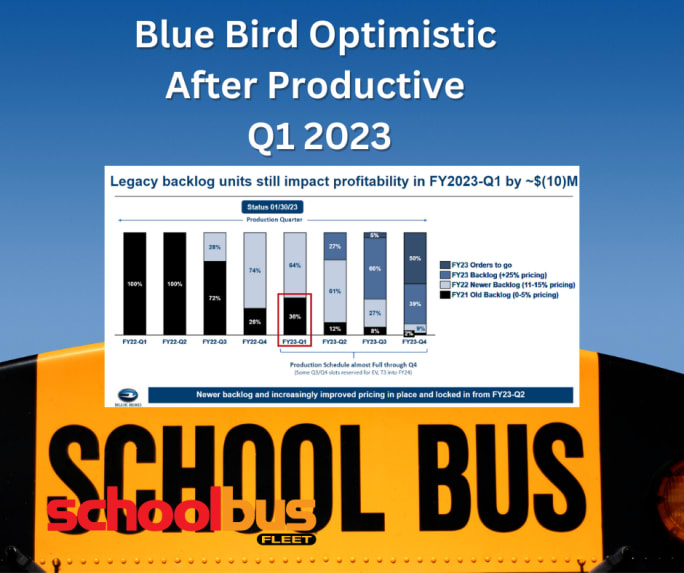
The first quarter saw 36% of units produced falling under the older 2021 Blue Bird pricing model, which gave lower profit margins.
Image: Canva
Blue Bird (NASDAQ: BLBD) corporate leaders on Feb. 8 reported positive results from their action plan to improve the school bus manufacturer's financial outlook.
"We made remarkable progress in the first quarter, as the overall operating environment continued to improve in line with our plan," said Matthew Stevenson, Blue Bird's CEO and president. "During the quarter we worked through the majority of the legacy-priced units in the backlog that have caused margin compression over the past several quarters. The Blue Bird team continued executing a rigorous plan to improve operations, reduce fixed costs, and recover economics through pricing. Therefore, we are well positioned for a significant recovery over the next several quarters."
Stevenson said that demand is strong for Blue Bird vehicles, with expanded growth in zero-emission school buses, including 130% more in electric school bus bookings, from states such as Nevada, Kentucky, Tennessee, and Utah. The company had more than 385 electric school buses in backlog at the end of Q1.
Ad Loading...
"Our order backlog will grow considerably over the next several months as orders are placed tied to the EPA's 2022 Clean School Bus Rebate Program, which will greatly accelerate the adoption of zero-emission student transportation across all 50 U.S. states," he said.
That EPA funding is expected to yield an estimated 500-700 orders for new Blue Bird electric buses, which could result in $200 million of additional revenue.
Razvan Radulescu, chief financial officer of Blue Bird, said the first-quarter results were exciting and gave reason for optimism. He reported that the company exceeded revenue projections, selling 808 more buses than during the same period in 2022. The company has sold out its Type D bus production slots for 2023, but some Q4 capacity may be reserved for Type C electric school buses.
Especially promising news came from the company's success at charging through production of buses purchased before per-unit prices started going up in 2021. About 36% of production in Q1 fell under the old backlog. In the next quarter, that should drop to 12%, with the bulk of the remaining production falling under the 11-25% higher priced backlog from 2022 and 2023.
"The great news is those (legacy-priced) units are now largely behind us," Stevenson said.
The new name represents a renewed vision for the nonprofit focused on advancing clean, equitable, and affordable transportation solutions that move people and goods.
Choosing the right school bus driver trainer takes more than experience. Learn six keys to selecting and developing trainers and evaluating program effectiveness.
STA's Canadian division acquires Ontario-based G&L Stevenson Transport while Durham School Services adds a new district contract in California, First Student adds a New Jersey contract, and Minnesota Coaches acquires Halo Transportation.
A summer pilot found that AI agents could handle most routine calls, freeing up time for customer service staff to focus on emergencies and complex family concerns.
A Texas transportation supervisor shares lessons on self-awareness, accountability, managing stress and building trust — and why investing in leadership development matters at every stage of your career.
Who earned national recognition for their work in student transportation? This year, NAPT named five recipients of its 2026 awards for service, safety, and leadership, plus its newest Hall of Famer.
Driver shortages. Rising costs. Growing safety expectations. More data, but not enough time to act on it. The 2026 State of Student Transportation Report reveals what transportation leaders say is putting the most pressure on their operations—and where they’re investing next. See how your priorities compare.
What makes emotions run high, and how should you handle an angry colleague or parent? Follow these steps for staying calm, listening, showing empathy, and resolving conflict.
Learn about the challenges shaping the 2026–2027 school year, from persistent driver shortages and budget pressure to technology and readiness gaps. See how school districts are responding and adapting in Zonar’s 2026 Back-to-School Readiness Report.






![Blue Bird 2023 Financial Reports [Updated 12/13]](https://assets.bobitstudios.com/image/upload/f_auto,q_auto,dpr_auto,c_limit,w_920/1223-blue-bird_1768117896050_qjkh4d.png)