





Related: Study Shows Propane School Buses Reduce Harmful Emissions
Blue Bird Marks 15K Propane Bus Sales as 2 Districts Expand Fleets
The school bus manufacturer delivers more than a dozen propane-powered buses to Newport News (Va.) Public Schools and North Penn School District in Lansdale, Pa.
October 28, 2019
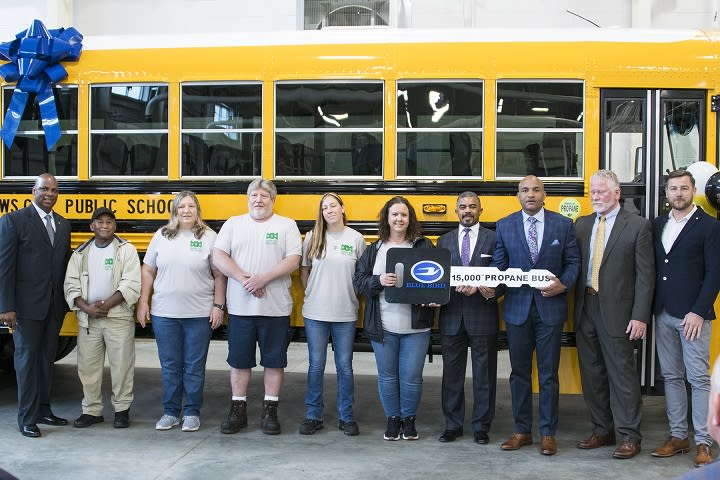
Newport News (Va.) Public Schools and Blue Bird celebrated the delivery of the school bus manufacturer's 15,00th propane-powered bus during an event on Tuesday. Photo courtesy Blue Bird
3 min to read

Newport News (Va.) Public Schools and Blue Bird celebrated the delivery of the school bus manufacturer's 15,00th propane-powered bus during an event on Tuesday. Photo courtesy Blue Bird
School districts in Virginia and Pennsylvania recently added more than a dozen propane-fueled buses to their fleets.
Newport News (Va.) Public Schools received a total of 18 Blue Bird Vision Propane school buses during an event at its new transportation facility on Tuesday, according to a news release from Blue Bird.
The bus delivery marks a milestone for the school bus manufacturer: the delivery of its 15,000th propane-powered school bus.
“The Newport News school district is joining hundreds of other school systems across the country that choose clean-operating and economical propane,” said Mark Terry, chief commercial officer of Blue Bird. “They want to save money, benefit the environment, and simplify maintenance. Propane’s reputation as economical, safe, and environmentally friendly is growing quickly.”
Newport News Public Schools currently operates a fleet of 335 buses, and 62 of those buses are propane, according to Blue Bird. It has reportedly run propane buses for two years and is expected to add 11 more by the end of 2019.
During the celebration, Tucker Perkins, the president and CEO of the Propane Education and Research Council (PERC), presented the district with PERC's Clean Energy Innovation Award.

Tucker Perkins (left), the president and CEO of the Propane Education and Research Council (PERC), presented Shay Coates, the transportation director for Newport News Public Schools, with PERC's Clean Energy Innovation Award. Photo courtesy Blue Bird
“We continue to replace our school district’s aging diesel buses with propane,” said Shay Coates, the transportation director for Newport News Public Schools. “Propane not only reduces emissions, but also saves our district thousands of dollars in fuel and maintenance costs each year.”
Brian Hanna, the district’s maintenance manager, added that the district has saved about $800 on oil changes alone in using propane buses compared to diesel ones, and that propane fuel costs about 80 cents less per gallon.
To accommodate its growing fleet, Newport News Public Schools has installed a second propane station that can fuel two buses at a time, according to Blue Bird. Its original fuel infrastructure will be used at a smaller onsite bus lot.
Meanwhile, in Pennsylvania, North Penn School District unveiled 14 new Blue Bird Vision Propane and Micro Bird buses during a ribbon-cutting ceremony on Wednesday, according to a news release from Blue Bird. The buses, funded in part by the state’s share of Volkswagen (VW) settlement funds, began operation last month.
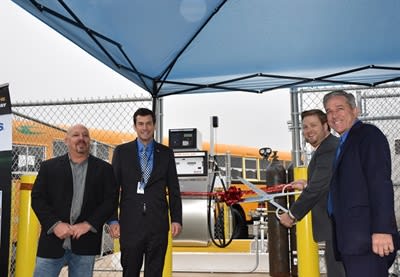
North Penn School District in Lansdale, Pa., unveiled its 14 new Blue Bird Vision Propane and Micro Bird buses as well as a propane fueling station during a ribbon-cutting ceremony on Wednesday. Photo courtesy North Penn School District
“Propane school buses make the most sense for us,” said Angelo Tornetta, technician supervisor for North Penn School District. “Propane autogas operates clean and is much cheaper than diesel or compressed natural gas, plus it costs less to maintain a propane school bus. So, it was an easy decision.”
North Penn School District currently pays 97 cents per gallon for propane fuel compared with $2.04 for diesel, according to Blue Bird. In addition to the new buses, the district has installed a new, onsite fuel station with 18,000-gallon tank capacity.
“The Ford engine with a Roush CleanTech propane fuel system exceeds today’s emissions standard at nearly 10 times lower [nitrogen oxide] NOx output, achieving California Air Resources Board’s optional, ultra-low certification,” said Ryan Zic, vice president of school bus sales for Roush CleanTech, the propane fuel system supplier for Blue Bird. “Both the school district and surrounding community will benefit from cleaner air and also less maintenance costs since the engine is so clean.”
North Penn School District said it plans to purchase more propane-powered buses with the budget it saves in fuel and maintenance costs, according to Blue Bird.
More Alternative Fuels

CALSTART and Forth Combine to Form Catalyst Mobility
The new name represents a renewed vision for the nonprofit focused on advancing clean, equitable, and affordable transportation solutions that move people and goods.
Read More →
Alt-Fuel Moves: New Buses, Charging Hubs & Real-World EV Testing
Propane and electric school bus deployments continue to grow as districts add new vehicles, expand charging infrastructure, and gather more real-world operating data.
Read More →
Fewer Electric School Bus Models Reshape the U.S. Market
WRI’s latest buyer’s guide points to a consolidating electric school bus market, but fewer options may reflect a maturing industry rather than fewer meaningful choices for school bus operators.
Read More →
The Fuel Budget You Can Actually Predict: How Propane Autogas Keeps Money in the Classroom
Learn how propane autogas helps school districts manage fuel costs with predictable pricing, lower maintenance, and reduced emissions from former transportation director Joel Stutheit.
Read More →
Hendrickson, Driventic Introduce New Electric Powertrain for School Buses
ELECTRAAX, the electrified, lightweight drive axle offers integrated ePowertrain efficiency and modular flexibility for Class 6–7 school bus use.
Read More →
The Mobility House Joins PowerFlex in Fleet Electrification Deal
The acquisition combines intelligent charging software, bidirectional charging expertise, and fleet electrification services to support the growing adoption of electric school buses across North America.
Read More →
Alt-Fuel Moves: Electric School Bus Investments Hit the Road
See which districts across the U.S. are putting electric school buses into service, expanding charging infrastructure, and planning the next phase of fleet electrification.
Read More →
With Fuel Volatility Ahead, School Districts Turn to Propane
While diesel prices peaked above $5 this spring, districts with propane autogas-powered fleets paid under $2 per gallon, according to PERC.
Read More →
EPA Unveils Proposed Changes to 2027 Heavy-Duty Engine Rules
The federal agency has proposed changes to next year’s targets that would eliminate DEF derates, ease warranty requirements, and retain current NOx emissions standards.
Read More →
Alt-Fuel Moves: EV Charging & Infrastructure Projects Gain Momentum
The latest developments include new funding, charging infrastructure, utility investments, and fleet technologies designed to support the transition to electric school buses nationwide.
Read More →