




A comprehensive approach to the stranded-student problem
When Dale Goby was head of transportation for Detroit Public Schools, children being left behind on the bus was a recurring problem. Then his team came up with a solution that eliminated the incidents, he tells SBF. He now offers the "low-cost, low-technology" ChildSaf System.

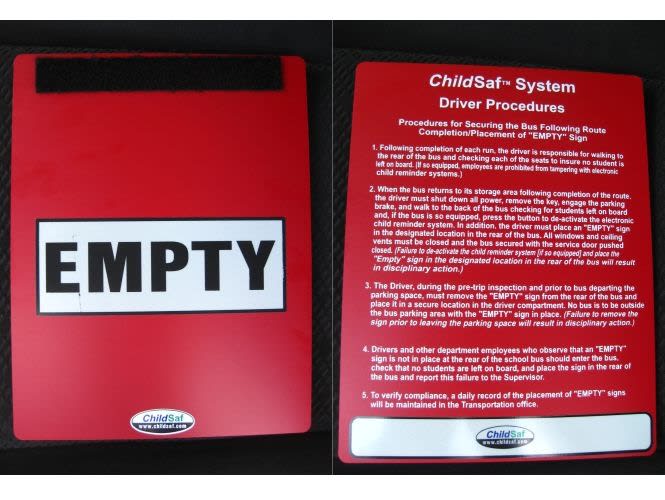
The ChildSaf System includes signs to be placed in the rear window of the bus to show that the driver has checked it for students. It reads "EMPTY" on one side and has driver procedures on the other.
CLARKSTON, Mich. — When Dale Goby was head of transportation for Detroit Public Schools, with a total of more than 600 contractor and district buses, children being left behind on the bus was a recurring problem.
Goby told SBF that the number of incidents was more than 10 per year until his leadership team developed a solution that brought the number down to zero. He said that the knowledge he gained resulted in the ChildSaf System, which he describes as a "low-cost, low-technology" approach to preventing children from being left on the bus.
"Many believe they have the solution to this problem, yet what I find is they do not understand the complexity of the problem they are trying to solve. Even many transportation supervisors don't fully understand it," Goby said. "Many use disciplinary action as the primary approach to solving this problem. Unfortunately, the result is that instances of children left on the bus continue."
According to Goby, who now runs Goby and Associates consulting and management services, ChildSaf is a comprehensive system that focuses on prevention and can work alongside the electronic child-reminder devices that many operations have in place on their buses.
"We put electronic child-reminder systems on all the new buses purchased at Detroit during my tenure there, and I believe they are very helpful," he said. "However, our experience taught us that they were not sufficient, by themselves, to fully prevent these instances."
The key to success, Goby said, is redundancy. This approach is based on an analysis of what steps are taken to make safety-critical operations successful. For example, the space shuttle has multiple systems for many of its critical functions. Additionally, airline flight systems require redundancy of critical instruments and controls to provide the level of safety required.
To that end, the ChildSaf System is based on a "team approach to prevention" focusing on five components:
1. A recommended district policy on checking buses for children. This provides the structure and administrative support for the system and requires driver post-route checks.
2. Specific driver procedures for securing the bus at the end of the route.
3. Administrator/supervisor procedures for checking on the drivers. This is a critical element of the redundancy. A form for this daily supervisory check and a system for measuring district performance are included. Further, the placement of the signs and the use of reflectorized materials make the supervisory checks easier.
4. Signs to be placed in the upper center of the rear window of the bus to show that the driver has checked it for students. The sign, which attaches with a Velcro-like material, reads "EMPTY" on one side and has the driver procedures on the other side.
5. An on-site training session for administrators and drivers on implementing the system. The session is about 45 minutes and is conducted by Goby.
According to Goby, no transportation provider that has fully implemented the ChildSaf System has had a child left behind on the bus unsupervised by an adult.
"One district that implemented the system had two sleeping kindergarten students left on the bus, but found by the driver in their vehicle check, in the first week of school," Goby said. "Others have informed me that the system works, and one driver told me that it saved her career."
ChildSaf is sold for $19.95 per bus. Those who would like further information or a review of their system can contact Goby at (248) 410-3632 or gobyd@comcast.net.
More Safety
School's Back. Here's What Happened to Traffic, Speeding & Distraction
What happens to traffic when school resumes? New data analysis examines changes in distracted driving, congestion, and speeding around schools.
Read More →
Geotab Expands Fleet Safety Tools With Video Coaching, Risk Insights
New safety and video capabilities aim to help fleet managers assess risk, support drivers, and take targeted action through video coaching, red-light violation detection, and more.
Read More →
How to Build a Better School Bus Driver Training Program
Is it time to strengthen your driver training? Here’s how to pick the right talent and improve recruitment, retention, and safety. This video is brought to you by IC Bus.
Read More →

Recent School Bus Accidents Leave 2 Dead, 2 Injured
Four school bus crashes in Florida, Illinois, and Georgia highlight risks in transportation lots, at bus stops, and during student loading and unloading.
Read More →
When Every Second Matters, Clarity Keeps Routes Moving
From routine delays to urgent incidents, strong communication practices help drivers, dispatchers, schools, and families respond with confidence.
Read More →
What Happens When a School Bus Catches Fire — and What Can Help
School bus fires are rare but can be devastating. Learn how advances in fire suppression and asset protection help fleets detect fires earlier, reduce damage, and improve safety.
Read More →
Geotab Launches Tool to Help Fleets Investigate Road Incidents
Geotab Investigations combines telematics data, video, documents, and other evidence to help fleets reconstruct incidents, resolve claims, and determine what happened.
Read More →
Texas Sixth Grader Wins 2026 National School Bus Safety Poster Contest
Sai Darshana Yekolu of Moseley Middle School in Prosper, Texas, was named the newest winner for her artwork, bringing the theme of “Safe Rides, Everyday Heroes” to life.
Read More →
Doing More With Less: How Transportation Directors Can Prioritize Safety Amid Budget Uncertainty
With diesel prices soaring and nearly one-third of transportation directors expecting budget cuts, maintaining student safety has never been more challenging. Download this guide to learn how leading districts are prioritizing risk, funding critical safety technology, and building stronger budget cases with data.
Read More →
Walton County Schools Adds Gatekeeper Stop-Arm Enforcement System
The Florida district will deploy Gatekeeper’s updated Student Protector technology, which now incorporates AI to improve video evidence.
Read More →