




Related: Indiana Stop-Arm Running Crackdown May Include Seizing Cars of Offenders
Delaware, Utah Bills Would Crack Down on Stop-Arm Running
Lawmakers in the two states propose legislation that includes measures such as external cameras on buses and increasing fines for offending motorists.

Sadiah Thompson・Assistant Editor
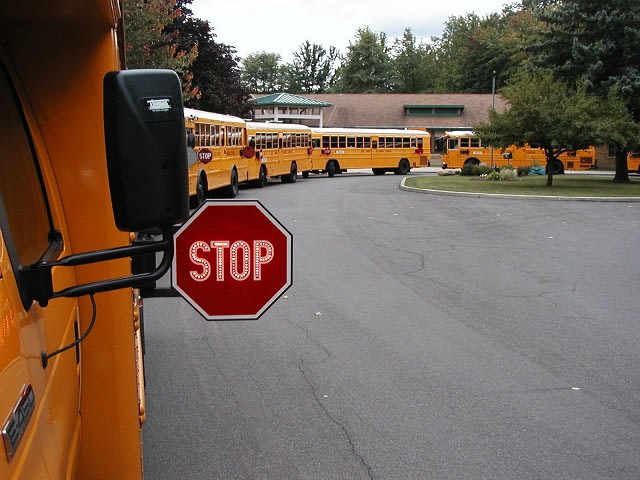
Lawmakers in Delaware and Utah have proposed legislation to combat stop-arm running, including measures such as external cameras on buses and increasing fines for offending motorists. Photo courtesy Michael Dallessandro
2 min to read
Lawmakers in Delaware and Utah have proposed legislation to combat stop-arm running, including measures such as external cameras on buses and increasing fines for offending motorists. Photo courtesy Michael Dallessandro
Lawmakers in two states recently proposed legislation that includes measures such as external cameras on buses and increasing fines for offending motorists in an effort to combat illegal school bus passing.
On Tuesday, lawmakers in Delaware approved House Bill 202 to create a pilot program that would allow Red Clay Consolidated School District to use external school bus cameras to capture stop-arm violations and issue fines to offending motorists. The program would require the district to display reflective tape that states “Violation for Passing When Red Lights Flashing” on the front and back of buses that are equipped with the cameras. The program would also require the district to make one public service announcement each year informing motorists about the use of the cameras.
Under HB 202, stop-arm violators would incur a $100 fine for a first offense and $500 for any subsequent offense within 10 years of a prior offense. The revenue collected from the fines would be used to further fund the operation of the pilot program.
As School Bus Fleet previously reported, the bill’s sponsor, Rep. Kim Williams, introduced similar legislation in March that would allow all school districts and charter schools in Delaware to install external camera systems on buses to capture stop-arm violations. House Bill 111 was voted out of the House Education Committee on April 10 and is now awaiting its third and final reading, according to the Delaware General Assembly’s website.
HB 202 is awaiting approval from Gov. John Carney.
Meanwhile, in Utah, Rep. Craig Hall introduced a bill that would increase penalties for stop-arm running.
House Bill 84 would raise the minimum fine for passing a school bus for the first time from $100 to $250 and from $200 to $500 for a second time within three years of a prior offense. A third violation would be a fine of $1,000 within three years of a prior offense.
The bill was submitted to the House on Jan. 16, according to the Utah State Legislature’s website. The state's 2020 legislative session is expected to begin on Jan. 27.
More Safety

How to Build a Better School Bus Driver Training Program
Is it time to strengthen your driver training? Here’s how to pick the right talent and improve recruitment, retention, and safety. This video is brought to you by IC Bus.
Read More →
Recent School Bus Accidents Leave 2 Dead, 2 Injured
Four school bus crashes in Florida, Illinois, and Georgia highlight risks in transportation lots, at bus stops, and during student loading and unloading.
Read More →
Sponsored•September 8, 2026
When Every Second Matters, Clarity Keeps Routes Moving
From routine delays to urgent incidents, strong communication practices help drivers, dispatchers, schools, and families respond with confidence.
Read More →

What Happens When a School Bus Catches Fire — and What Can Help
School bus fires are rare but can be devastating. Learn how advances in fire suppression and asset protection help fleets detect fires earlier, reduce damage, and improve safety.
Read More →
Geotab Launches Tool to Help Fleets Investigate Road Incidents
Geotab Investigations combines telematics data, video, documents, and other evidence to help fleets reconstruct incidents, resolve claims, and determine what happened.
Read More →
Texas Sixth Grader Wins 2026 National School Bus Safety Poster Contest
Sai Darshana Yekolu of Moseley Middle School in Prosper, Texas, was named the newest winner for her artwork, bringing the theme of “Safe Rides, Everyday Heroes” to life.
Read More →
Sponsored•August 27, 2026
Doing More With Less: How Transportation Directors Can Prioritize Safety Amid Budget Uncertainty
With diesel prices soaring and nearly one-third of transportation directors expecting budget cuts, maintaining student safety has never been more challenging. Download this guide to learn how leading districts are prioritizing risk, funding critical safety technology, and building stronger budget cases with data.
Read More →
Walton County Schools Adds Gatekeeper Stop-Arm Enforcement System
The Florida district will deploy Gatekeeper’s updated Student Protector technology, which now incorporates AI to improve video evidence.
Read More →
How To Build a More Secure School Bus Yard During and After Hours
As thefts and overnight security threats continue, school transportation leaders are combining stronger operational practices with AI-enabled surveillance to better protect buses, facilities, and staff.
Read More →
FMCSA Names New Chief Safety Officer: What School Bus Operators Should Know
Steve Dowling is set to lead the federal agency's efforts to advance commercial motor vehicle safety and reduce crashes, fatalities, and injuries on the nation's roadways.
Read More →