




Related: 4 Keys for Enforcing Seat Belt Use
NAPT Session Examines Benefits of Seat Belts on School Buses
Seat belts have evolved considerably over the last few decades and now offer behavior and safety benefits, presenters said.

Nicole Schlosser・Former Executive Editor
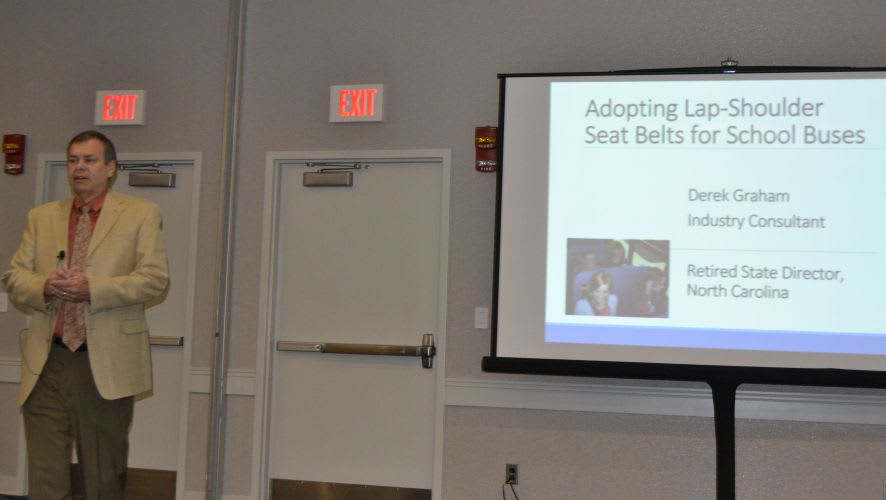
Derek Graham, a consultant and the former state director for North Carolina, discussed the history of pupil transportation's relationship with seat belts on buses and their safety and behavior benefits.
5 min to read
Derek Graham, a consultant and the former state director for North Carolina, discussed the history of pupil transportation's relationship with seat belts on buses and their safety and behavior benefits.
COLUMBUS, Ohio — Seat belts have evolved considerably over the last few decades and now offer more benefits than just keeping kids safe, one session revealed at the National Association for Pupil Transportation’s (NAPT’s) annual conference on Monday.
Derek Graham, a consultant and the former state director for North Carolina, took attendees through the history of pupil transportation's relationship with seat belts on buses, which began with lap belts. The thinking for some time was that compartmentalization — the closely spaced, high-back, padded seats designed to absorb impact — was sufficient protection for students.
In particular, many thought that lap belts, which were the only choice available before 2003, were too expensive, would cause abdominal injuries and whiplash, and be used as weapons by students.
“That was the song we were singing for a long time,” Graham said. “But the song has changed.”
In 2003, North Carolina rolled out lap-shoulder belts on a total of 13 buses in 11 school districts. Although student safety was improved, a downside was that the seats were fixed capacity. Five students per row (three on one side and two on the other) resulted in reduced capacity at the elementary school level, Graham said.
However, four years later, the reduced capacity issue started getting solved, Graham added, with flexible seating accommodating either two or three students per 39-inch seat. Unfortunately, Graham noted, the following year, 2008, the Great Recession hit, and the state couldn’t purchase more seat belts for buses until 2015.
Behavior improvements have also resulted from adding seat belts, he said.
A bus driver in Cumberland County, N.C., following his first year driving a bus with the lap-shoulder belts was the “best year ever in his 15 years driving a bus” because of improved student behavior. He also reported that his fellow drivers were asking when they could get seat belts on their buses.
Additionally, a technician who worked for a school district in the state commented at a conference that when lap-shoulder belts were added to buses at his district, he expected students to vandalize the belts and seats, but the actual result was better-behaved students. One school bus driver even reconsidered quitting her job because of the significantly positive behavior change on her bus.
Still, flexible seating continued to evolve, and then in 2014, the National Association of State Directors of Pupil Transportation Services changed from supporting lap-shoulder belts if there was funding for them to supporting them regardless of funding.
And on the heels of that shift, Graham said, was a pivotal statement in 2015 on lap-shoulder belts from Dr. Mark Rosekind, the administrator of the National Highway Transportation Safety Administration at the time: “School buses should have seat belts. Period.”
“That rocked our world,” Graham said.
Soon after, in 2017, the National Transportation Safety Board for the first time recommended that states require lap-shoulder belts in school buses as a result of its investigations into the fatal Chattanooga, Tenn., and Baltimore crashes that occurred in 2016.
Graham then outlined which states require seat belts and to what degree. New York has required lap belts as a minimum since 1987; New Jersey joined in 1993 as did Florida in 2001; Louisiana jumped on board with a seat belt requirement if funding was available, although financial support “was never in the picture,” Graham said.
California has required seat belts since 2005. Jumping ahead more than 10 years to 2017, Nevada adopted the requirement, and Arkansas also passed one for school buses to come with seat belts if 10% of voters petition for a local vote for them and it passes. Meanwhile, Texas put the lap-shoulder belt requirement in place unless a school board explains in a public meeting that the district can’t afford them. The following year, New Jersey upgraded its 1993 law from requiring lap belts to lap-shoulder belts after the fatal Mount Olive crash.
Most recently, Iowa began requiring seat belts on all new school buses as of Oct. 2.
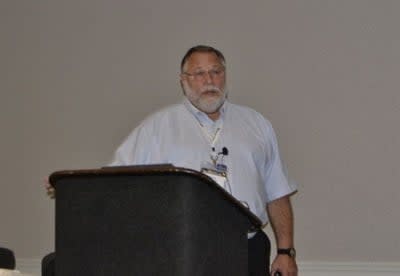
Chris Darling, executive director of the Iowa Pupil Transportation Association, explained to attendees how a recent school bus evacuation demonstration showed that students wearing seat belts on the bus can evacuate in a timely manner.
Chris Darling, executive director of the Iowa Pupil Transportation Association, explained to attendees how a recent school bus evacuation demonstration, conducted with students at the association’s annual conference in July, showed members that students wearing seat belts on the bus can evacuate in a timely manner.
Darling explained that the students, who had never ridden a school bus before, evacuated the bus in one minute and six seconds the first time, and were even faster the second time, completing evacuation in 42 seconds.
“That told us two things,” Darling said. “One: students wearing seat belts can evacuate in a reasonable period of time. Two: they can evacuate even faster with practice.”
Graham suggested that districts making an investment in equipping school buses with seat belts plan which buses and routes will get the belts first and form a plan for the beginning of the rollout for responses to parents who want to know why only some buses have seat belts.
He also advised attendees to put a procedure for enforcement in place, pointing to Helena (Mont.) Public Schools, which requires bus drivers to do two things: remind students every morning to buckle up and every afternoon before leaving school, to check to ensure all students are wearing a seat belt.
Graham added that he is not aware of any cases in which a school bus driver would be held liable in a situation in which a student was not wearing a seat belt.
More Safety

How to Build a Better School Bus Driver Training Program
Is it time to strengthen your driver training? Here’s how to pick the right talent and improve recruitment, retention, and safety. This video is brought to you by IC Bus.
Read More →
Recent School Bus Accidents Leave 2 Dead, 2 Injured
Four school bus crashes in Florida, Illinois, and Georgia highlight risks in transportation lots, at bus stops, and during student loading and unloading.
Read More →
Sponsored•September 8, 2026
When Every Second Matters, Clarity Keeps Routes Moving
From routine delays to urgent incidents, strong communication practices help drivers, dispatchers, schools, and families respond with confidence.
Read More →

What Happens When a School Bus Catches Fire — and What Can Help
School bus fires are rare but can be devastating. Learn how advances in fire suppression and asset protection help fleets detect fires earlier, reduce damage, and improve safety.
Read More →
Geotab Launches Tool to Help Fleets Investigate Road Incidents
Geotab Investigations combines telematics data, video, documents, and other evidence to help fleets reconstruct incidents, resolve claims, and determine what happened.
Read More →
Texas Sixth Grader Wins 2026 National School Bus Safety Poster Contest
Sai Darshana Yekolu of Moseley Middle School in Prosper, Texas, was named the newest winner for her artwork, bringing the theme of “Safe Rides, Everyday Heroes” to life.
Read More →
Sponsored•August 27, 2026
Doing More With Less: How Transportation Directors Can Prioritize Safety Amid Budget Uncertainty
With diesel prices soaring and nearly one-third of transportation directors expecting budget cuts, maintaining student safety has never been more challenging. Download this guide to learn how leading districts are prioritizing risk, funding critical safety technology, and building stronger budget cases with data.
Read More →
Walton County Schools Adds Gatekeeper Stop-Arm Enforcement System
The Florida district will deploy Gatekeeper’s updated Student Protector technology, which now incorporates AI to improve video evidence.
Read More →
How To Build a More Secure School Bus Yard During and After Hours
As thefts and overnight security threats continue, school transportation leaders are combining stronger operational practices with AI-enabled surveillance to better protect buses, facilities, and staff.
Read More →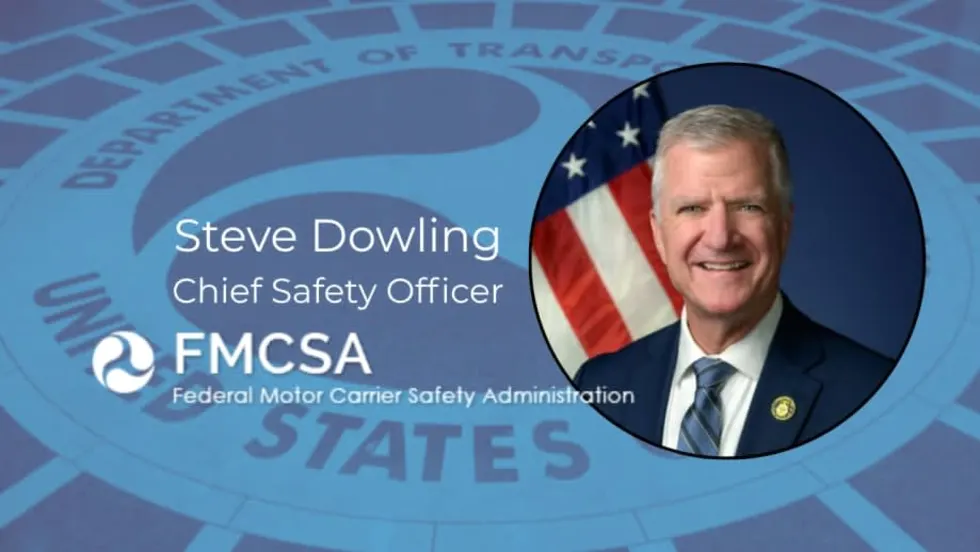
FMCSA Names New Chief Safety Officer: What School Bus Operators Should Know
Steve Dowling is set to lead the federal agency's efforts to advance commercial motor vehicle safety and reduce crashes, fatalities, and injuries on the nation's roadways.
Read More →