




4 Keys for Enforcing Seat Belt Use
Although buckling up is a habit for many kids, bus drivers need a policy, training, and community support behind them for successful enforcement. Convertible seats help with implementation.

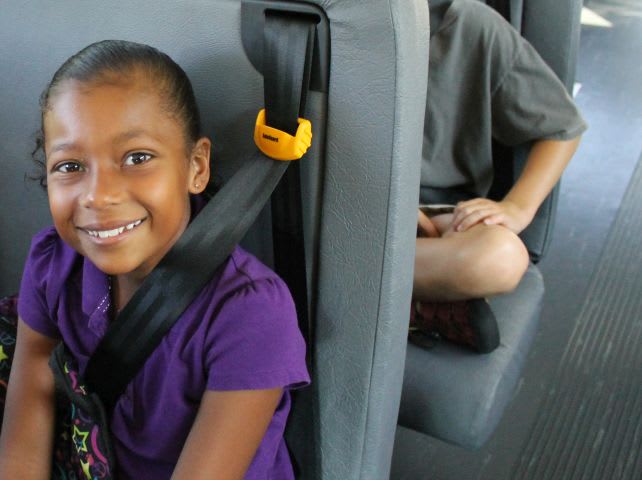
A concern that many school bus drivers and districts have is over their responsibility in making sure students buckle up, and what happens if they don’t.
Photo: IMMI/SafeGuard
Calls for legislation requiring seat belts on school buses have increased recently. Texas and Nevada signed bills into law requiring lap-shoulder belts (also known as three-point belts) on new school buses (although Texas school districts can opt out due to financial constraints). Meanwhile, lawmakers in many other states have introduced school bus seat belt legislation that hasn’t passed.
Additionally, Tennessee Congressman Steve Cohen introduced a national bill in late 2016 that would create federal grants to equip school buses with three-point belts.
Lap-shoulder belts have been required on new school buses in California for over 10 years. Florida, New Jersey, and New York require lap belts.
There are also pilot projects taking place in Iowa and North Carolina to determine the costs and benefits of equipping school buses with lap-shoulder belts.
A concern that many school bus drivers and districts have is over their responsibility in making sure students buckle up, and what happens if they don’t. Community support, a policy that outlines consequences and driver responsibility, and training can help drivers successfully enforce seat belt use. Easy seat convertibility has also proven helpful for implementation.
1. Seek Community, Stakeholder Support
Ideal lap-shoulder belt implementation involves the entire community. It should be supported by everyone who will be affected by the decision, says Charlie Vits, market development manager for IMMI’s seating and restraint supplier SafeGuard. That includes not only district leadership (the superintendent, school board, principal, and transportation department), but also contractors, parents, first responders, other community members, and even the students.
“Everyone [should have] the same understanding that the belts are there to increase student safety on the bus and it is expected that all students will wear them,” Vits explains.
The Helena (Mont.) Public Schools board and community supported seat belt use, which made it easier to add lap-shoulder belts in 2012 and to enforce their use, says Tom Cohn, manager of transportation for the district. The district gathered support from the school board in public meetings and in sessions with parents, teachers, and board members.
“The first part was getting information out to parents and letting them know what seat belts accomplish for us,” Cohn says. “After that, it was a downhill slide.”

HSM’s convertible NextGen seat, built exclusively for Blue Bird buses, is designed to let customers change the seat back frame to include a three-point or child-restraint seat without having to buy new seats for reinstallation.
Photo: HSM
2. Create Policy, Procedure with Consequences
The most critical factor in successful lap-shoulder belt use on school buses is establishing an enforceable usage policy as part of school bus rider behavior rules, Vits says. Moreover, the policy should state that a student’s noncompliance will have consequences.
In many cases, though, compliance hasn’t proven to be much of a problem with younger students.
“When young children get on a school bus for the first time, and there are lap-shoulder belts, they just put them on,” says Donna Anderson, transportation consultant at the California Department of Education. “They just got out of a car with [seat belts].”
However, older students may have had several years of experience without being required to wear seat belts on the bus.
“Suddenly telling a junior high student to buckle up is going to be difficult,” Vits says. “That’s where the need for an enforceable usage policy comes in. As long as Johnny realizes there are consequences for not being compliant, he’s going to cooperate.”
Helena Public Schools created a procedure for three-point belt use instead of a policy, because it would be more flexible for any tweaks needed as technology evolves, allowing changes to go into effect almost immediately, Cohn says.
“When we create a procedure, it can be fluid. A policy is a recorded document in the school district.”
The district’s procedure is pretty cut-and-dry: Drivers enforce seat belt use, or they don’t get to drive, and students wear the belts, or they don’t get to ride.
Montana law also bolsters the procedure: If a seat belt is provided in a vehicle, a passenger has to wear it.
The procedure is outlined in the district’s handbook, created with its school bus contractor, First Student. Drivers are trained every year on instructing students to wear the belts.
Drivers instruct students every morning as they board the bus, at every stop, to put on their seat belt, Cohn says. In the afternoon, just before leaving school, the driver walks to the rear of the bus and back to the front, checking to make sure that every student is wearing a seat belt.
If a student refuses to wear their seat belt, they are briefly suspended from the bus, for a first offense. If they continue to refuse to wear their belt, that can become a year-long suspension.
3-Point Belts on Buses: Real-World Experience Mitigates Most Concerns
Meanwhile, drivers are told that they are required to enforce seat belt use to drive for Helena Public Schools.
“We have very little issue with our drivers because they understand the added safety of seat belts and do as good a job as they can to make sure the kids are wearing their belts,” Cohn says.
The transportation department has had to turn down very few prospective drivers because they will not enforce seat belt use. The department works with drivers who have trouble getting students to wear the belts. Most drivers want students to wear the belts, Cohn says, because when they do, the need for discipline goes down considerably.
In California, enforcing seat belt use is required of drivers. Moreover, the school district governing board is required to provide disciplinary consequences when a child continually refuses to submit to the authority of a driver.
Although California Vehicle Code indicates that a driver cannot be issued a citation if a student isn’t wearing his or her seat belt, that does not mitigate the driver’s liability, Anderson says. It doesn’t have to be the driver who instructs the students, but the fact that three-point belts are required to be used puts some liability on the driver as well as the carrier, she adds.
In California, all passengers on a school bus with seat belts need to be instructed in proper fastening and release; placement on students; times when the belts should be fastened and released; and placement of the belts when not in use.
“It is up to each pupil transporter how they provide that information, but at minimum, it should be based on the manufacturer’s recommendations,” Anderson says.
The only required uniformity in instructing students is explaining related terms, such as latch plate and buckle, providing information for how to conduct training, and documenting that instruction. Anderson recommends telling every driver what to include in their speech, so they can give all students consistent instruction.
3. Train on Technology
Drivers also need to be educated on the latest school bus lap-shoulder belt system technology and disabused of popular myths, such as students using the belts as weapons, Vits says.
However, he adds, when drivers understand the design of the new belts, it’s much easier for them to encourage students to use them properly.
With older belt technology, some of the heavy metal buckles were on long straps. Since 2011, there has been a limit on the length of the strap with the buckle, whether on a lap belt or a lap-shoulder belt, Vits says.
“On the new belt systems, the buckle barely comes out of the seat,” he explains. “It’s essentially impossible to swing them.”
The latch plate, he adds, is lightweight and on a retractor, so a student who wants to hit another student with the belt would find it difficult to pull it out of the retractor and against the retracting force to swing it.
SafeGuard provides a variety of training materials for seat belt use and maintenance, such as its user’s manual, online documents, videos, and links to other support sources. The supplier also offers onsite training with a representative.
Starting in October, HSM will offer training and seminars across the U.S. on its NextGen convertible seat, and is developing training and instructional videos as well as online classes and seminars upon request, says Tony Everett, president of HSM Transportation & Specialty Manufacturing Co. (formerly the C.E. White Co.). One video series will cover correct use and installation of the seats and belts, and the other will instruct on changing the covers and the belts.

The convertibility of SynTec Seating Solutions’ SC3 seats with lap-shoulder belts was a particular advantage when the supplier partnered with Des Moines (Iowa) Public Schools in 2016 on a seat belt use test.
Photo: SynTec
4. Consider Convertible Seating
The convertibility of SynTec Seating Solutions’ SC3 seats with lap-shoulder belts was a particular advantage when it partnered with Des Moines (Iowa) Public Schools in late 2016 on a lap-shoulder belt use test.
SynTec outfitted two buses with the three-point belt seats, says Shane Wright, dealer account manager for the company.
SynTec wanted to show that the convertibility of its seats now offers more flexibility with the option to add lap-shoulder belts should state or federal law change, Wright adds.
“Compartmentalization [works well when students] sit correctly in the seats, and if this helps keep them positioned in the seats correctly, it’s a plus,” he says.
Through bus video, the district compared the students’ behavior with the belts and previously without them.
The district instructs its drivers to remind students to buckle up as often as they think reminders are needed, but at least once, says Todd Liston, transportation director for Des Moines Public Schools. If students refuse, that is treated the same as breaking any other bus rule.
Although some middle school students needed to be reminded to wear the belts, overall compliance was better than expected, and having the seat belts on the bus contributed to more positive student behavior, Liston says.
The convertibility of the seats was a significant factor for the district’s transportation department in deciding to take part in the study, he points out.
“If … there was negative feedback, changing the seats back to standard non-belted was not going to be prohibitively expensive.”
HSM’s convertible NextGen seat, built exclusively for Blue Bird buses, is designed to let customers change the seat back frame to include a three-point or child-restraint seat without having to purchase new seats for reinstallation. It is also designed to be more comfortable by incorporating automotive technologies, Everett says.The NextGen belts now retract into the seat, and the company removed the fold-out flap to improve aesthetics, functionality, and comfort. The seat covers can also be changed 25% faster than the previous generation of seat belt covers, according to HSM.
Another convertible seating option is the SafeGuard BTI seating system for IC Bus, with seat back versions that include lap-shoulder belts, integrated child seats, and latch anchorages for child seat attachment.
Safety First: Evolution of Seat Belt Laws on U.S. School Buses
More Safety

How to Build a Better School Bus Driver Training Program
Is it time to strengthen your driver training? Here’s how to pick the right talent and improve recruitment, retention, and safety. This video is brought to you by IC Bus.
Read More →
Recent School Bus Accidents Leave 2 Dead, 2 Injured
Four school bus crashes in Florida, Illinois, and Georgia highlight risks in transportation lots, at bus stops, and during student loading and unloading.
Read More →
When Every Second Matters, Clarity Keeps Routes Moving
From routine delays to urgent incidents, strong communication practices help drivers, dispatchers, schools, and families respond with confidence.
Read More →

What Happens When a School Bus Catches Fire — and What Can Help
School bus fires are rare but can be devastating. Learn how advances in fire suppression and asset protection help fleets detect fires earlier, reduce damage, and improve safety.
Read More →
Geotab Launches Tool to Help Fleets Investigate Road Incidents
Geotab Investigations combines telematics data, video, documents, and other evidence to help fleets reconstruct incidents, resolve claims, and determine what happened.
Read More →
Texas Sixth Grader Wins 2026 National School Bus Safety Poster Contest
Sai Darshana Yekolu of Moseley Middle School in Prosper, Texas, was named the newest winner for her artwork, bringing the theme of “Safe Rides, Everyday Heroes” to life.
Read More →
Doing More With Less: How Transportation Directors Can Prioritize Safety Amid Budget Uncertainty
With diesel prices soaring and nearly one-third of transportation directors expecting budget cuts, maintaining student safety has never been more challenging. Download this guide to learn how leading districts are prioritizing risk, funding critical safety technology, and building stronger budget cases with data.
Read More →
Walton County Schools Adds Gatekeeper Stop-Arm Enforcement System
The Florida district will deploy Gatekeeper’s updated Student Protector technology, which now incorporates AI to improve video evidence.
Read More →
How To Build a More Secure School Bus Yard During and After Hours
As thefts and overnight security threats continue, school transportation leaders are combining stronger operational practices with AI-enabled surveillance to better protect buses, facilities, and staff.
Read More →
FMCSA Names New Chief Safety Officer: What School Bus Operators Should Know
Steve Dowling is set to lead the federal agency's efforts to advance commercial motor vehicle safety and reduce crashes, fatalities, and injuries on the nation's roadways.
Read More →