




Related: Utah, Minnesota Seek to Require Seat Belts on New School Buses
Iowa May Require Seat Belts on New School Buses
The State Board of Education is reviewing a rule change that would start requiring lap-shoulder belts in all new school buses. If approved, the rule could go into effect in October.

Nicole Schlosser・Former Executive Editor
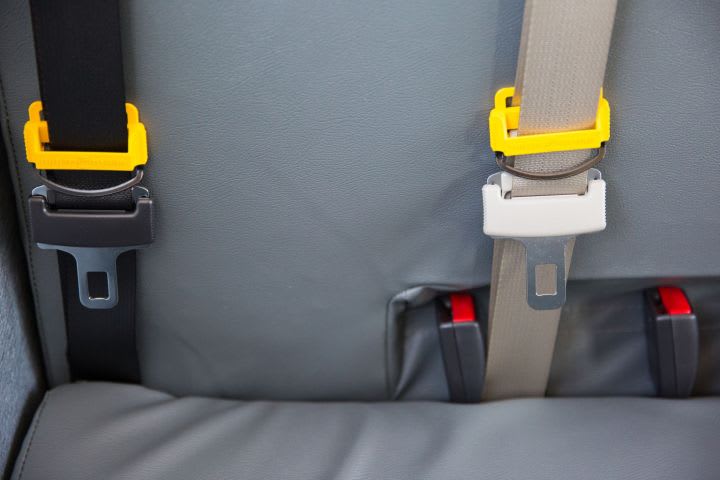
Iowa's State Board of Education State Board of Education is reviewing a rule change that would start requiring lap-shoulder belts in all new school buses, possibly as soon as October.
4 min to read
Iowa's State Board of Education State Board of Education is reviewing a rule change that would start requiring lap-shoulder belts in all new school buses, possibly as soon as October.
DES MOINES, Iowa — Iowa may soon follow in the footsteps of several other states that require seat belts on school buses.
The Iowa Department of Education recommended a rule change to require lap-shoulder, also known as three-point, belts in all new school buses to the State Board of Education in May, Max Christensen, an executive officer for school transportation at the Iowa Department of Education, told School Bus Fleet.
Currently, the rule does not recommend or require seat belts on school buses in the state, but if a school district or school bus company chooses to install them, they must use lap-shoulder belts.
A public hearing was held on the recommendation on Tuesday, and the Department of Education will take the rule to the Administrative Rules Review Committee (ARRC) for approval on July 9.
If the rule change is approved, the State Department of Education will then seek final approval from the State Board of Education, and then the change goes back once more to the ARRC for final approval.
If approved, the rule likely would go into effect sometime in October, Christensen said.
Some districts in Iowa already have the requirement in place. As of February, 15 out of 333 school districts in the state now require three-point belts in all new school buses, he added.
Support for the requirement has been culminating locally and nationally since 2014, when the National Association of State Directors of Pupil Transportation Services (NASDPTS) published its position paper in support of the installation and use of lap-shoulder belts.
“We (NASDPTS) stopped just short of recommending they be required, but at the time, we took our position as far as we believed we could at the time,” Christensen, who is also the Iowa state director and past president of NASDPTS, said. “Yet that paper did reignite the ‘great seat belt debate’ and has been, I believe, quite critical in moving the discussion forward.”
Additionally, with the National Transportation Safety Board (NTSB) coming out with its recommended requirement in May 2018 that all new buses be equipped with three-point belts and a successful Des Moines Public Schools pilot in 2016, both just helped to cement the Iowa Department of Education’s recommendation of the rule change, he added.
“It appears the time has come for the rest of our state to, at the very least, take a look at making lap-shoulder belts a requirement in all new school buses,” Christensen said. “It seems that children will just be safer and more secure with lap-shoulder belts in our school buses.”
Christensen added that the school transportation industry has had an ongoing debate about seat belts in buses for at least 30 years, and although at one time installing them in buses did not make sense, equipment has since evolved, and adding the belts is now more affordable.
“Over the course of the last 10 years or so, with the advent of the flexible seating lap-shoulder belts that are now available, all the old arguments have gone away,” Christensen said. “The cost has come down. It would be nearly impossible to use the belts as weapons. And finally, with the flex seating designs, there is no longer a reduction in capacity. Compartmentalization is great, but it's not enough, as it's very ineffective in side impacts or rollovers.”
Merrill Mueller, the transportation director for Algona Community School District, has backed lap-shoulder belts in school buses since last spring when two of his school buses collided, he told KCCI.
"Seeing what can happen to young kids in car accidents or bus accidents and knowing there's something out there we can do to prevent this drive me," he told the news source.
KCCI also reports that installing the seat belts will cost $8,000 per bus, and that Christensen told the news source that, when factoring in the life of a school bus, the cost is approximately 4 cents a day.
Other states requiring seat belts in school buses are New Jersey, New York, Florida, Nevada, and California. Texas requires three-point belts unless the district's board of education determines that the district can't afford it. Louisiana passed a school bus seat belt bill, but it is contingent on funding being allocated to pay for the restraints. Since the mandate remains unfunded, it has not been enforced.
More Safety
Illegal School Bus Passing Drops 24% in New York Districts
With fewer than 5% of citations involving repeat offenders, Westchester County officials said enforcement, education, and community partnerships are helping change driver behavior.
Read More →
School's Back. Here's What Happened to Traffic, Speeding & Distraction
What happens to traffic when school resumes? New data analysis examines changes in distracted driving, congestion, and speeding around schools.
Read More →
Geotab Expands Fleet Safety Tools With Video Coaching, Risk Insights
New safety and video capabilities aim to help fleet managers assess risk, support drivers, and take targeted action through video coaching, red-light violation detection, and more.
Read More →
How to Build a Better School Bus Driver Training Program
Is it time to strengthen your driver training? Here’s how to pick the right talent and improve recruitment, retention, and safety. This video is brought to you by IC Bus.
Read More →
Recent School Bus Accidents Leave 2 Dead, 2 Injured
Four school bus crashes in Florida, Illinois, and Georgia highlight risks in transportation lots, at bus stops, and during student loading and unloading.
Read More →
When Every Second Matters, Clarity Keeps Routes Moving
From routine delays to urgent incidents, strong communication practices help drivers, dispatchers, schools, and families respond with confidence.
Read More →
What Happens When a School Bus Catches Fire — and What Can Help
School bus fires are rare but can be devastating. Learn how advances in fire suppression and asset protection help fleets detect fires earlier, reduce damage, and improve safety.
Read More →
Geotab Launches Tool to Help Fleets Investigate Road Incidents
Geotab Investigations combines telematics data, video, documents, and other evidence to help fleets reconstruct incidents, resolve claims, and determine what happened.
Read More →
Texas Sixth Grader Wins 2026 National School Bus Safety Poster Contest
Sai Darshana Yekolu of Moseley Middle School in Prosper, Texas, was named the newest winner for her artwork, bringing the theme of “Safe Rides, Everyday Heroes” to life.
Read More →
Sponsored•August 27, 2026
Doing More With Less: How Transportation Directors Can Prioritize Safety Amid Budget Uncertainty
With diesel prices soaring and nearly one-third of transportation directors expecting budget cuts, maintaining student safety has never been more challenging. Download this guide to learn how leading districts are prioritizing risk, funding critical safety technology, and building stronger budget cases with data.
Read More →