




36 Georgia districts awarded for cutting bus emissions
The districts were honored at the Georgia Association for Pupil Transportation’s 50th Annual Conference & Trade Show last month with the Georgia Diesel Emissions Reduction Awards. Three districts were recognized for reducing emissions in 75% or more of their school bus fleet.

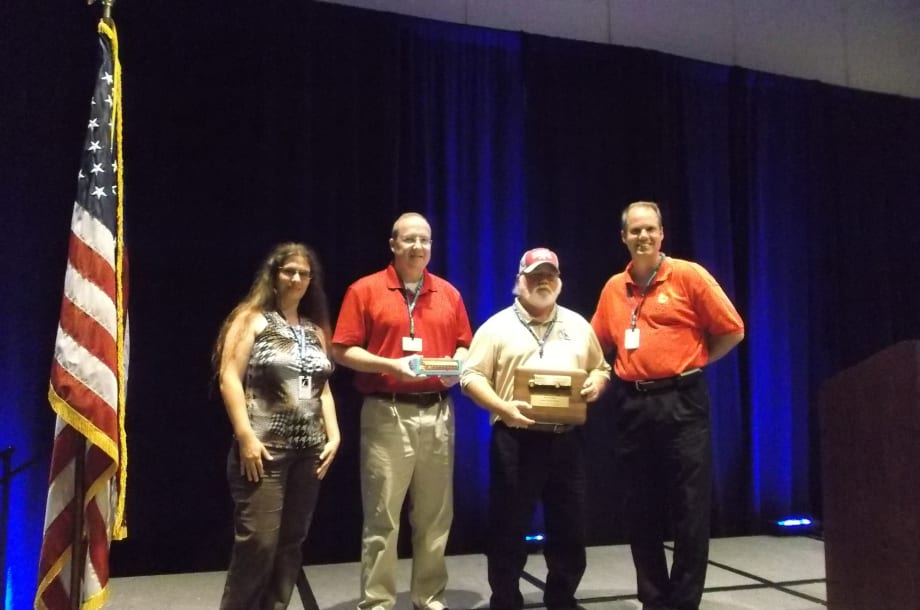
Newton County Schools received a GaDER Blue Sky Award for cutting emissions in at least 75% of its school bus fleet. Pictured left to right: Stacy Allman, EPD environmental specialist and coordinator of the GaDER Program; Michael Barr, director of support services, Newton County School System; Randall Luna, transportation coordinator, Newton County School System; and William Cook, EPD environmental engineer and manager of the GaDER Program.
School districts were honored at the Georgia Association for Pupil Transportation’s (GAPT) 50th Annual Conference & Trade Show at Jekyll Island, Georgia, last month, when the Georgia Environmental Protection Division (EPD) presented 36 school district systems with the Georgia Diesel Emissions Reduction (GaDER) Awards.
The Blue Sky Award is the highest achievement offered in the GaDER Program and is awarded to school systems that have reduced emissions in 75% or more of their school bus fleet.
The following school districts were recipients of the Blue Sky Award: Atlanta Public Schools, Henry County Schools and Newton County Schools.
The GaDER Gold Award is awarded to school systems that have reduced emissions in 26% to 74% of their school bus fleet through early replacement of buses, installation of emissions control equipment and/or the use of alternative fuels.
The following school systems were recipients of the GaDER Gold Award:
• Banks County Schools
• Barrow County Schools
• Bartow County School System
• Bibb County School District
• Burke County Public School System
• Carroll County Schools
• Clarke County Schools
• Clayton County Public Schools
• Cobb County School District
• Coweta County School System
• DeKalb County School District
• Dooly County Schools
• Fayette County Schools
• Gordon County Schools
• Griffin-Spalding County School System
• Gwinnett County Public Schools
• Jackson County School System
• Madison County School District
• Marietta City Schools
• Muscogee County School District
• Pickens County Schools
• Rockdale County Public Schools
• Walker Schools
• Washington County Public Schools
The GaDER Green Award is awarded to school systems that have reduced emissions in 25% or less of their school bus fleet through installation of emissions control equipment and/or the use of alternative fuels.
The following school systems were recipients of the GaDER Green Award:
• Appling County School District
• Cherokee County School District
• Floyd County Schools
• Fulton County Schools
• Hall County Schools
• Houston County School System
• Jeff Davis County Schools
• Monroe County Schools
• Richmond County School System
Division representatives attended this year’s GAPT Conference to present the GaDER Awards.
“Older diesel buses emit a high amount of particles in the exhaust,” said William Cook, EPD environmental engineer and manager of the GaDER Program. “New buses and those that have been retrofitted with diesel particulate filters reduce these particulates by more than 85%, which results in a significant improvement in the air quality inside and around the school bus. Transportation directors and their staff who receive a GaDER award should be celebrated for their hard work and dedication to ensure that schoolchildren are riding in the safest and cleanest buses available.”
The GADER School Bus Program assists Georgia school systems by offering grants, technical assistance and education.
More Alternative Fuels

CALSTART and Forth Combine to Form Catalyst Mobility
The new name represents a renewed vision for the nonprofit focused on advancing clean, equitable, and affordable transportation solutions that move people and goods.
Read More →
Alt-Fuel Moves: New Buses, Charging Hubs & Real-World EV Testing
Propane and electric school bus deployments continue to grow as districts add new vehicles, expand charging infrastructure, and gather more real-world operating data.
Read More →
Fewer Electric School Bus Models Reshape the U.S. Market
WRI’s latest buyer’s guide points to a consolidating electric school bus market, but fewer options may reflect a maturing industry rather than fewer meaningful choices for school bus operators.
Read More →
The Fuel Budget You Can Actually Predict: How Propane Autogas Keeps Money in the Classroom
Learn how propane autogas helps school districts manage fuel costs with predictable pricing, lower maintenance, and reduced emissions from former transportation director Joel Stutheit.
Read More →
Hendrickson, Driventic Introduce New Electric Powertrain for School Buses
ELECTRAAX, the electrified, lightweight drive axle offers integrated ePowertrain efficiency and modular flexibility for Class 6–7 school bus use.
Read More →
The Mobility House Joins PowerFlex in Fleet Electrification Deal
The acquisition combines intelligent charging software, bidirectional charging expertise, and fleet electrification services to support the growing adoption of electric school buses across North America.
Read More →
Alt-Fuel Moves: Electric School Bus Investments Hit the Road
See which districts across the U.S. are putting electric school buses into service, expanding charging infrastructure, and planning the next phase of fleet electrification.
Read More →
With Fuel Volatility Ahead, School Districts Turn to Propane
While diesel prices peaked above $5 this spring, districts with propane autogas-powered fleets paid under $2 per gallon, according to PERC.
Read More →
EPA Unveils Proposed Changes to 2027 Heavy-Duty Engine Rules
The federal agency has proposed changes to next year’s targets that would eliminate DEF derates, ease warranty requirements, and retain current NOx emissions standards.
Read More →
Alt-Fuel Moves: EV Charging & Infrastructure Projects Gain Momentum
The latest developments include new funding, charging infrastructure, utility investments, and fleet technologies designed to support the transition to electric school buses nationwide.
Read More →