




Yellow buses are green
I haven't seen Al Gore's documentary An Inconvenient Truth, but I generally agree with the notion that climate change caused by human beings co...
I haven't seen Al Gore's documentary An Inconvenient Truth, but I generally agree with the notion that climate change caused by human beings could be damaging the environment. Which is why I try to ride a transit bus to work once a week, although it's, well, inconvenient.
The transit industry aggressively promotes the environmental benefits of its buses and trains. As an example, the American Public Transportation Association (APTA) recently held its second annual Dump the Pump Day, urging Americans to park their cars and use public transportation. "It is a day for people across the country to make a difference as they conserve gasoline and help our environment," APTA President Bill Millar said in a press release.
According to APTA, public transportation produces nearly 50 percent less carbon dioxide and nitrogen oxide per passenger mile as private vehicles. The association also reports that U.S. public transit systems save 1.4 billion gallons of gasoline every year, the equivalent of 300,000 cars filling up their tanks every day.
OK, so we know that transit buses and passenger railcars provide environmental benefits, but what about school buses?
It's an image thing
They do, of course; we just don't talk about it much. Maybe that’s because we've been regarded as polluters for so long. The image of black smoke spewing from the tailpipes of older school buses still lingers in the minds of many, but newer buses are much, much cleaner. And buses with 2007 engines burn even cleaner still.
Let's take a look at the environmental benefits of school buses. I'm going to throw out some very unscientific numbers for the sake of comparison. If we start with the premise that 25 million children ride school buses 180 times per year (yes, that’s probably on the high side in regard to an average student’s attendance). Then, I'm going to estimate that each child travels, say, 6 miles to and from school each day.
Now, let's say that all 475,000 school buses in the U.S. are parked for a year. Of the 25 million schoolchildren who ride each day, how many of them will be driven to school in an automobile? I'm going to guess 75 percent. The other 25 percent would walk, bike or use public transportation.
So, now we've got 18.75 million children getting rides to and from school 180 days a year, with the rides being approximately 6 miles total. According to my math, those 18.75 million cars are traveling 20.25 billion miles. If those cars average 18 miles per gallon, they would burn 1.125 billion gallons of gasoline in a year!
That's not pure excess, of course. You would have to subtract the amount of fuel used by the school buses that would otherwise transport those children. But the difference would still be immense. School buses, indeed, are contributing greatly to the planet’s sustainability.
Let's promote blue skies
As we all know, safety is the No. 1 benefit of riding in a school bus, but it's not the only benefit. We need to promote yellow school buses as "green," too.
School boards should be made aware that they are supporting the environment when they authorize funding for school bus transportation. In fact, they should be encouraged to bolster their investment. Every school bus that's on the road replaces dozens of cars — promoting safe student travel, reducing traffic congestion and, importantly, helping to preserve the environment for future generations. That's what I would call "a convenient truth."
More Alternative Fuels
Alt-Fuel Moves: Electric Bus Rollouts, Bidirectional Charging & Propane Growth
See which fleets are adding electric and propane school buses as districts and operators invest in charging infrastructure, bidirectional technology, and alternative-fuel expansion.
Read More →
Nobody Told Diesel Prices They Were Supposed to Come Down
With diesel prices surging, school bus fleets have new reason to stress-test fuel costs, consider diversification, and calculate what each route really costs to operate.
Read More →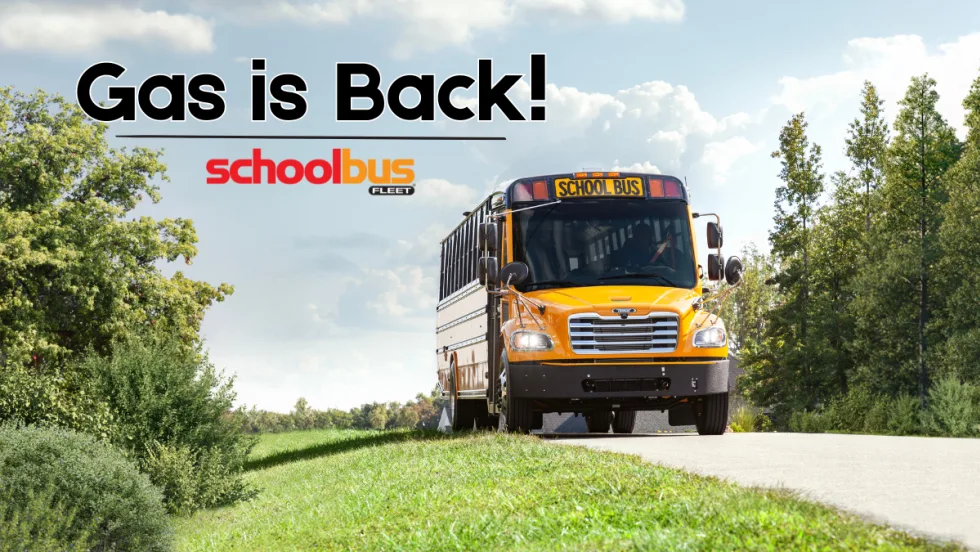
Why Gasoline School Buses Are Making a Comeback
Gasoline is gaining ground in full-size school buses. See how today’s options stack up against diesel on cost, maintenance, emissions, performance, and more.
Read More →
EPA Opens $180M DERA Funding Round for Diesel Upgrades
The 2026 Diesel Emissions Reduction Act program seeks applications from eligible organizations to accelerate the retirement of legacy diesel vehicles.
Read More →
The Secret Life of an Electric School Bus Battery
Batteries change throughout years of daily routes, but degradation doesn’t necessarily mean the end. Here’s what operators should know about performance, safety, and second life.
Read More →
CALSTART and Forth Combine to Form Catalyst Mobility
The new name represents a renewed vision for the nonprofit focused on advancing clean, equitable, and affordable transportation solutions that move people and goods.
Read More →
Alt-Fuel Moves: New Buses, Charging Hubs & Real-World EV Testing
Propane and electric school bus deployments continue to grow as districts add new vehicles, expand charging infrastructure, and gather more real-world operating data.
Read More →
Fewer Electric School Bus Models Reshape the U.S. Market
WRI’s latest buyer’s guide points to a consolidating electric school bus market, but fewer options may reflect a maturing industry rather than fewer meaningful choices for school bus operators.
Read More →
The Fuel Budget You Can Actually Predict: How Propane Autogas Keeps Money in the Classroom
Learn how propane autogas helps school districts manage fuel costs with predictable pricing, lower maintenance, and reduced emissions from former transportation director Joel Stutheit.
Read More →
Hendrickson, Driventic Introduce New Electric Powertrain for School Buses
ELECTRAAX, the electrified, lightweight drive axle offers integrated ePowertrain efficiency and modular flexibility for Class 6–7 school bus use.
Read More →