




Maintenance Must-Haves: School Bus Shop Products We Love in 2026
Tips for Ensuring School Bus Garages Are Safe and Warm Year-Round
Cold maintenance bays and rising heating costs? Learn how school bus garages can improve comfort with targeted heating, better airflow, and winter preparation.
by Jamie Tuinstra, Modine
October 14, 2026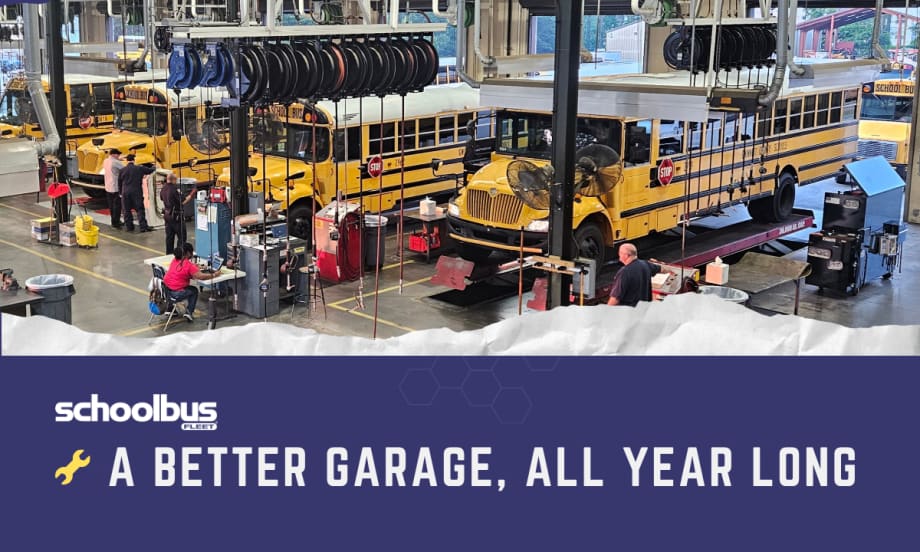
Keeping school bus garages comfortable isn't just about turning up the heat. Strategic heater placement, better airflow, and reducing heat loss can help maintenance teams stay productive while improving energy efficiency year-round.
Credit:
Gwinnett County Schools/School Bus Fleet
5 min to read
Early into the new school year, there is plenty of attention on classrooms, buses, and transportation schedules. But there’s another part of the equation that can be easy to overlook: the garages where those buses are inspected, repaired, and maintained.
These facilities can be challenging environments to keep comfortable. Large overhead doors open and close throughout the day. Ceilings are often high. Some bays may be busy for hours at a time, while others sit largely unused. And because buses are constantly moving in and out, outdoor conditions have a way of finding their way indoors.
That may not be much of a concern during mild weather. Once temperatures start dropping, however, those same characteristics can make it difficult to maintain consistent heat where mechanics, drivers, and other employees are actually working.
Why School Bus Garages Are Difficult to Heat
In many ways, a bus garage has the same problems as a warehouse, loading dock, or maintenance facility. The difference is how often some of those problems can occur at once.
Consider the overhead doors. Every time one opens to let a bus enter or leave, warm indoor air escapes and cold air moves in. During busy periods, particularly early in the morning or when buses return from their routes, those doors may be cycling fairly regularly.
High ceilings also create problems. Warm air rises naturally, and in a tall garage it can collect well above floor level. The heating system may be producing plenty of heat, but that doesn’t necessarily mean employees are benefiting from it.
Then there are the different areas within the building itself. A repair bay where mechanics are working throughout the day may need more consistent heat than a parts storage area. Offices or driver areas may have different needs altogether.
For facility teams, that makes uniform heating difficult. Turning up the thermostat across the entire garage may increase energy use without necessarily solving the cold spots that prompted the adjustment in the first place.
Heating the Areas That Need It Most
One way to approach the problem is with more targeted heating.
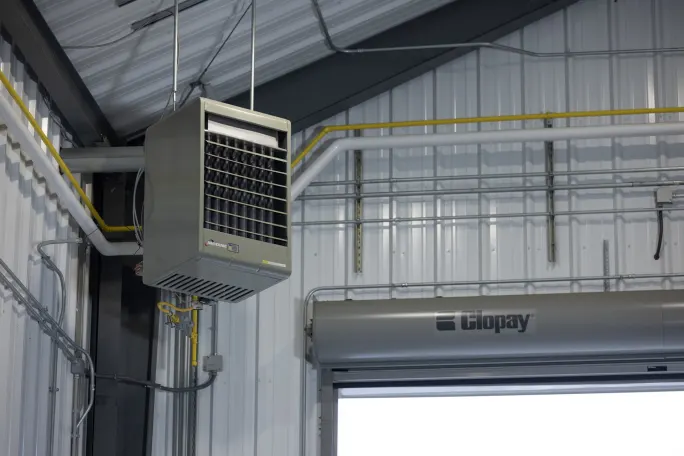
Strategic placement of unit heaters near garage doors and work areas can help offset heat loss and keep maintenance bays comfortable
Credit:
Modine
Unit heaters can be useful in bus garages because they provide heat directly to individual areas without requiring the entire building to be treated as a single zone. A heater can be positioned near a repair bay, workstation, or other area where employees spend extended periods of time.
This can also help near exterior doors, where heat loss is more likely to occur. Rather than forcing a central system to compensate every time a garage door opens, localized heating can help address the areas that tend to cool down fastest.
Of course, simply installing more heaters isn’t necessarily the answer. Placement, sizing, and airflow all matter. A heater that sends warm air straight toward the ceiling won’t do much good for someone working underneath a bus at floor level.
This is also where zoning can prove helpful. When different parts of the garage see different levels of activity, separate controls can allow facility teams to heat those areas accordingly instead of maintaining the same temperature everywhere.
Making Better Use of the Heat Already There
Heat stratification can be another source of wasted energy in bus garages.
When warm air accumulates near the ceiling, employees may still feel cold even as the heating equipment continues to run. In particularly tall spaces, there can be a considerable temperature difference between the ceiling and the floor.
Destratification fans can help circulate that warm air back toward the occupied part of the building. They don’t add heat to the space. Instead, they help redistribute the heat that is already there.
For garages with high ceilings, pairing unit heaters with destratification fans can help create more consistent temperatures without simply asking the heating system to work harder.
Taking a Closer Look Before Winter
Back-to-school season also happens to be a good time to identify some of the basic building issues that can make a garage harder to heat once winter arrives.
Overhead doors are an obvious place to start. Worn seals, damaged weatherstripping, or gaps around the perimeter can allow cold air into the building even when the doors are shut.
The same goes for insulation. Older garages in particular may have areas around walls, roofs, or other penetrations where heat is escaping more quickly than it should.
Facility teams should also make sure heating equipment, fans, thermostats, and controls are operating properly before they are needed continuously.
A system that appears to work fine on a cool fall morning may have a much harder time keeping up during an extended cold spell.
There is also value in paying attention to where employees actually experience problems. If one repair bay is consistently cold, or if temperatures drop sharply every time a particular door opens, that can tell facility teams more than simply looking at the thermostat for the building as a whole.
Ventilation should be part of the seasonal check as well. Bus garages have specific air-quality requirements because vehicles are moved and serviced indoors, so ventilation equipment needs to stay in good working order alongside the heating system.
Keeping the Garage Ready Throughout the School Year
The school bus garage may not get much attention when everything is working as intended. But it plays a critical role in keeping buses on the road and transportation schedules running smoothly.
As colder weather approaches, facility teams should focus not only on whether the garage has enough heat, but where that heat is going. Addressing cold zones, reducing unnecessary heat loss, and improving air circulation can go a long way toward keeping employees comfortable without forcing heating equipment to compensate for problems elsewhere in the building.
A little attention before winter arrives can make the garage a much more manageable place to work once the cold weather sets in.

Credit:
Jamie Tuinstra/Modine
About the Author: Jamie Tuinstra is a product manager at Modine Manufacturing, where he oversees product development, profit optimization, and customer satisfaction for both new and established product lines. Modine is headquartered in Racine, Wisconsin (USA), with operations in North America, South America, Europe, and Asia.
Subscribe to Our Newsletter
More Maintenance

ASE Highlights School Bus Technician Certification Requirements
ASE is encouraging school bus maintenance professionals to maintain their certifications, highlighting seven specialized tests and five-year renewal requirements.
Read More →
International Adds E-Commerce Capabilities to Fleetrite.com
IC Bus customers can now browse, buy, and track shipments for more than 400,000 aftermarket parts online.
Read More →
The Most Expensive Thing You Do Before Selling a School Bus: Wait
When should you sell an aging school bus? Learn how maintenance, mileage, corrosion, specifications, and timing can affect resale value long before the auction.
Read More →
The Evolution of DEF Header Technology: What School Bus Operations Should Know at Replacement Time
See what school bus fleets should consider when replacing DEF headers to improve reliability, reduce repeat repairs, and control maintenance costs.
Read More →
Sponsored•September 8, 2026
The Essential Guide to School Bus Maintenance and Student Safety
Your district's buses carry students to school every day. This guide shows how predictive maintenance powered by fleet data helps keep buses reliable, drivers accountable and students safer from the first bell to the last stop.
Read More →
Kerry Brothers Grows Michigan School Bus Repair Network
The acquisition of Downriver Truck and Bus expands Kerry Brothers’ school bus maintenance footprint across southeast Michigan, adding repair capacity, diagnostic resources, and state inspection support.
Read More →
Noregon Introduces CAN Bus Diagnostic Tool, Expands JPRO Features
CAN Mentor and the latest JPRO update aim to simplify vehicle network diagnostics and improve repair efficiency for technicians of all experience levels.
Read More →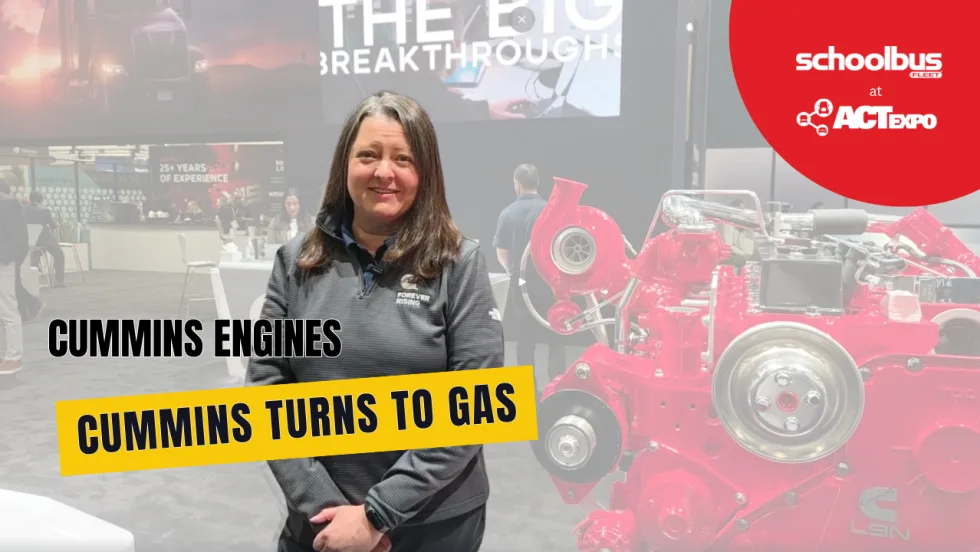
Cummins on Smarter, Simpler Engine Innovation
Cummins discusses its first-ever gasoline engine for school buses, EPA 2027, and why bus fleets still want durable, simpler internal combustion options.
Read More →
Report: 72% of Diesel School Buses Now Use Advanced Low-Emission Engines
New data shows advanced low-emission diesel technology continues expanding across school bus fleets, even as electric bus adoption gains momentum.
Read More →
Vampire Tools' CAIMAN 7.5-Inch Multi-Purpose Screw Extractor Long-Nose Pliers with Crimper
Vampire Tools introduced the VAMPLIERS Caiman 7.5-inch multi-purpose pliers, combining screw extraction, cutting, crimping, and gripping functions into a single tool designed for fleet maintenance professionals.
Read More →