




The Benefits of Bus Surveillance
When early video recording equipment was installed on school buses, the black box with a red light focused above the driver and along the aisle to view student behavior.
When early video recording equipment was installed on school buses, the “black box with a red light” focused above the driver and along the aisle to view student behavior. In some cases, sounds within the bus were also recorded.
Video recording was often under driver control, with an on/off switch to tape a student incident that could later be viewed by school authorities to support the driver’s written incident report. Only student performance on the bus was at issue. Drivers felt protected by this system.
Other problems, however, were not resolved. Video cameras were not built to withstand use on school buses. Cameras were regularly jostled out of focus or out of place, changing the viewing angle to the floor or ceiling.Video tapes often overheated in summer or froze in winter, drastically reducing tape utility. Additionally, videotaping quality degraded after multiple recordings. Camera batteries also failed when they became too hot or too cold.
Cameras were replaced years before their normal mean time because buying new cameras was less costly than repairing existing ones. Budgetary constraints required rotating fewer cameras across the entire fleet, giving one-third of the fleet daily video coverage and two-thirds of the fleet none.
Costs increased when archiving video tapes was required, taking up entire rooms for archival storage and retrieval. Labor costs were the highest budgetary line item needed to manage tapes and cameras, to change tapes across the fleet and to monitor tapes of incidents that some drivers may not have wanted their supervisors to see.
In with the new
Newer technology has been bringing the outside world into school buses in America. Event data recorders are already built into our school buses. GPS is increasingly being used to track them.
There is no privacy from outside the bus with existing technology. Neither will there continue to be privacy within the school bus due to the monitoring of driver performance. Every pre-trip inspection item, left and right turn on the route, braking or acceleration, curb hopping and driving above the speed the limit is, or soon will be, accessible by driver supervisors.
Parents will soon be widely afforded notice before their child’s bus stop is reached. They will also be informed whether their child rode the bus and whether he or she disembarked at an alternate bus stop.
Parents can put tracking devices into their child’s backpack and watch the progress of their child’s bus between home and school on their home computer with Google Maps scrolling on their monitors. Student cell phones with digital cameras bring home to parents any event recorded on the bus from their child’s viewpoint.
Various viewpoints
Digital technology is based on charge-coupled devices. These are better known as “the unblinking eye.” The interior of the bus can now be monitored digitally from the front, middle and back. Evidence of every passenger’s behavior can be stored daily on hard drives and downloaded wirelessly.
Technology will also soon provide a driver’s- view record of outside traffic with reference to the school bus movements along the route. The same technology can provide the driver with a total view under or behind the bus when backing is needed.
Security measures
We need stop-arm runner cameras on the bus exterior to document driver, make, model and license plate of our highest-risk motorists. While buses are parked, cameras can keep watch in the bus for movement on board, vandalism or tampering with bus systems.
Onboard computers and sensors are already on school buses. Stolen or hijacked buses can be tracked to give police their exact position. On-Star-type monitoring gives 911 an instant location and a communication link for school bus collisions, evasive movements, hard turning, over-steering or rollovers.
That same technology will prevent drivers from not wearing their seat belt and shoulder harness.
The average new school bus has more than 22 different computer systems on board, all of which can be accessed by a hand-held, onboard diagnostic system reader and software. Our onboard technology can read the temperature of braking systems and any other onboard “hot zones” and forewarn the driver before system failure or fires.
Implications of surveillance
Digital video and onboard computer surveillance are more of a defense for drivers against false accusations of wrongdoing from parents and supervisors and less of a constant “eye” for their daily route service performance.
Supervisors may never fully know what differences the addition of surveillance technology will bring to each bus, because they have been “blind” to past driver team performance levels. Continuous onboard driver team performance monitoring will raise the overall level of service quality, timeliness and security.
Good drivers need never fear! Just as many drivers would welcome a police officer following along their entire route, why should drivers who comply with the law not welcome the presence of surveillance?
Substandard, illegal and/or outright dangerous driver performance will be seen using present technology. When drivers underperform, they endanger every passenger on the bus. Good drivers who perform satisfactorily have the digital evidence to document against false accusations made by others.
Good drivers and monitors should welcome the affirmation of their skills and caring for the students on their bus. Other driver teams will have to maintain a higher level of performance than they did before.
Many police departments across America have a motto emblazoned on their vehicles: “To serve and protect.” I suggest that we put that same motto somewhere on the outside of our school buses.
Let us not fear the technology of “the unblinking eye,” for it is here and now within our buses. We owe every student and every parent of every student who rides our buses the promise of maximum safety, minimum risk and genuine security.
More Safety
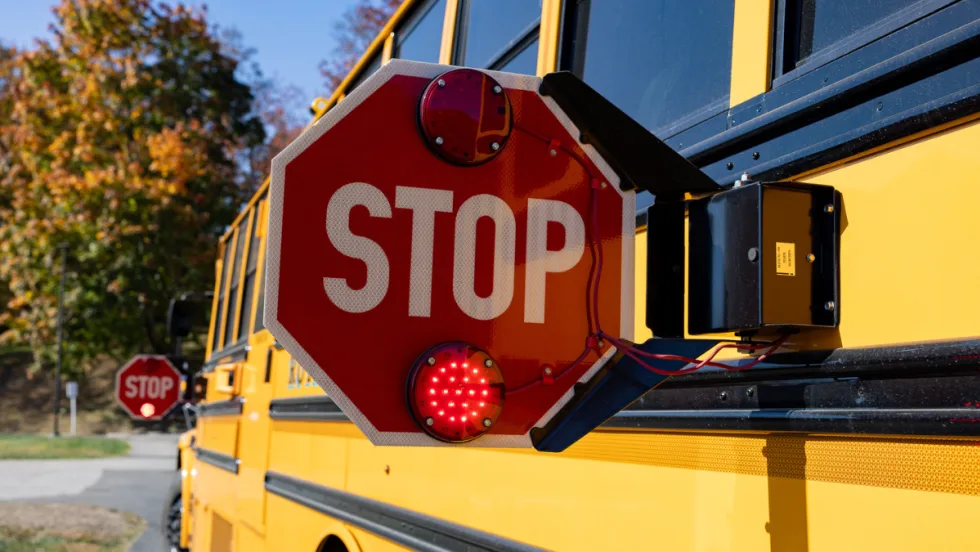
Illegal School Bus Passing Drops 24% in New York Districts
With fewer than 5% of citations involving repeat offenders, Westchester County officials said enforcement, education, and community partnerships are helping change driver behavior.
Read More →
School's Back. Here's What Happened to Traffic, Speeding & Distraction
What happens to traffic when school resumes? New data analysis examines changes in distracted driving, congestion, and speeding around schools.
Read More →
Geotab Expands Fleet Safety Tools With Video Coaching, Risk Insights
New safety and video capabilities aim to help fleet managers assess risk, support drivers, and take targeted action through video coaching, red-light violation detection, and more.
Read More →

How to Build a Better School Bus Driver Training Program
Is it time to strengthen your driver training? Here’s how to pick the right talent and improve recruitment, retention, and safety. This video is brought to you by IC Bus.
Read More →
Recent School Bus Accidents Leave 2 Dead, 2 Injured
Four school bus crashes in Florida, Illinois, and Georgia highlight risks in transportation lots, at bus stops, and during student loading and unloading.
Read More →
When Every Second Matters, Clarity Keeps Routes Moving
From routine delays to urgent incidents, strong communication practices help drivers, dispatchers, schools, and families respond with confidence.
Read More →
What Happens When a School Bus Catches Fire — and What Can Help
School bus fires are rare but can be devastating. Learn how advances in fire suppression and asset protection help fleets detect fires earlier, reduce damage, and improve safety.
Read More →
Geotab Launches Tool to Help Fleets Investigate Road Incidents
Geotab Investigations combines telematics data, video, documents, and other evidence to help fleets reconstruct incidents, resolve claims, and determine what happened.
Read More →
Texas Sixth Grader Wins 2026 National School Bus Safety Poster Contest
Sai Darshana Yekolu of Moseley Middle School in Prosper, Texas, was named the newest winner for her artwork, bringing the theme of “Safe Rides, Everyday Heroes” to life.
Read More →
Doing More With Less: How Transportation Directors Can Prioritize Safety Amid Budget Uncertainty
With diesel prices soaring and nearly one-third of transportation directors expecting budget cuts, maintaining student safety has never been more challenging. Download this guide to learn how leading districts are prioritizing risk, funding critical safety technology, and building stronger budget cases with data.
Read More →