





Have You Entered? School Bus Fleet's 2024 Photo Contest Now Accepting Submissions!
STORER AT THE WHEEL: How a Childhood Job Evolved into Professional Passion
Inspired by his grandparents, Donald Storer has helped his company overcome challenges – including the COVID 19 pandemic – with a focus on safety, innovation, and family values. Storer Transportation is our School Bus Fleet Contractor of the Year for 2024.
June 12, 2024
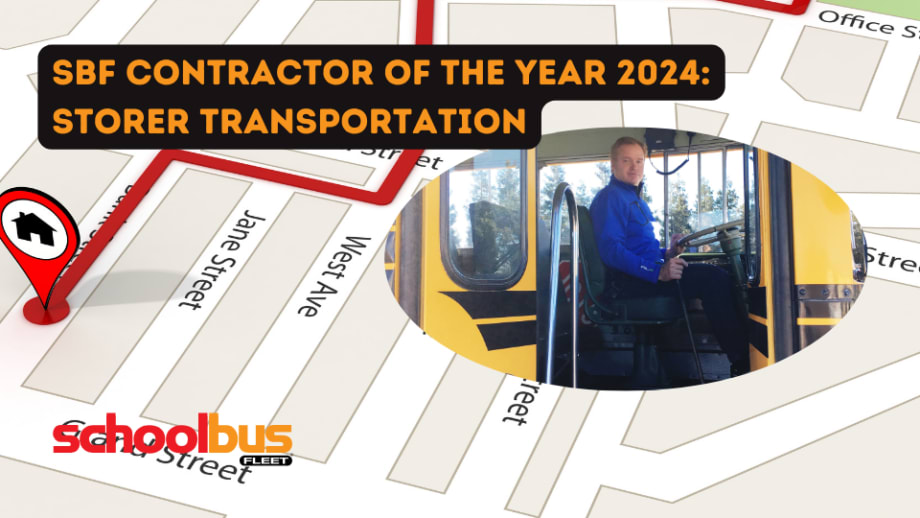
Donald Storer has been driving buses (at least short distances) for his family business since he was just 9.
Source: Canva, Storer Transportation
4 min to read
At age 9, Donald Storer’s grandparents gave him a job on the lot of their family business: bus washer. They let him take the wheel of the stick-shift buses so he could drive from the lot to the wash bay.
It was fun, at first.
“The fun soon wore out as I had that very important job until I was 18 years old,” recalls Storer, who is now CEO of Storer Transportation.
The company, founded in Modesto, Calif., in 1952 by his grandparents, Walter and Gladys, has grown from humble beginnings to a major player in the West Coast transportation industry, with about 1,000 vehicles in operation. The story of Storer Transportation is all about family legacy, opportunities for innovation, and a resilient nature handed down from one generation to the next.
These values led School Bus Fleet to select Storer Transportation as Contractor of the Year for 2024.
Growing into Leadership
At 18, Donald Storer took that driving experience from the yard to the California Highway Patrol and applied to take the state’s school bus driver written exam and driving test.
Not too surprisingly, he passed.
“I took the test in our largest school bus and still to this day proudly hold a school bus driver certificate, which holds no restrictions,” Storer says.
He was born and raised in Modesto – a hometown he shares with movie legend George Lucas, Olympic gold medalist Mark Spitz, and Joan Mitchell, co-inventor of the JPEG digital image format. He and his wife Julie have raised three children, including daughter Sarah, the fourth generation working for the 72-year-old company.
His current office is set up in what used to be his grandparents’ one-car garage on 10 acres at one of Storer Transportation’s first yards.

Donald Storer is CEO of California-based Storer Transportation, our Contractor of the Year for 2024.
Source: Storer Transportation
His father, Warren, went into the motorcoach charter business in the 1960s. Storer still operates about 125 motorcoaches today, but “it is a hard segment of the business to grow in as capital expenses are so high,” Donald Storer says.
As Donald Storer's role within the company grew, he focused on expanding and diversifying Storer Transportation. In the early 1980s, he spearheaded the creation of the transit division, securing contracts with cities and counties to provide turnkey transit services, including fixed routes, paratransit, and on-demand public transportation. This strategic move diversified the company’s portfolio and positioned Storer Transportation as a versatile player in the industry.
By 1997, Donald had successfully expanded the company's school bus operations to multiple locations. Leveraging the operational models developed in Modesto, he replicated this success across various regions, significantly increasing the company’s reach and influence. This period of growth was marked by the establishment of strong relationships with school districts.
Making the Best of the COVID Pandemic
The COVID-19 pandemic posed unprecedented challenges for Storer Transportation. In late March 2020, as schools across the country went into lockdown, the demand for student transportation plummeted. This sudden and complete shutdown of in-person classes meant that nearly all transportation services came to a halt. For Donald Storer, this period was marked by difficult decisions and significant financial strain.
One of the most heart-wrenching decisions was to lay off almost 900 employees within a week. This was a profound blow, as these employees were considered family within the company.
“It was a horrible, helpless feeling,” Storer says.
Despite this difficult decision, he ensured that all laid-off employees continued to receive company-paid benefits, reflecting the company’s commitment to its workforce.
During the pandemic, while buses sat idle without income but with plenty of expenses, Storer remembers watching the news one night “showing all the cars of people waiting in ridiculously long lines to get tested for COVID.”
He decided to develop a mobile testing operation, working with Sarah for six months to develop a business plan.
“It grew to more than 65 mobile medical units, which tested thousands of people throughout California for almost three years,” Storer says. “We are still using this model and have expanded our operations in this newly created field.”
Coming out of the pandemic would be more difficult than going in, he thought, because of the nature of business, operations, and requirements to be a certified school bus driver in California. On average, it can take about six months to get that certification.
“With the unemployment rate below 4%, competition has become fierce for us to attract and retain a quality workforce,” Storer says. “In most of our school divisions, we had to raise wages 25 to 30%. When you are locked into multiple-year contracts, raising wages without receiving a rate increase is a bad business decision. On the flip side, not performing due to a driver shortage is equally as bad. I made the decision to raise the wages and perform, which we have done in all our contracts.”
Storer Transportation may have a long history, but the family really only seems interested in finding the way forward to the future.
“Storer is only looking ahead of the road and not in the rear-view mirror,” Storer says. “We welcome the challenges brought before us and will find a way to meet and exceed these challenges the way we have done before with a 72-year track record of success.”
Subscribe to Our Newsletter
More Management

How to Build a Better Driver Training Program
Ready to boost up your school bus instructor training? Here’s how to pick the right talent and improve recruitment, retention, and safety.
Read More →
CALSTART and Forth Combine to Form Catalyst Mobility
The new name represents a renewed vision for the nonprofit focused on advancing clean, equitable, and affordable transportation solutions that move people and goods.
Read More →
What Makes a Great School Bus Driver Trainer?
Choosing the right school bus driver trainer takes more than experience. Learn six keys to selecting and developing trainers and evaluating program effectiveness.
Read More →


School Bus Contractors Expand Through New Deals, Acquisitions & Partnerships
STA's Canadian division acquires Ontario-based G&L Stevenson Transport while Durham School Services adds a new district contract in California, First Student adds a New Jersey contract, and Minnesota Coaches acquires Halo Transportation.
Read More →
Logan Bus Company Rolls Out AI Phone System for NYC School Bus Families
A summer pilot found that AI agents could handle most routine calls, freeing up time for customer service staff to focus on emergencies and complex family concerns.
Read More →
From Intent to Impact: What I Learned About Leadership from TAPT
A Texas transportation supervisor shares lessons on self-awareness, accountability, managing stress and building trust — and why investing in leadership development matters at every stage of your career.
Read More →
NAPT Names 2026 Award Recipients, Hall of Fame Inductee
Who earned national recognition for their work in student transportation? This year, NAPT named five recipients of its 2026 awards for service, safety, and leadership, plus its newest Hall of Famer.
Read More →
Sponsored•September 2, 2026
2026 State of Student Transportation Report
Driver shortages. Rising costs. Growing safety expectations. More data, but not enough time to act on it. The 2026 State of Student Transportation Report reveals what transportation leaders say is putting the most pressure on their operations—and where they’re investing next. See how your priorities compare.
Read More →
How to De-Escalate an Angry Person: 5 Steps for Handling Workplace Conflict
What makes emotions run high, and how should you handle an angry colleague or parent? Follow these steps for staying calm, listening, showing empathy, and resolving conflict.
Read More →
Sponsored•September 1, 2026
What Readiness Looks Like This School Year
Learn about the challenges shaping the 2026–2027 school year, from persistent driver shortages and budget pressure to technology and readiness gaps. See how school districts are responding and adapting in Zonar’s 2026 Back-to-School Readiness Report.
Read More →