




School Buses and Bicycles: Sharing the Road Safely
Staff members at a Michigan transportation department work with local cyclists on safety exercises and learn that it is possible for the two transportation modes to coexist in harmony.
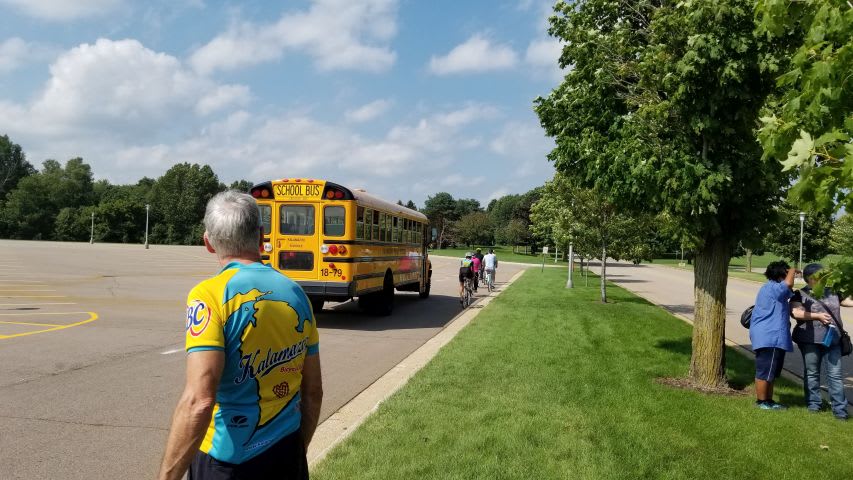
Kalamazoo (Mich.) Public Schools’ transportation department held a symposium on school buses and bicycles sharing the road. Law enforcement officers, state transportation safety specialists, members of the local bicycle club, and a city planner also participated. Photo courtesy David Rank
Kalamazoo (Mich.) Public Schools’ transportation department held a symposium on school buses and bicycles sharing the road. Law enforcement officers, state transportation safety specialists, members of the local bicycle club, and a city planner also participated. Photo courtesy David Rank
Imagine a collision between a watermelon and a strawberry. The watermelon would be hard-pressed to even be aware of the contact, but the strawberry would be smashed and spread out across the floor. The strawberry would be at the same disadvantage as that of a bicycle hit by a school bus. The weight ratios are about the same.
Imagine also that the watermelon typically only sees pumpkins, cantaloupes, and coconuts, and therefore is not even aware of the presence of the tiny and thin-skinned strawberry.
You now have a fairly accurate mental picture of the peril that bicycle riders experience every time they head out onto the city streets. It is critical that school bus drivers not only care for and protect the students riding the bus, but also avoid collisions with bicyclists and other vulnerable road users outside of the bus.
Eye-opening Exercises
Just before the start of the 2018-19 school year, as part of our annual in-service series of meetings to prepare for the coming school year, the Kalamazoo (Mich.) Public Schools transportation department held a symposium to address the issue of school buses and bicycles sharing the road in close proximity. We invited a variety of speakers who hold differing perspectives to present their point of view to our bus drivers. The list included a city planner, law enforcement officers, a psychology professor from a local university, state transportation safety specialists, members and the president of the local bicycle club, and an adult bicyclist who recently experienced a near miss with one of our school buses.
Several bicycle club members provided a hands-on demonstration of the difficulties that bicycle riders face while negotiating their bike alongside school buses and other motorized traffic.
To gain the perspective of a bicyclist, bus drivers were given the chance to ride a bicycle and experience the intimidating size, sound, and wind turbulence caused by a passing school bus. As several bicycles were ridden in single file, a school bus passed the line several times at varying speeds and at a distance of three to five feet to simulate passing on the road. The bus did the same alongside a line of bus drivers standing on a curb as pedestrians, driving by at 10 miles per hour and then at 30 miles per hour. The resulting wide eyes and gasps were apparent.
In another exercise, the bus was loaded with drivers as it followed a bicycle ridden by a club member through a mock city street laid out with construction cones. The drivers saw how the bicyclist had to swerve way out into the traffic lane to get around a parked car while also allowing room for a potentially open car door. The bus also followed the bike as it approached an intersection and the drivers saw that for a right turn, the bicyclist stayed close to the right curb.
For a left turn, the bicyclist changed lanes twice before the intersection to enter the left turn lane before turning left in line with the rest of the turning traffic. For going straight through the intersection, the bicyclist moved away from the curb into the middle of the right lane to be more easily seen as they traveled through the intersection.
It was noted that although these are the proper techniques for handling an intersection on a bicycle, what happens in practice is often much different, so drivers need to be prepared for nearly anything.
Then, in an additional exercise, the drivers sat, one by one, in the driver’s seat of the bus while bicycles were placed at strategic locations around the bus for the purpose of demonstrating locations where the bicycles could be hidden from the driver’s view. Though blind spots were found to the rear of the bus and in front of the front bumper, the most dangerous place a bicycle rider is likely to be is to the right side of the bus, just behind the service door and five feet or more away from the bus. (Any closer than that and the bike was visible via the convex mirror.) The only way to see a bicycle in such a position is to look in the right crossover mirror, which drivers don’t typically do. Even so, the image was grossly distorted due the curvature of the mirror, so the bicycle easily escaped notice.
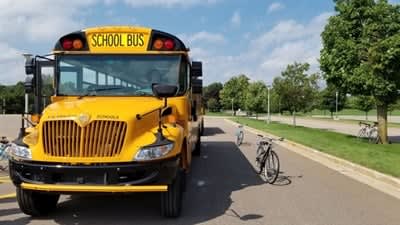
In one exercise, bicycles were placed around a school bus to demonstrate where they could be hiding in a blind spot. Photo courtesy David Rank
Lessons Learned
In addition to our in-service exercises, our own dispatcher and driver supervisor, David Rank, and the president of the Kalamazoo Bicycle Club, Paul Wells, were presenters on the subject of bicycle awareness at the 2019 Michigan Traffic Safety Summit in March.
What we learned:
There is a growing trend across the nation to “complete” the streets in communities. Completed streets are those that are safer and more accessible not just to motorized vehicles, but also to more vulnerable road users, which would include, among others, bicycle riders. More people are relying on pedal power for regular transportation to work or school, increasing the need for safe access to the transportation system.
According to U.S. Census figures, in the five-year span from 2006 to 2011, many cities across the nation experienced large growth in bicycle commuters: New York city grew by 50%; Los Angeles, California, by 68%; and Lansing, Michigan, by 300%. Not unexpectedly, the number of bicycle crashes has grown in a similar fashion.
Large and small vehicles driving within close proximity of each other is inherently dangerous, especially for the smaller vehicle. Given the disparity of size and weight between buses and bicycles, school bus drivers need to be extra vigilant in searching for hazards, because bicycle riders are not only vulnerable, but relatively small, and therefore more likely to go unnoticed.
Because of the relative size of bicycles, bus drivers need to avoid distractions as much as possible if they are to notice the bike riders. Of course, bus drivers already have as many as 60 or more distractions sitting (hopefully) behind them, so this is a particularly difficult task. Keeping cell phones turned off and mental focus turned on, especially outside of the bus, will help.
Share the road. Bicycles are considered to be vehicles in most places, and as such, have as much right to use the road as motorists. They must also follow the same rules of the road as motorists, though they often don’t. Laws concerning passing bicycles will vary, but Michigan law requires a three-foot gap with some local ordinances requiring five feet when passing.
In most states, riding a bicycle on the sidewalk is illegal (though not in Michigan). Still, many bike riders feel safer on the sidewalk, so it is common to see them there. In fact, they are about 10 times as likely to get hit there as they are in a bike lane. Bicycles are less visible on a sidewalk, because traffic coming out of driveways or side streets typically look out into the street rather than the sidewalk, so they stop their vehicle at the curb or edge of the street. The sidewalk user then gets run into by the car or bus, or the bike runs into the vehicle.
Technological advances are constantly making school buses and other vehicles smarter and safer to drive, but crashes of all types are still happening at an alarming rate. A loaded school bus has the approximate weight of 10 average-sized cars. Just as physical exercise can’t override poor eating habits, technology such as exterior cameras and proximity alarms aren’t enough to make up for poor driving habits.
Sharing the road is as much an attitude as it is an action. Understand that others need to use the road too, and be willing to allow them safe passage. Safety on the road for everyone is ultimately up to you, the driver.
Lane Bertrand is a bus driver and trainer for Kalamazoo (Mich.) Public Schools.
More Safety
Illegal School Bus Passing Drops 24% in New York Districts
With fewer than 5% of citations involving repeat offenders, Westchester County officials said enforcement, education, and community partnerships are helping change driver behavior.
Read More →
School's Back. Here's What Happened to Traffic, Speeding & Distraction
What happens to traffic when school resumes? New data analysis examines changes in distracted driving, congestion, and speeding around schools.
Read More →
Geotab Expands Fleet Safety Tools With Video Coaching, Risk Insights
New safety and video capabilities aim to help fleet managers assess risk, support drivers, and take targeted action through video coaching, red-light violation detection, and more.
Read More →

How to Build a Better School Bus Driver Training Program
Is it time to strengthen your driver training? Here’s how to pick the right talent and improve recruitment, retention, and safety. This video is brought to you by IC Bus.
Read More →
Recent School Bus Accidents Leave 2 Dead, 2 Injured
Four school bus crashes in Florida, Illinois, and Georgia highlight risks in transportation lots, at bus stops, and during student loading and unloading.
Read More →
When Every Second Matters, Clarity Keeps Routes Moving
From routine delays to urgent incidents, strong communication practices help drivers, dispatchers, schools, and families respond with confidence.
Read More →
What Happens When a School Bus Catches Fire — and What Can Help
School bus fires are rare but can be devastating. Learn how advances in fire suppression and asset protection help fleets detect fires earlier, reduce damage, and improve safety.
Read More →
Geotab Launches Tool to Help Fleets Investigate Road Incidents
Geotab Investigations combines telematics data, video, documents, and other evidence to help fleets reconstruct incidents, resolve claims, and determine what happened.
Read More →
Texas Sixth Grader Wins 2026 National School Bus Safety Poster Contest
Sai Darshana Yekolu of Moseley Middle School in Prosper, Texas, was named the newest winner for her artwork, bringing the theme of “Safe Rides, Everyday Heroes” to life.
Read More →
Doing More With Less: How Transportation Directors Can Prioritize Safety Amid Budget Uncertainty
With diesel prices soaring and nearly one-third of transportation directors expecting budget cuts, maintaining student safety has never been more challenging. Download this guide to learn how leading districts are prioritizing risk, funding critical safety technology, and building stronger budget cases with data.
Read More →