




Q&A: International's Cancelliere Sets Sights on Higher Ground
In March, International Truck and Engine Corp. announced the promotion of Tom Cellitti from vice president and general manager of the Bus Vehicle Cent...


In March, International Truck and Engine Corp. announced the promotion of Tom Cellitti from vice president and general manager of the Bus Vehicle Center to the same title at the Medium Truck Vehicle Center. Cellitti, a well-respected industry veteran, helped to form the company's bus business in the early 1990s. His departure created an undeniable void — and extraordinary opportunity.
Into this void stepped Michael Cancelliere, who previously was International's vice president of North American sales for its truck division.
Although Cancelliere has a long history with International, having started working for the company as a sales management trainee in 1980, he is new to the school bus industry.
In the past few months, he has been getting a crash course in the market and the IC Corp. product line. What he's discovered is that Cellitti and other bus veterans have left him with solid footing in the marketplace.
Taking International's school bus division to the next level is his goal, however. SBF Editor Steve Hirano recently sat down with Cancelliere to discuss his perceptions of the industry and how he intends to fulfill the company's mission.
Tell me about your background.
I graduated from Boston University with a degree in business administration, and my first job was with International Truck and Engine Corp. In June 1980, I started as a commissioned retail truck salesman in Buffalo, N.Y., as part of the company's sales management trainee program. Since then, I've progressed through the organization in various sales and marketing leadership positions, most recently as vice president of North American sales.
What's been your experience so far with the Bus Vehicle Center?
It's been great. People have been very supportive. This was already a winning team. We've got a history of product and market leadership.
We owe a lot of our success to my predecessor, Tom Cellitti, and the great team of people in the product center and manufacturing plants for executing on his vision to take our industry leadership to new heights.
So when I came in, I viewed it as an opportunity to build on those existing strengths, rather than rebuilding what was already in existence. Clearly, we have the trust, respect and credibility of our customers and the industry, and we've done a lot of things right for a lot of years. Together with Bob Whitehouse, president and CEO of IC Corp., the goal is to take the team's success to the next level.
How would you describe your managerial style?
The word that comes to mind is inclusive. I'm very sensitive to input and buy-in from the rest of the team on whatever issue or opportunity we're discussing. My personal belief is that people get more passionate about doing a great job on a personal or professional level when their motivations and ideas are being considered. This inclusive style also includes dealers and customers. I spend a lot of time listening to them. Being relatively new to the industry, I think it's even more appropriate for me to do that.
At the end of the day, I'm prepared to make the tough calls and tough decisions, but only after all positions have been considered. I try to find win-win solutions whenever possible. And I would describe myself as flexible. Most problems have more than one solution. {+PAGEBREAK+} What do you think is your greatest strength?
I have an extremely positive attitude. I believe anything's possible with proper preparation, determination and planning. This positive attitude enables me to support the rest of the team by focusing on the strength in others, not their shortcomings.
In developing your new products, you speak of evolution rather than revolution.
We call it a common-sense approach. We like to slowly build on existing successful technology, and let it be proven elsewhere. For example, we tested our multiplexing system on the truck side for two years before adopting the technology for our school buses.
We don't view the industry as looking for revolutionary change overnight.
How different is the truck market from the school bus market?
The school bus market is much smaller and it's more cyclical. As a result, I'd say the importance of relationships between dealers and customers, while important in the truck industry, is absolutely paramount in the bus industry. Your reputation is everything in the bus industry.
What do you think of your current product line?
I was fortunate to come aboard after the launch of the new CE products. Customer and dealer acceptance have been terrific. Since their introduction, our share of the industry's orders has grown significantly. What impresses me most is how we listened to the customer. Development of these products was done not only with the safety of the passenger in mind. It also took into consideration the owner, the driver and the maintainer, all of which are important to us.
What's the status of the 2005 CE?
It's available for order right now. Production began 90 to 120 days ago. The volume of orders we've received would indicate tremendous customer and dealer support.
What are the key challenges facing the industry?
First and foremost, funding. If there's no money, no buses are bought. This industry must have consistent funding to upgrade the nation's school bus fleet for the benefit of all involved.
Another challenge is finding funding for improved air quality. We all care about clean air and clean school bus emissions. However, to do this, it will take considerable funding from the Environmental Protection Agency's [EPA] Clean School Bus USA program. The funding already provided by the EPA, although less than originally earmarked, is a step in the right direction.
I'd like to mention one other challenge. I recognize that there are public and private sectors in this industry, and I appreciate the differences. But there are as many, if not more, similarities as differences. Both public and private school transportation providers are concerned with the safe, efficient and healthy transportation of schoolchildren on a daily basis, and in that regard, it would be great to see the industry's three major associations working together to present a unified voice on issues in which they're all aligned.
Any final thoughts?
This industry, like any industry, has its challenges, but at the heart of it are great people who are committed to doing the best they can on a daily basis to fulfill their mission. I believe with people like this in our industry, there isn't any challenge that can't be overcome.
More Management

EverDriven Launches Route Consolidation Calculator to Estimate Diesel Savings
As diesel prices hit record highs, the largest alternative transportation provider says a 10% route consolidation could save a 120-route district more than $78,000 a year in fuel alone.
Read More →
Zum Secures Continued Financing Support for School Bus Expansion
Generate Private Credit has financed approximately $75 million in school bus deployments across three states, supporting more than 500 buses as Zum expands across the county.
Read More →
Beyond Discipline: A Different Approach to Student Behavior on the Bus
After implementing a dean of students program in Oregon, North Clackamas is seeing positive improvements. Here’s how it worked. The Route is brought to you by IC Bus.
Read More →
A Dean of Transportation's Different Approach to Student Behavior on the School Bus
After implementing a dean of students program in Oregon, North Clackamas is seeing positive improvements on the bus. Here’s how it worked.
Read More →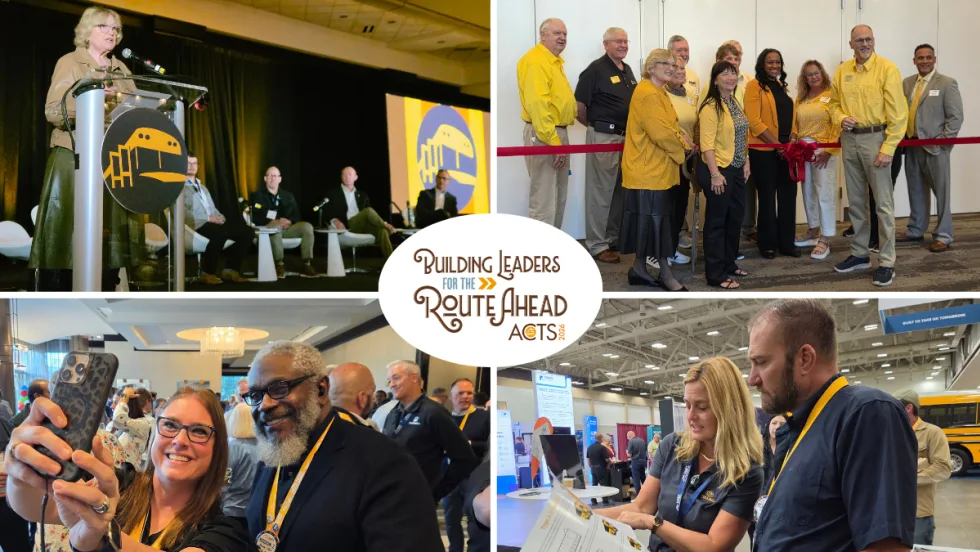
Inside NAPT ACTS 2026: Highlights from Louisville
From federal updates and student behavior strategies to new school bus technology and industry awards, see highlights from NAPT ACTS 2026 in Louisville.
Read More →
Meet the 2025 School Bus Driver Hero Winner: Annette Brown
We caught up with Wa-Nee Community Schools' Annette Brown on site at SBFX, where she was named the 2026 School Bus Driver Hero Award winner. Hear about her reaction, what she loves most about being a school bus driver, and more!
Read More →
Predictability Is Like Ketchup (According to 6-Year-Olds)
To students, a different school bus can feel like a full-blown crisis. One driver reflects on why familiar routines, showing up on time, and being reliably boring matter more than we think.
Read More →
Samsara Launches Free Driver Rewards Program
The new Driver Perks program gives eligible professional drivers access to discounts and offers without adding a cost for participating fleets.
Read More →
How Tax-Exempt Municipal Leases Can Help Finance School Buses
Let’s explore school bus financing options, including municipal leases, vendor payable accounts, and balloon payments, and how they can help stretch fleet budgets.
Read More →
Nominate Rising School Transportation Pros Under 40!
We’re searching for the next generation of leaders making an impact across the K-12 student transportation industry to recognize as SBF’s 2027 Trailblazers. Nominations are open now!
Read More →