




Q&A: 2010 Engine Technology
With the EPA’s 2010 emissions standards drawing near, school bus OEMs answer key questions about the engine technology that will power their large buses.

Blue Bird
What type of engine technology will be in your buses to meet the EPA’s 2010 emissions standards?
Blue Bird has chosen the Cummins selective catalytic reduction, or SCR, as our solution to meet the Environmental Protection Agency’s 2010 emissions standards. Cummins has joined major engine manufacturers including Daimler, Mack, Paccar, Volvo and others in the use of the SCR emission solution.
How does this technology work, and what are its advantages?
The way SCR works is simple. When NOx exhaust gas travels toward the SCR system, it is injected with diesel exhaust fluid (DEF), which is decomposed into ammonia prior to the NOx entering the SCR system. Inside this system, the ammonia and NOx react over the surface of the catalyst.
That reaction breaks the NOx emissions down into harmless nitrogen and water vapor — pure, natural components of the air we breathe. The nitrogen and water vapor then pass harmlessly through the tailpipe. SCR is clean and uncomplicated.
How will the emissions levels compare to those of the 2007 engine standards?
2010 emissions levels are lower than 2007 levels. NOx levels will be reduced from 1.2 grams per brake horsepower-hour to 0.2. Particulate matter (PM) emissions will not change — the 2007 technology addressed PM by the addition of the diesel particulate filter.
Will this engine technology affect fuel economy?
Fuel economy will not be adversely affected by the 2010 SCR solution and will be quite comparable to the fuel economy of today’s 2007 model engines.
Has this technology already been in use elsewhere?
SCR is a proven technology designed to meet Euro IV and V standards utilized in commercial vehicle application for several years now in Europe. At last report, our engine and aftertreatment supplier, Cummins, has built and shipped some 45,000 SCR engines with an additional 200,000 SCR systems built and shipped by Cummins Emissions Solutions.
How will it affect maintenance of the buses?
Blue Bird-utilized Cummins engines and aftertreatment systems are designed to keep our buses on the road and out of the shop. Oil filter, fuel filter, coolant filter, overhead adjustment and all the other normal maintenance items will have the same intervals currently experienced. The only addition will be a DEF filter that will need to be changed at 200,000 miles or 5,000-hour intervals.
Will there be any changes from the driver’s perspective?
The Cummins aftertreatment system on the Blue Bird bus with adequate DEF levels won’t change the driving performance in terms of pulling power, engine responsiveness, durability or dependability.
The DEF tank will need to be replenished periodically. DEF fluid consumption will be approximately 2 percent of diesel consumption. So for every 50 gallons of fuel consumed, the system will use about one gallon of DEF. A DEF fluid level gauge on the dash will provide a level indication. The driver need simply top off this fluid level like any other being checked.
There will also be a light to warn against low DEF. The light will warn that an eventual de-rate can take place if ignored. A driver would really need to ignore the light for a long period before de-rate would be experienced.
The level indicator and warning lamp are meant to be a visual and provide significant time (days) to refill. Consider that one gallon of DEF will allow for about 400 miles (50 diesel gallons at 8 mpg each). The warning will be triggered prior to reaching the one gallon mark.
What type of training will be needed for staff?
Fill the DEF tank when below a certain level, using the fuel level indicator as a visual reference. A refill for a bus with annual mileage of 15,000 miles is expected to require about four refills per year.
Replace the DEF filter every 200,000 miles.
Sufficient DEF should be readily available for dispensing into the DEF tanks on the buses. Although DEF has life of over one year if stored between 10 and 90 degrees, the fleet only needs to supply sufficient DEF for the upcoming weeks or months. Just like with diesel, a year’s worth of supply is not procured up front. Concerns on degradation have been exaggerated.
{+PAGEBREAK+}
IC Bus
Navistar's MaxxForce 7 engine What type of engine technology will be in your buses to meet the EPA’s 2010 emissions standards?
IC Bus will use Advanced EGR [exhaust gas recirculation] to meet the EPA’s 2010 emissions requirements.
How does this technology work, and what are its advantages?
Advanced EGR works through the use of proprietary engine technology to control NOx before it is created in the engine. Through the use of advanced fuel injection technology that allows for better control of fuel injection events, a new proprietary combustion bowl allowing a more complete burn of fuel, dual-stage turbo chargers, and improved engine electronic calibration strategies, IC Bus is able to decrease the creation of NOx, instead of having to attempt to control it after creation.
Advanced EGR removes the burden of compliance from owners and operators. With Advanced EGR, you are compliant for 2010 emissions standards as soon as you turn the key. Advanced EGR does not require the use or handling of urea. This allows operators to maintain fleet consistency — they do not have to develop special maintenance or training plans, nor worry about the storage and supply of urea, a key component to the use of SCR [selective catalytic reduction]-based systems.
How will the emissions levels compare to those of the 2007 engine standards?
2010 emissions standards are much more stringent from 2007 EPA emissions levels. NOx emissions are reduced 83 percent from 2007 requirements.
Will this engine technology affect fuel economy?
We expect fuel economy of the MaxxForce 7 and DT to be neutral when compared to 2007 emissions MaxxForce engines.
Has this technology already been in use elsewhere?
In Europe, both MAN and Scania are developing their own Advanced EGR engines to replace models that previously relied upon SCR to meet the EURO standards.
How will it affect maintenance of the buses?
Advanced EGR allows operators to continue “business as usual” for all aspects of their operations, including maintenance. 2010 MaxxForce engines will follow the same maintenance intervals as the 2007 emissions MaxxForce engines.
Will there be any changes from the driver’s perspective?
Drivers of IC Bus brand products using 2010 emissions MaxxForce engines will have no changes to their driver environment. This includes no new lights or buzzers to monitor, or fill schedules for urea. Drivers and operators will be compliant from the time they turn the key in the ignition, with no additional worries or hassles, all the while being clean.
What type of training will be needed for staff?
No new training is required for the service or maintenance of 2010 MaxxForce engines. Maintenance staff does not need to spend valuable time in training learning about the handling and storage of urea, fill schedules or how to work on new components, such as an SCR catalyst, urea doser, sensors, urea tanks or urea tank heaters.
{+PAGEBREAK+}
Thomas Built Buses
What type of engine technology will be in your buses to meet the EPA’s 2010 emissions standards?
Thomas Built Buses will employ the proven technology of selective catalytic reduction (SCR) to meet 2010 EPA requirements and maintain maximum fuel efficiency and engine performance.
How does this technology work, and what are its advantages?
Using existing engine architecture and SCR hardware, the technology allows the engine to function at higher, more optimal combustion temperatures, which results in increased fuel efficiency and reliability. SCR is specifically designed to reduce tailpipe emissions (commonly referred to as NOx) by treating the exhaust stream with a spray of diesel exhaust fluid (DEF), an aqueous solution of 32.5-percent urea and 67.5-percent de-ionized water. The DEF reacts with the NOx to form harmless nitrogen and water, elements present in the air we breathe every day, before vehicle emissions are released into the environment. DEF is clear, nontoxic, biodegradable and non-flammable. DEF is easy to handle, affordable and readily available.
There are many benefits of SCR, including:
Maintains daily ease of use.
Requires only a glance at the dash-mounted diesel exhaust fluid (DEF) gauge. Low-level warning is as easy as reading a fuel gauge.
Preserves passenger safety, as engine will not shut down if DEF tank is empty.
Provides a durable technology and offers greater component reliability due to less exhaust gas recirculation (EGR), higher oxygen levels, less heat rejection and fewer changes to moving engine parts.
No complex changes to the engine.
School bus components and equipment, such as air conditioning condensors, wheelchair lifts and luggage compartments, are unaffected.
How will the emissions levels compare to those of the 2007 engine standards?
By 2010, the EPA emissions standards are NOx exhaust of 0.2 g/hp-hr, an 83-percent reduction from 2007 levels.Will this engine technology affect fuel economy?
Cummins testing found that their SCR technology delivered a 5- to 9-percent fuel economy advantage, compared to an in-line cylinder EGR. This includes fuel saved due to fewer regenerations. A 9-percent increase in fuel efficiency could save up to $265 in fuel costs per bus per year for a typical Thomas Built school bus. This savings takes DEF costs into consideration.Has this technology already been in use elsewhere?
First patented in the U.S. in 1957, SCR has long been used for stationary diesel engines, and since 1978, many different exhaust systems in Europe have incorporated SCR technology. More than 600,000 vehicles equipped with SCR are in operation in Europe today, and more than 245,000 of those are Daimler and/or Cummins vehicles. More than 12 million miles have been logged in the U.S. to date.How will it affect maintenance of the buses?
Because SCR uses DEF, a safe solution that is less toxic than most other shop fluids, the technology requires no complex changes to the engine, and with Thomas’ 11- or 13-gallon DEF tanks, a bus typically can go 4,000 to 5,000 miles on one tank. School buses average 12,000 to 13,000 miles a year, so that means just three or four refills a year. Thomas Built engineers believe most customers will refill the DEF tank as part of their preventive maintenance schedule, so this will be just one more item on the monthly inspection list, allowing customers to adhere to their operation’s maintenance schedule.DEF filter replacement is required approximately every 200,000 miles or 6,500 hours, typically once in a bus lifetime.
Will there be any changes from the driver’s perspective?
Drivers need only glance at a dash-mounted DEF gauge. A yellow gauge warning indicates an estimated 450 miles to go, about a gallon and a half of DEF. The engine will not shut down while driving, even if the DEF tank becomes empty. A 5 mph de-rate occurs only after the bus has been turned off and restarted, and full power resumes when the DEF tank is refilled.What type of training will be needed for staff?
Training will be minimal. Technicians will need to add DEF fill-ups to the maintenance schedule and learn how to replace the DEF filter. Drivers will only need to be shown the new gauge, as the DEF tank fill intervals should allow for fill as part of the regular technician servicing, eliminating driver fill-ups.
More Alternative Fuels

What's Underneath the Jouley Electric School Bus? Take a Look at This Chassis!
Get an inside, up-close look at Thomas Built Buses’ C2 electric bus chassis in this walkaround video on location at Freightliner Custom Chassis.
Read More →
Bipartisan Bill Seeks to Extend Clean School Bus Program Through 2031
The proposed legislation would renew federal support for cleaner school buses as districts navigate funding uncertainty, rising fuel and infrastructure costs, and fleet replacement needs.
Read More →
Alt-Fuel Moves: Electric Bus Rollouts, Bidirectional Charging & Propane Growth
See which fleets are adding electric and propane school buses as districts and operators invest in charging infrastructure, bidirectional technology, and alternative-fuel expansion.
Read More →
Nobody Told Diesel Prices They Were Supposed to Come Down
With diesel prices surging, school bus fleets have new reason to stress-test fuel costs, consider diversification, and calculate what each route really costs to operate.
Read More →
Why Gasoline School Buses Are Making a Comeback
Gasoline is gaining ground in full-size school buses. See how today’s options stack up against diesel on cost, maintenance, emissions, performance, and more.
Read More →
EPA Opens $180M DERA Funding Round for Diesel Upgrades
The 2026 Diesel Emissions Reduction Act program seeks applications from eligible organizations to accelerate the retirement of legacy diesel vehicles.
Read More →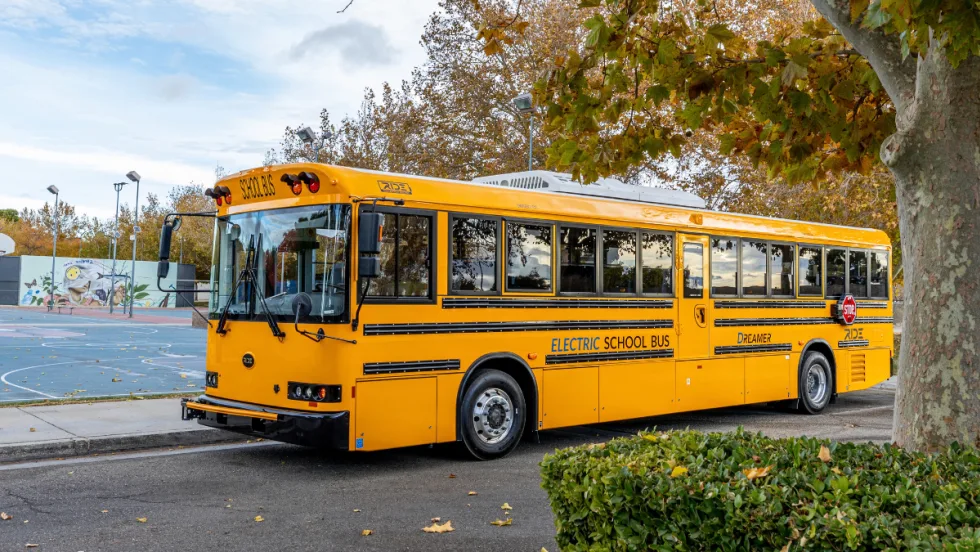
The Secret Life of an Electric School Bus Battery
Batteries change throughout years of daily routes, but degradation doesn’t necessarily mean the end. Here’s what operators should know about performance, safety, and second life.
Read More →
CALSTART and Forth Combine to Form Catalyst Mobility
The new name represents a renewed vision for the nonprofit focused on advancing clean, equitable, and affordable transportation solutions that move people and goods.
Read More →
Alt-Fuel Moves: New Buses, Charging Hubs & Real-World EV Testing
Propane and electric school bus deployments continue to grow as districts add new vehicles, expand charging infrastructure, and gather more real-world operating data.
Read More →
Fewer Electric School Bus Models Reshape the U.S. Market
WRI’s latest buyer’s guide points to a consolidating electric school bus market, but fewer options may reflect a maturing industry rather than fewer meaningful choices for school bus operators.
Read More →