




Maximizing Safety in the Seats
Compartmentalization is an extraordinary, time-tested concept, but it can’t do everything. Some younger passengers — including those in pre-school, He...
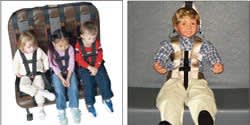
Compartmentalization is an extraordinary, time-tested concept, but it can’t do everything. Some younger passengers — including those in pre-school, Head Start, day care and other such programs — are just too small to be fully protected by the standard school bus seat.
That’s where child safety restraint systems (CSRSs) come in. These devices, which include safety vests, harnesses and integrated seats, ensure that your extra-precious cargo stays safe in your buses.
According to the National Highway Traffic Safety Administration (NHTSA), the transportation of pre-school age children in school buses has increased significantly in the past decade, and it will continue to increase.
NHTSA published guidelines in 1999 recommending that all pre-school age children transported in school buses be secured with CSRSs. And last year, NHTSA adopted a final rule permitting restraints that mount on school bus seats.
It’s important to note that under the new NHTSA rules, the entire seat directly behind one with a wrap-around restraint should be unoccupied or have restrained occupants. Seats using CSRSs should also be positioned with the maximum spacing permissible under Federal Motor Vehicle Safety Standard (FMVSS) 222 to reduce the chance of injury in a crash and allow easier access for bus personnel. Many of the CSRSs, however, allow school bus operators to still fit three small children in a seat, so it’s possible to prevent significant reduction of capacity.
Bus tested, kid approved
Q’Straint, which holds its U.S. headquarters in Ft. Lauderdale, Fla., produces a CSRS called the Q’Vest, which is available in two sizes. The small version is for children weighing 20 to 60 pounds, while the large is for those beyond 60 pounds. School bus operators have the option of placing three Q’Vests on a 39-inch seat.
To make the restraint device more appealing to children, the Q’Vest has a front panel with a colorful, whimsical display. “We did a lot of research to come up with the colors and designs that were used in that panel,” says Q’Straint’s John Goss.
During testing, the company went beyond requirements to check its vest in the most appropriate scenario possible.
“FMVSS 213 requires using a different type of seat,” Goss says of the testing. “Since these vests were being used on school bus seats only, we decided to also run a number of tests on actual school bus seats to make sure that everything operated the way we hoped it would.” {+PAGEBREAK+} In case of an emergency on the bus, children can get out of the Q’Vest by themselves if they are properly trained. The vest has two seatbelt release buckles — one on each side, with the release button in the center — that are easy to work with. The crotch strap portion of the vest, which has a squeeze-type plastic buckle, may not be quite as simple for young hands. In some cases, an adult would need to help out, but many children can do it with training.
“It’s something that has to be practiced,” Goss says. “You can’t teach little ones well enough if you only have two evacuations a year — it has to be practiced quite often.”
The colors of protection
For passengers of varying sizes, BESI Inc. of Hamilton, Ohio, offers its Adjustable Securement Vest. The restraint, which hooks to a seat mount with upper and lower D-rings, comes in three sizes. The small, which fits waists from 22 to 28 inches, is brown. The medium (30- to 36-inch waists) is maroon. And the large (38- to 44-inch waists) is gray.
William Moore, president of BESI, explains the logic behind the color-coding: “Originally, all the harnesses had about nine different sizes, and they were all the same color,” he says. “So if the label started to wear, a lot of times it was hard to determine which one was which size.”
Accordingly, each size of the Adjustable Securement Vest has its own color. The seat mount for each vest also ties in with the scheme.
Another interesting facet of BESI’s vest is that each one comes with two zipper inserts of different sizes (2 and 4 inches) to adjust to the size of the child. The two inserts can be used on their own or combined to add a total of 6 inches. BESI recently released its Retro-Fit Crotch Strap Kit, which attaches to larger and older-style vests that didn’t come with such a strap. Moore says the new NHTSA ruling on these types of restraints advises that younger children be secured with a crotch strap to prevent them from coming out the bottom of the harness. The small model of BESI’s vest does come standard with the crotch strap.
The company also offers the Over the Shoulder Harness, which can be used in conjunction with a lap belt on seats that meet FMVSS 210 (which deals with seat belt assembly anchorages) to provide greater protection and securement.
Adding on safety
Another CSRS that can be hooked up to an existing seat is SafeGuard’s Student Transportation Add-On Restraint (STAR) line. The system combines a five-point restraint and a flexible base with cam-wrap technology to secure it to any school bus seat.
James Johnson, director of strategic development for the Westfield, Ind.-based company, says that STAR not only ensures the safety of smaller passengers, but it provides comfort and ergonomic support as well.
The system is designed with a platform that raises the child slightly from bus-seat level. “There are two reasons for that platform,” Johnson says. “One is that it positions the harness correctly across the child’s chest and lower hips. And two — it allows children to bend their knees.” {+PAGEBREAK+} The standard STAR accommodates children who weigh from 25 to 65 pounds. SafeGuard recently introduced the STAR Plus model, which fits children from 25 to 90 pounds and has a larger base. With the new version, SafeGuard also increased the size of the comfort pad and shoulder area.
Another addition to SafeGuard’s product line is the STAR Connector Strap, which allows three standard STARs to be positioned on a 39-inch school bus seat. In such a case, the maximum combined weight allowed is 180 pounds.
Easy does it
E-Z-ON Products Inc. of Florida, based in Jupiter, Fla., offers a variety of child restraint products, including several styles of vests, harnesses and mounts.
Rob Boehm, president of Boehm & Associates Inc. and account executive to E-Z-ON, says that the company offers a wide selection of these products because there is no “perfect” restraint that fits every child in every situation.
The product line is especially well suited for retrofitting to older buses. But on any type of school bus, the restraints provide flexibility and quick installation and removal. To make matters easier for drivers and bus attendants, Boehm says that many children are already wearing their vest when they board the bus.
According to Boehm, one of the most popular E-Z-ON safety restraints is the 103Z Adjustable Vest. This model includes an adjustable zipper panel and D-rings for quick securement with the E-Z-ON Seat Mount and Floor Mount. E-Z-ON has received favorable response to its products from school bus operators as well as children.
“Kids like wearing them,” Boehm says. “They like the fact that it’s the same kind of harness that racecar drivers and airplane pilots use.”
Integrating safety
The C.E.White Co. of New Washington, Ohio, produces a system called the Integrated Child Restraint School Bus Seat. The unit is available in four sizes: a 26- or 30-inch single seat and a 37- or 39-inch double seat.
Mike Roscoe, director of school bus products, says that one of the key advantages of the C.E. White seat is that the whole system is intact. This contributes not only to its level of safety, but to ease of use as well. When the restraint component is not in use, a flap simply folds back up into the seat.
In an effort to prevent capacity loss on the school bus, the company slimmed the back of its seat from five inches to 4.25 inches. Now, they’re in the process of slimming it down again.
Roscoe, who has also served as state pupil transportation director for Kentucky, says he championed the seat even before working for the company. “The big question I had when I came to Kentucky was how to transport 3- and 4-year-olds safely,” he says. “When this seat came out, I said, ‘That is just exactly what we need.’”
More Safety

How to Build a Better School Bus Driver Training Program
Is it time to strengthen your driver training? Here’s how to pick the right talent and improve recruitment, retention, and safety. This video is brought to you by IC Bus.
Read More →
Recent School Bus Accidents Leave 2 Dead, 2 Injured
Four school bus crashes in Florida, Illinois, and Georgia highlight risks in transportation lots, at bus stops, and during student loading and unloading.
Read More →
When Every Second Matters, Clarity Keeps Routes Moving
From routine delays to urgent incidents, strong communication practices help drivers, dispatchers, schools, and families respond with confidence.
Read More →

What Happens When a School Bus Catches Fire — and What Can Help
School bus fires are rare but can be devastating. Learn how advances in fire suppression and asset protection help fleets detect fires earlier, reduce damage, and improve safety.
Read More →
Geotab Launches Tool to Help Fleets Investigate Road Incidents
Geotab Investigations combines telematics data, video, documents, and other evidence to help fleets reconstruct incidents, resolve claims, and determine what happened.
Read More →
Texas Sixth Grader Wins 2026 National School Bus Safety Poster Contest
Sai Darshana Yekolu of Moseley Middle School in Prosper, Texas, was named the newest winner for her artwork, bringing the theme of “Safe Rides, Everyday Heroes” to life.
Read More →
Doing More With Less: How Transportation Directors Can Prioritize Safety Amid Budget Uncertainty
With diesel prices soaring and nearly one-third of transportation directors expecting budget cuts, maintaining student safety has never been more challenging. Download this guide to learn how leading districts are prioritizing risk, funding critical safety technology, and building stronger budget cases with data.
Read More →
Walton County Schools Adds Gatekeeper Stop-Arm Enforcement System
The Florida district will deploy Gatekeeper’s updated Student Protector technology, which now incorporates AI to improve video evidence.
Read More →
How To Build a More Secure School Bus Yard During and After Hours
As thefts and overnight security threats continue, school transportation leaders are combining stronger operational practices with AI-enabled surveillance to better protect buses, facilities, and staff.
Read More →
FMCSA Names New Chief Safety Officer: What School Bus Operators Should Know
Steve Dowling is set to lead the federal agency's efforts to advance commercial motor vehicle safety and reduce crashes, fatalities, and injuries on the nation's roadways.
Read More →