




Making the Business Case for Alternative Fuels
End users say savings on propane autogas and CNG fuel and maintenance costs, along with having to perform less maintenance, help recoup the extra cost of purchasing the vehicles and installing fueling systems.


Yuma (Ariz.) Educational Transportation Consortium, which operates 23 propane autogas buses, cut infrastructure costs by buying fuel at a bulk rate.
Using alternative fuels such as propane autogas and compressed natural gas (CNG) can cut carbon emissions, creating cleaner air and health benefits for students, bus drivers and the community. However, with the cost of diesel now somewhat lower, and gasoline still significantly cheaper as of press time, is there still a business case to be made for making the switch? Considering factors such as cost savings on fuel and maintenance, increased uptime, and an equivalent performance level, end users and experts agree the answer is yes.
Although school transportation has mainly run on diesel for a number of decades, the interest in alternative-fuel vehicles and the options are without a doubt growing. In 2013, according to Blue Bird, approximately 10% of all Type C buses purchased were Blue Bird propane autogas school buses. Propane Education & Research Council (PERC) is seeing a faster adoption of the fuel in the industry: Sales of over 7,000 vehicles have been logged in 44 states, from private contractors and school districts, mainly in the last two to three years.
Thomas Built Buses is producing buses that run on CNG and propane autogas; its new Saf-T-Liner C2 CNG will go into production in 2016, says Jed Routh, product planning manager at Thomas Built Buses. IC Bus’ new CE Series propane autogas school bus became ready for order in February, and Collins Bus is offering NEXBUS Type A propane and CNG school buses.
Electric buses are also becoming options, with Trans Tech’s SSTe all-electric school bus in demonstration in California and Lion Bus’ eLion all-electric Type C school bus to be released this fall.
There are two hurdles to purchasing alternative-fuel vehicles, end users say: the purchase price for them tends to be higher than for diesel-fuel buses, and CNG infrastructure can be considered expensive. However, districts can recoup those expenses by saving money on fuel and maintenance and securing grants to help pay for the buses and sometimes the fueling systems as well.
Savings on fuel, maintenance costs
One common practice for school districts and private contractors to get back some of that higher initial expenditure on alternative-fuel vehicles is to secure the annual fuel pricing through the bid process. As with gasoline and diesel, propane autogas suppliers can assist with competitive annual fleet pricing or even longer-term contracts to lock in lower prices, says Michael Taylor, director of autogas business development for the Propane Education & Research Council (PERC).
Propane autogas costs about 30% less than gasoline and up to 50% less than diesel nationwide, and its price holds steady as crude oil prices fluctuate, he adds. “Historically propane has followed that trend,” Taylor explains. “We don’t see that changing.”
The average time frame for a school district’s transportation department to start seeing savings kick in depends overall on three factors, regardless of fuel used: the miles driven, driver operating habits and maintenance practices, according to Taylor.
“Given that those factors are consistent, we’re seeing savings in one or two years, depending on the number of buses,” he explains.
As with propane autogas, CNG offers a cost advantage even with diesel at a lower price, since CNG pricing is one dollar per gallon cheaper than diesel, says Peter Grace, senior vice president of sales for Clean Energy Fuels. Additionally, gasoline prices are creeping back up, whereas CNG remains stable, he adds.
The fuel cost savings when using CNG is paid back in eight or nine years, and since the typical life of school buses is 13 to 15 years, fleet owners benefit from the lower fuel prices for the rest of the life of the bus, says Matt Godlewski, president of NGVAmerica.
Most important, however, is the total cost of ownership, Taylor says. Multiple factors need to be considered, such as maintenance, fuel, repairs, time spent in repair shops, uptime versus downtime, and productivity versus efficiency from the time of purchase to when the vehicle will be retired.
James Wigo, superintendent of schools at Rose Tree Media School District in Media, Pennsylvania, says that of the 23 CNG buses put in service by the district from December 2014 through the end of January, 15 were new Thomas Built CNG buses, and eight were older International diesel buses that were converted to run on CNG.
Grace Eves, director of management services for the district, says the CNG cost for 22 of the buses in January 2015 was $6,606. The diesel cost would have been $16,639, bringing a savings of $10,033.
Meanwhile, the district’s twenty-third CNG bus was delivered at the end of January and is expected to provide more savings. Next year’s savings should increase by $50,000 with the addition of 12 new CNG buses that are scheduled to be delivered this summer, Eves adds.
The district received $360,000 in grants for the initial 23 buses that it converted and purchased, and 100% of the grant money went toward the purchase of the buses.
Crittenden County and the Kentucky Department of Education’s pilot program for one Blue Bird Propane Vision bus in the 2013-14 school year exceeded initial cost savings expectations, and has grown to include eight of the buses, says Wayne Winters, Crittenden County transportation official and vice president of the Kentucky Association for Pupil Transportation.
With this year’s propane autogas prices, it’s costing Crittenden County about 23 cents a mile to fuel the alternative-fuel buses and 56 cents a mile to fuel the diesel buses, for a savings of about 50%, he adds.
Alternative-fuel vehicle customers are also getting a return on investment with reduced maintenance costs.
Winters says his shop still changes the oil of the propane autogas buses at 6,000 miles, just like with the diesel buses. However, he has found that propane autogas buses require significantly less oil and cheaper filters.
“[It costs] around $130 to $170 to change the oil in a diesel bus and about $38 to change the oil in a propane bus,” he explains. “That’s a considerable savings [for us]; we run 16,000 miles on some of our routes, so we change the oil three or four times a year.”
[PAGEBREAK]
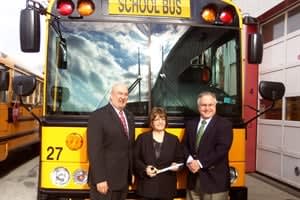
Rose Tree Media School District recently saved over $10,000 on fuel with its CNG buses. Shown here left to right: James Wigo, superintendent of schools; Grace Eves, director of management services; and school board President John Hanna.
Less maintenance needed
CNG and propane autogas don’t require aftertreatment, such as particulate filters or additives, that a diesel bus needs to burn off the soot coming out of the tailpipe, which can add several thousand dollars to a bus maintenance shop’s costs over the year.
“[CNG] can meet emissions standards with a catalytic converter without adding a filtration system or fuel to clean it up,” Grace explains. “There’s less maintenance, cost and downtime, which translates into lower labor costs, because you’re not performing as much maintenance and replacing as many parts.”
Using propane autogas reduces preventive maintenance costs by about 30% to 40% just in fluids and filters alone when compared with diesel, Taylor adds.
Additionally, starting up the vehicles in cold temperatures is much quicker than with diesel-powered vehicles.
Winters says he did not have to plug the propane autogas buses into a block heater overnight as he did with the diesel buses last winter.
“That cost us anywhere from $800 to $1,200 per month over about a five-month period,” he explains. “We spent an entire day [trying to get] our two diesel buses started. The propane autogas buses started instantly, at zero [degrees Fahrenheit] and 20 below zero wind chill.”
Ron Halley, vice president of fleet and facilities for Student Transportation of America (STA), which deployed 435 Blue Bird propane vision buses for Omaha (Neb.) Public Schools and Millard Public Schools in 2013, shared a similar experience. He says his shop manager in Omaha easily started up 134 propane autogas buses with no assistance when it was 24 degrees below zero last winter.
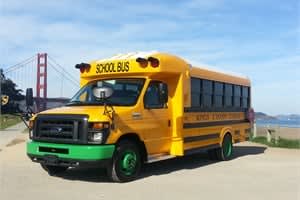
Electric buses are also becoming options, with Trans Tech’s SSTe all-electric school bus in demonstration in California.
Vehicle, infrastructure prices present challenges
On average, a propane autogas-powered bus costs about 5% more than a diesel bus, ranging from the mid-$80,000s to just over $100,000, depending on options, according to PERC’s Taylor.
That falls in line with what Crittenden’s Winters says. “The up cost on a propane bus versus a regular bus for us was about $5,000.” He was able to recoup that extra cost and more — $5,300 — in the first year with the first pilot program bus.
Ron Schepers, director of transportation at Yuma (Ariz.) Educational Transportation Consortium, says the consortium definitely recouped the $5,000 extra to buy its new propane autogas bus by reducing maintenance and labor costs.
“We anticipate being able to extend oil change intervals [and] shouldn’t have to work on a lot of plugged-up emission controls because of soot that comes out of diesel,” he notes.
The incremental cost on Type D CNG buses is typically as much as $40,000, says NGVAmerica’s Godlewski.
“It takes some time to make up the cost differential of a CNG bus compared to a diesel bus, but over the course of 12 years, the net benefit will be about $1 million, based on the 23 initial buses,” Rose Tree’s Wigo says.
The cost to install CNG or propane autogas fueling infrastructure, if the district cannot easily access a nearby fueling station, can be an obstacle and takes time, at three to six months.
The two types of fueling stations for CNG vehicles — slow-fill, which is designed to fill the vehicle’s tank overnight, allowing for a fuller fill without the issue of heat compression, and fast-fill, which will fill the tank in about the same amount of time as filling a traditional diesel tank — offer different benefits, says Thomas Built’s Routh. The slow-fill station can save districts money with a fuller fill, and the fast-fill station can save time.
Propane autogas stations can be added to a property relatively easily because they are available as skid systems that can be dropped into place on the lot and they can be moved easily, if necessary, Routh adds.
Rose Tree’s transportation department wanted its own CNG fueling station because its fleet travels about 1 million miles a calendar year. Installing the station took about six months, Wigo says.
“We decided early on that with the savings we were able to incur, we were going to install a fast-fill service fuel station at the bus depot,” he says. “If you have a fast-fill in the area that you can enter an agreement with, it would speed up the process a bit.”
Sometimes, depending upon the amount of fuel being used, an alternative-fuel supplier will put the fueling station on the district’s property at a lower cost, and recoup that investment via fuel sales over a multi-year fuel contract, Clean Energy’s Grace points out.
“The district is not paying out of pocket for the expense, and they save money on a per-gallon basis over the life of the vehicle,” Grace says.
The Yuma Educational Transportation Consortium operates eight Thomas C2 buses and 15 Blue Bird Vision buses and was able to mitigate infrastructure costs by arranging to get fuel at a bulk rate, Schepers says. The district installed an 18,000 gallon propane autogas fueling infrastructure with three dispensers and gets a 50-cent rebate on the fuel.
“We purchased fuel at some point for as low as the equivalency of 80 cents a gallon,” he says.
More Alternative Fuels

CALSTART and Forth Combine to Form Catalyst Mobility
The new name represents a renewed vision for the nonprofit focused on advancing clean, equitable, and affordable transportation solutions that move people and goods.
Read More →
Alt-Fuel Moves: New Buses, Charging Hubs & Real-World EV Testing
Propane and electric school bus deployments continue to grow as districts add new vehicles, expand charging infrastructure, and gather more real-world operating data.
Read More →
Fewer Electric School Bus Models Reshape the U.S. Market
WRI’s latest buyer’s guide points to a consolidating electric school bus market, but fewer options may reflect a maturing industry rather than fewer meaningful choices for school bus operators.
Read More →
The Fuel Budget You Can Actually Predict: How Propane Autogas Keeps Money in the Classroom
Learn how propane autogas helps school districts manage fuel costs with predictable pricing, lower maintenance, and reduced emissions from former transportation director Joel Stutheit.
Read More →
Hendrickson, Driventic Introduce New Electric Powertrain for School Buses
ELECTRAAX, the electrified, lightweight drive axle offers integrated ePowertrain efficiency and modular flexibility for Class 6–7 school bus use.
Read More →
The Mobility House Joins PowerFlex in Fleet Electrification Deal
The acquisition combines intelligent charging software, bidirectional charging expertise, and fleet electrification services to support the growing adoption of electric school buses across North America.
Read More →
Alt-Fuel Moves: Electric School Bus Investments Hit the Road
See which districts across the U.S. are putting electric school buses into service, expanding charging infrastructure, and planning the next phase of fleet electrification.
Read More →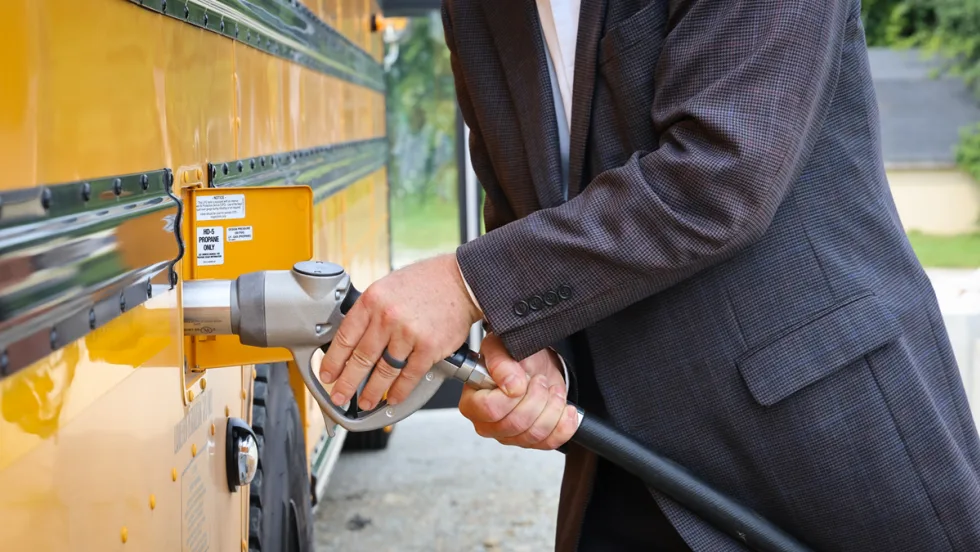
With Fuel Volatility Ahead, School Districts Turn to Propane
While diesel prices peaked above $5 this spring, districts with propane autogas-powered fleets paid under $2 per gallon, according to PERC.
Read More →
EPA Unveils Proposed Changes to 2027 Heavy-Duty Engine Rules
The federal agency has proposed changes to next year’s targets that would eliminate DEF derates, ease warranty requirements, and retain current NOx emissions standards.
Read More →
Alt-Fuel Moves: EV Charging & Infrastructure Projects Gain Momentum
The latest developments include new funding, charging infrastructure, utility investments, and fleet technologies designed to support the transition to electric school buses nationwide.
Read More →