




Extending Safety Margins Around School Buses
It would be easy to take for granted the safety equipment that has become commonplace on the exterior of school buses — stop arms, eight-way light sys...
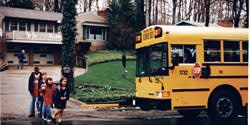
It would be easy to take for granted the safety equipment that has become commonplace on the exterior of school buses — stop arms, eight-way light systems and crossing gates, among others.
But, as we all know, these devices have contributed greatly to the outstanding safety record of the industry.
According to statistics compiled by the Kansas State Department of Education, the number of U.S. fatalities in the loading and unloading zones of school buses has averaged 18 per year over the past decade.
That’s an amazing statistic, given that 24 million children ride buses each school day. Of course, most of the credit goes to the 450,000 or so bus drivers who transport these children. Without their skill, experience and dedication, the fatality rate would certainly be higher.
Compelling numbers
It’s difficult to quantify the effectiveness of safety equipment in reducing the number of accidents.
Intuitively, however, we know that the addition of stop arms, crossing gates and eight-way warning lights to school buses has had a significant impact on safety in and around the vehicles.
To gauge the safety cushion created by the addition of one common device, Specialty Mfg. in Pineville, N.C., has compiled a report that compares the fatality rate of buses with and without crossing arms. The report, which sources the Kansas Department of Education, SCHOOL BUS FLEET and School Transportation News, studies a 16-year span, between the 1986-87 and 2001-02 school years. The results are compelling.
Over the 16 years, focusing only on fatalities at the front of buses, buses without crossing arms were involved in 115 fatalities; meanwhile, buses with crossing arms were involved in only 11 front fatalities. On a per-bus basis, the percentage of fatalities is .052 percent (without) and .004 percent (with).
It should be noted that nine of the 11 children killed at the front of crossing arm-equipped buses had crossed safely but circled back and returned from the driver’s left side. The other two fatally injured children were running to catch the bus and fell in front of it.
The effectiveness of crossing arms in preventing front-of-the-bus injuries and fatalities has prompted 21 states to mandate the installation of the device on new school buses. In some of these states, school bus operators have also been required to retrofit crossing gates on existing buses.
Dana Spurgeon, national sales manager at Specialty Mfg., says interest in crossing arms continues to grow. “Every year or so, another state adds crossing arms to its mandatory specification for new school buses,” he says. Wisconsin was the latest state to enact this requirement, which took effect in April.
Raising the safety bar
Although the safety record of school buses is exemplary, it could be improved. To that end, the manufacturers of safety products continue to enhance their offerings to the industry.
Specialty Mfg. offers air and the 5- and 6-series electric stop arms and crossing arms. The company was the first to develop and supply solid-state models to the industry with the 6-series product line. It recently introduced strobing and non-strobing LED stop arms, which have higher visibility and longer life.
Specialty also offers strobe lights that can be placed on the bus roof at the front or rear to improve bus visibility to other motorists.
Transpec Worldwide in Sterling Heights, Mich., also has enhanced its product line. In addition to the standard two-light incandescent stop arm, it offers a two-light strobing unit and an LED-based model that spells out "STOP" in 96 high-bright LEDs. A two-light strobing LED unit will be available soon.
Transpec also offers four types of crossing arms: a single pole, a double pole and a double pole with a retroreflective extrusion. The fourth unit, the newest addition to the line, utilizes a single wide extrusion polyrod.
Transpec relies on modular technology to drive all of its stop and crossing arms with a single weather-resistant motor housing manufactured with rust-proof components.
In addition to stop arms and crossing arms, Transpec also manufactures the Driver Alert™ LED message sign for the back of the bus. When the buses’ amber warning lights are activated, the sign alternately flashes “CAUTION” and “STOPPING.” When the red warning lights are activated, “STOP” and “DO NOT PASS” alternately flash. Field tests on numerous buses in more than 15 states have shown that the signs can significantly reduce illegal pass-bys.
{+PAGEBREAK+} Improved visibility
Strobe lights and eight-way warning lights help improve the visibility of buses, but retroreflective tape also plays a role. During the day or evening, conspicuity tape helps motorists see the bus.
Sun Art Decals manufactures high-performance reflective tape that exceeds federal specifications and can be overlaid on stop arms, adding to the device’s effectiveness. It also offers tape striping that can be used to outline the emergency exit or other strategic exterior areas.
Meanwhile, 3M also manufactures high-intensity retroreflective material for school bus safety markings. The material is designed to withstand repeated spray washings without delamination.
Avery Dennison manufactures a microprismatic acrylic film that can be seen from distances of up to 1,000 feet and is effective in all types of weather conditions. The tape, model V-9701, has a seven-year warranty.
High-tech options
Although not in widespread use in school transportation, high-tech object detection systems help warn drivers of children in the danger zone.
C.A.R.E. Inc. manufactures a motion-activated sensor system that uses a reflected radio signal to determine whether there are objects in the danger zones. One to four sensors can be installed, covering the front, two sides and rear of the vehicle. When the sensor detects reflected energy from a child in the danger zone area, an alarm is sounded and a red light is activated on a display unit in the driver compartment.
Meanwhile, Rostra Precision Controls manufactures the Student Detection System (SDS), which uses a network of microwave radar sensors that automatically look for movement in the danger zone when the bus stops and the eight-way warning flashers come on. If movement is detected by any of the sensors (up to 10 can be mounted around the bus), a visual and audible alarm warns the driver. Rostra officials say school bus operators in several states are beginning to install the system on existing buses as well as specifying the product on new buses.
Preco Inc. also manufactures an object detection system for school buses. The PreView™ system uses patented pulse radar technology to detect objects at the rear, on the sides or at the front of a vehicle. The system is designed to resist moisture, dust, vibration, heat, snow, rain and mud.
Radio Engineering Industries offers a rear-vision camera system for school buses that allows the driver to see behind the vehicle. It uses a weather-proof camera with a 130-degree diagonal viewing area connected to a 7-inch monitor.
Avoid complacency
Of course, the presence of external safety equipment isn’t a guarantee of safe passage. Transportation managers need to constantly emphasize the need for driver awareness of children around the bus.
An effective driver training program, coupled with the enhancements of safety equipment being offered by industry suppliers, will assuredly maintain pupil transportation’s standing as the safest mode of surface transportation.
More Safety

Geotab Expands Fleet Safety Tools With Video Coaching, Risk Insights
New safety and video capabilities aim to help fleet managers assess risk, support drivers, and take targeted action through video coaching, red-light violation detection, and more.
Read More →
How to Build a Better School Bus Driver Training Program
Is it time to strengthen your driver training? Here’s how to pick the right talent and improve recruitment, retention, and safety. This video is brought to you by IC Bus.
Read More →
Recent School Bus Accidents Leave 2 Dead, 2 Injured
Four school bus crashes in Florida, Illinois, and Georgia highlight risks in transportation lots, at bus stops, and during student loading and unloading.
Read More →

When Every Second Matters, Clarity Keeps Routes Moving
From routine delays to urgent incidents, strong communication practices help drivers, dispatchers, schools, and families respond with confidence.
Read More →
What Happens When a School Bus Catches Fire — and What Can Help
School bus fires are rare but can be devastating. Learn how advances in fire suppression and asset protection help fleets detect fires earlier, reduce damage, and improve safety.
Read More →
Geotab Launches Tool to Help Fleets Investigate Road Incidents
Geotab Investigations combines telematics data, video, documents, and other evidence to help fleets reconstruct incidents, resolve claims, and determine what happened.
Read More →
Texas Sixth Grader Wins 2026 National School Bus Safety Poster Contest
Sai Darshana Yekolu of Moseley Middle School in Prosper, Texas, was named the newest winner for her artwork, bringing the theme of “Safe Rides, Everyday Heroes” to life.
Read More →
Doing More With Less: How Transportation Directors Can Prioritize Safety Amid Budget Uncertainty
With diesel prices soaring and nearly one-third of transportation directors expecting budget cuts, maintaining student safety has never been more challenging. Download this guide to learn how leading districts are prioritizing risk, funding critical safety technology, and building stronger budget cases with data.
Read More →
Walton County Schools Adds Gatekeeper Stop-Arm Enforcement System
The Florida district will deploy Gatekeeper’s updated Student Protector technology, which now incorporates AI to improve video evidence.
Read More →
How To Build a More Secure School Bus Yard During and After Hours
As thefts and overnight security threats continue, school transportation leaders are combining stronger operational practices with AI-enabled surveillance to better protect buses, facilities, and staff.
Read More →