Beyond the Bus: Supporting Safe Ways to School for All Students
Transportation departments can adopt new approaches to help reduce traffic around schools and to ensure the safety of students who don’t qualify for yellow bus service.
by Bob Young
July 24, 2015
9 min to read
School bus service hasn’t changed much in the past 60 years, even though the world has changed significantly.
If our industry is going to stay relevant and effective, school transportation officials will have to embrace new approaches to ensuring the safety of all students — whether they qualify to ride the yellow bus or not.
Ad Loading...
School buses have become safer, and more students ride the bus because more and more people have come to recognize that riding the school bus is the safest way to get to and from school. Yet we still decide who gets to ride the bus by how far they live from school, while parents of students who don’t qualify to ride the bus clamor for transportation service.
Routing buses to pick up students takes advantage of the latest software technology; cameras monitor what happens on the bus; and GPS keeps track of where the buses are. But the service we provide continues to follow the same basic entitlement model we’ve used since the beginning of busing.
Entitled to transportation? Students who live far enough from school or have special needs are entitled to transportation. Those who don’t meet whatever criteria the school board or state has set are out of luck.
If you don’t think that’s an entitlement model, just listen to a few of those parents whose student missed the bus — or was taken off the bus for misbehavior — or those parents who believe the stop is too far away, or who think they should get a bus stop because both parents work.
"The reality is that we just don’t have the resources to carry every student on the yellow bus. But that doesn’t mean we don’t care about all of those other kids."
Ad Loading...
Try to save money by cutting routes and you’ll certainly hear from those who think they are entitled! For more than half a century, the perception of those who qualify for school bus service is that school transportation is an entitlement.
City buses operate as a service to the public with no one having privilege over anyone else. This is a service model. They provide a scheduled service, and anyone is free to take advantage of it.
You may say that school transportation does that, too, but on city buses anyone can ride — not just those who are qualified under some arbitrary rule, like how far they live from their job. People get on and off wherever they want to.
Getting on and off wherever one wants is heresy in the school bus world. You can’t let students get on anywhere and get off anywhere! Actually, with student tracking technology or with the use of bus monitors, you could.
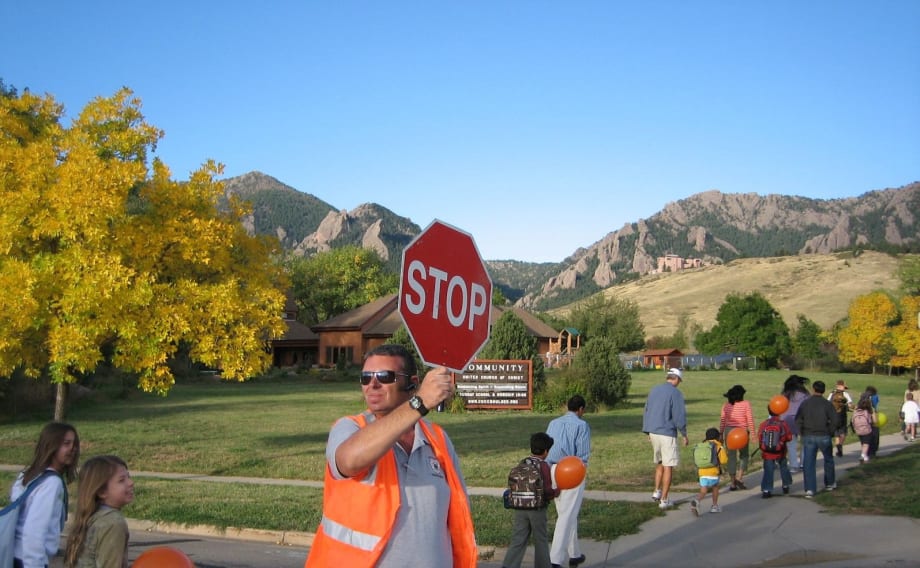
Boulder Valley School District’s Transportation Options program promotes bike to school days, as seen here.
Innovative service in Denver Denver Public Schools has implemented what they call the Success Express. In two areas of the district (soon to be three), buses travel continuous circular routes, stopping at schools and at a few neighborhood stops. One bus travels clockwise, and another travels counterclockwise. Monitors keep track of students, and each bus services multiple grade levels at the same time. Kids don’t exactly get on and off wherever they want — especially the younger ones — but their only qualification to ride is that they are district students. How far they live from the school doesn’t matter. These routes look more like city bus routes than school bus routes, and students have more options as to which school they attend. In today’s world of open enrollment, that’s a service that parents appreciate.
Ad Loading...
Success Express isn’t something that will work everywhere, but it’s the out-of-the-box type thinking our industry needs. Credit Pauline Gervais, Denver Public Schools’ former executive director of transportation services, and Nicole Portee, the current executive director, for making Success Express the success it has become.
Developing safe routes There is more to school transportation than just getting kids to and from school in yellow buses. While school buses transport millions of kids per day, millions more get to school some other way.
Some ride city buses, and some walk or ride bikes, but the majority ride to school in the family car, creating traffic problems and increasing pollution at schools across the nation. Half a century ago, most kids who didn’t ride the school bus walked or rode bikes to their neighborhood school. Today, parents live in fear — fed by sensationalist, instant news media — that their child will be abducted or get lost, even though such things are statistically rare.
Parents don’t want to let children out of their sight. It’s this change in attitudes and how it has influenced the way kids travel to and from school that inspired the Safe Routes to School program.
The idea of enhancing the safety of kids walking and biking to school certainly isn’t new. The Safe Routes to School concept started in Denmark in the 1970s.
Ad Loading...
The first official U.S. Safe Routes to School program was in the Bronx, New York, in 1997. California passed legislation in 1999 to fund Safe Routes to School programs, and federal funding started kicking in a year later.
Funding has increased over the years, but only recently has a connection begun to grow between yellow bus transportation and other to/from school transportation programs, even though they both share the same goals of getting kids to school and home safely.
School transportation departments can’t put every student on a school bus, but they can take part in assuring the safety of every student traveling to and from school.
Reducing traffic, boosting safety The city of Boulder, Colorado, recognized in the late ’90s that it had a traffic problem around schools. Working with the Boulder Valley School District, the city obtained a Congestion Mitigation and Air Quality Improvement (CMAQ) federal grant to reduce the traffic around schools.
Using this grant money, the school district hired a student transportation coordinator to work on the problem. Unique to the school transportation industry, this coordinator worked in the transportation department to help students who did not qualify for the yellow bus by finding ways to and from school other than in their parents’ car.
Ad Loading...
While the safest way for kids to get to school is on the yellow bus, the reality is that we just don’t have the resources to carry every student. But that doesn’t mean we don’t care about all of those other kids.
Providing this service in the transportation department for students who are not qualified to ride the bus was not only innovative, but it also demonstrated that we do care about making the trip to and from school safer for everyone. Transportation is much more than yellow buses.
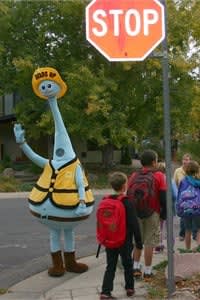
One component of Boulder’s Transportation Options program is a street crossing awareness campaign called Heads Up. The Heads Up mascot is pictured here.
Transportation options in Boulder Boulder’s original CMAQ grant morphed into the Transportation Options program, or, as we call it, the “TO School” program. We now have two people working on finding transportation options for students: Landon Hilliard, the original student transportation coordinator, and Peter Hurst, a bus driver turned alternative transportation advocate.
Here’s what the program encompasses:
Bike lesson and safety training in physical education classes
Walking safety assemblies
Street crossing awareness campaign (called Heads Up)
Crossing guard training
Promoting walk and bike to school days
Carpool matching
Walking school bus organization
Ad Loading...
Most popular by far is Peter’s Trip Tracker program, which rewards students for walking, biking, carpooling, riding city buses and even riding the school bus with Trip Tracker dollars that can be spent at local participating businesses.
Using grant money and donations, Peter then buys back Trip Tracker dollars at 50 cents on the dollar from those businesses. The businesses gain customers, and the kids learn about earning money.
Although it’s a struggle for Peter to find the donations and recruit businesses to participate, the program has been extremely popular, with more schools and parent volunteers being added each year.
Partnering for safety The Safe Routes to School National Partnership has been working to promote the integration of Safe Routes to School programs into school transportation departments. It’s a natural progression if we, as transportation professionals, really care about the safety of all kids. Also, it’s a first step away from the entitlement perception that so many parents (and school personnel) have of school transportation.
Innovative thinking like Success Express and the wise integration of Safe Routes to School is the future of the school transportation industry. Society has changed and has brought new expectations for service.
Ad Loading...
Neighborhood schools have given way to open enrollment in many states, with parents given more and more options in their children’s education. But by and large, when it comes to school transportation, parents have few if any options.
Education is changing, our buses have changed, and the way we think about traffic and vehicle emissions has changed, but the service side of school transportation hasn’t kept up with the times. The way school bus service is delivered needs to change.
More miles per gallon and reduced bus emissions are great, but they won’t make up for the increased fuel used and emissions created by all those parents taking kids to school in the family car.
Walking and biking are healthy. If one of those is an option for students, they should take it.
A comprehensive school transportation policy isn’t just about safety; it is about health and pollution, and teaching kids about safety and self-sufficiency. It’s about customer service that supports all aspects of education.
Ad Loading...
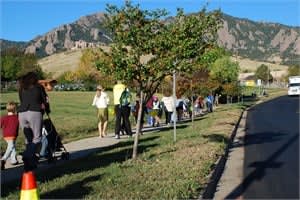
Boulder Valley School District’s Transportation Options program includes a variety of efforts to boost walking safety.
Creating sustainable programs You may be asking where the money for all of this is coming from. Some of these initiatives are expensive, some have a minimal cost and some cost nothing.
Peter’s program is close to becoming self-sufficient as he makes plans for next year without grant money. Parents and businesses alike have stepped up with monetary and voluntary support as they’ve seen the benefits of less traffic around schools.
Grant money is just a kick start, so when designing a program with grant money, think about how you will keep it going after the grant money runs out. Boulder Valley School District principals saw the advantages of the TO School program, and they gave the support needed to keep it going after the grant money was gone.
Those of us in the school bus profession have to work with our school administration, school boards, principals and parents to change the perception of transportation service. We have to promote not only the school bus, but all modes of transportation as a part of the education process. If we are successful — if school boards find it beneficial to education — they will find ways to fund it.
If there is a Safe Routes to School program in your district, get the transportation department involved. If there isn’t, start your own. Show the principals that you care about all their students, and they will help.
Ad Loading...
Most of all, we need innovative ideas like Success Express to demonstrate that we care about all students. We need to find more ways to show that school transportation isn’t an entitlement.
School transportation isn’t just about getting kids to and from school; it’s about access to education for all kids.
Bob Young is director of transportation at Boulder Valley School District.
More online Follow these links to find out more about the transportation programs mentioned in this article.
With fewer than 5% of citations involving repeat offenders, Westchester County officials said enforcement, education, and community partnerships are helping change driver behavior.
New safety and video capabilities aim to help fleet managers assess risk, support drivers, and take targeted action through video coaching, red-light violation detection, and more.
Is it time to strengthen your driver training? Here’s how to pick the right talent and improve recruitment, retention, and safety. This video is brought to you by IC Bus.
Four school bus crashes in Florida, Illinois, and Georgia highlight risks in transportation lots, at bus stops, and during student loading and unloading.
School bus fires are rare but can be devastating. Learn how advances in fire suppression and asset protection help fleets detect fires earlier, reduce damage, and improve safety.
Geotab Investigations combines telematics data, video, documents, and other evidence to help fleets reconstruct incidents, resolve claims, and determine what happened.
Sai Darshana Yekolu of Moseley Middle School in Prosper, Texas, was named the newest winner for her artwork, bringing the theme of “Safe Rides, Everyday Heroes” to life.
With diesel prices soaring and nearly one-third of transportation directors expecting budget cuts, maintaining student safety has never been more challenging. Download this guide to learn how leading districts are prioritizing risk, funding critical safety technology, and building stronger budget cases with data.