




Related: 8 Tips for Cleaning School Buses in the Age of Coronavirus
7 Bus Safety Practices Districts Are Planning for School Start
Extra sanitizing, contact tracing, social distancing, and increased training and communication are some of the best practices that transportation directors are implementing for school reopening amid COVID-19.
by Lynda Van Kuren
June 23, 2020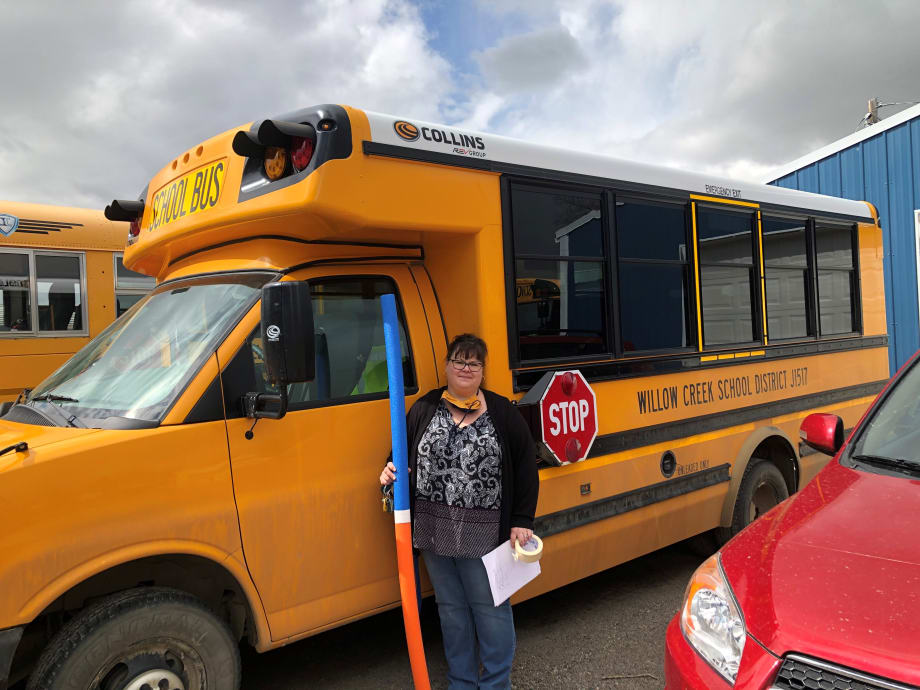
Willow Creek (Mont.) School District J1517, which serves 56 students, can easily implement social distancing on its two school buses. Shown here is bus driver Chrystal Duvall, holding a pool noodle, which school staff use to demonstrate 6 feet to students.
Photo courtesy Willow Creek (Mont.) School District J1517
5 min to read
Nothing about this year is business as usual, and that is especially true for school transportation departments. Front and center is how COVID-19 is changing everything from scheduling to operating procedures to driver responsibilities in efforts to prevent the virus’s spread.
“The question to ask is what are the things we can do to mitigate risk for any of the students, drivers, and monitors,” says Tim Ammon, co-owner of the consulting firm Decision Support Group.
Following are some of the best practices that transportation directors are planning to implement for school reopenings amid COVID-19.
1. Virus-Free Buses
The first line of defense against COVID-19 is keeping the buses virus-free, a process that entails cleaning, sanitizing, and ventilation, says Bill Harvey, director of transportation and security for the Honeoye Falls-Lima Central School District in Honeoye, N.Y.
“Buses can be a rolling petri dish,” he says. “Germs that were left on the bus at 7 a.m. are still on the bus at 3 p.m.”
Though new technologies such as ultraviolet light and electrostatic sprayers are available, to zap COVID-19 on his buses, Alfred Karam, the director of transportation for Shenendehowa Central School District in New York, will use the more economically feasible and proven fog machines two times a day on his buses. The electrically charged sanitizing fog wraps around every item and provides 100% coverage, he says.
Harvey’s buses will be disinfected twice daily with CDC-approved products. In addition, he will have his drivers or other staff wipe down high-contact points such as grab rails and seat tops after every run with disinfecting wipes.
Harvey also hopes to increase ventilation by keeping roof hatches open and, perhaps, installing power vents; while Karam says he will ensure drivers run their buses’ fans or air conditioners. Both will keep the windows cracked open when weather permits, and the wind doesn’t adversely affect a student.
2. Encouraging Personal Protection
To further prevent the virus’s spread, Jim Beekman, general manager of transportation for the Hillsborough County Public Schools in Florida, and Bonnie Lower, superintendent of Willow Creek School District J1517 in Montana, as well as Harvey and Karam, will also encourage their drivers and attendants to wear masks. Additionally, Karam, Harvey, and Beekman will provide gloves to their drivers and face shields to attendants who work with special needs students who spit or cough.
Beekman has hand sanitizer on his buses, too, and Harvey will install it on his fleet.
3. Contact Tracing Methods
School transportation departments can use a variety of tools, including student tracking technology and cameras, to determine which students were on a bus at the same time as a peer who has the virus, Ammon says. However, districts don’t have to go high tech. Karam is giving all students an assigned seat, and Harvey’s drivers will take attendance using a clipboard on each route.
4. Implementing Social Distancing
Willow Creek School is one district that has met the CDC recommendation to keep students six feet from each other on the buses (see sidebar below). However, Lower says she can do so only because her district is so small.
For larger districts, school transportation departments are juggling budgetary and time constraints while working to keep as much distance between students as possible. In the end, Harvey says the space between students will depend on the number of children on a bus. Given the uncertainty regarding how many parents will allow their children to ride a bus, Harvey is considering requiring parents to request transportation services.
Harvey also will address social distancing by boarding and dropping students off in shifts and at multiple school doors as well as breaking up consolidated stops where numerous students board a bus.
5. Planning Routing Scenarios
Karam, Harvey, and Beekman are working closely with their superintendents to ensure any possible plans, whether that be hybrid days, alternate days or weeks, or another option, are possible transportation-wise. To do so, they try out different scenarios on their base routes. For example, Karam examines the numbers derived from his routing software’s analytics and determines what options need to be implemented to achieve social distancing or make a plan workable.
Karam then gives his administrators feedback as well as alternatives on every plan considered.“I tell them whether a plan is feasible or not from a transportation perspective,” he says. “If their plan doesn’t work, give them a plan B and C, and let the decision makers decide where their comfort zone is.”
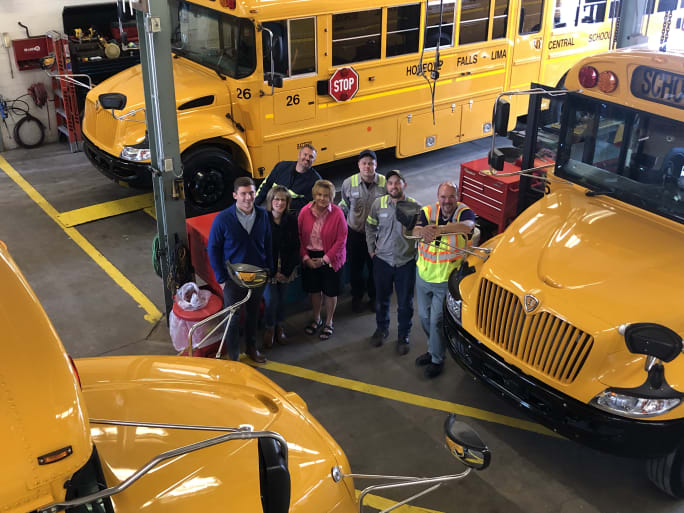
The first line of defense against COVID-19 is keeping the buses virus-free, which entails cleaning, sanitizing, and ventilation, says Bill Harvey, director of transportation and security for the Honeoye Falls-Lima Central School District. He is shown right with office and shop team members.
Photo courtesy Bill Harvey
6. Extra Driver Training
Because COVID-19 has redefined his drivers’ jobs, Beekman is providing additional training for them. Drivers must learn how and when to use cleaning and disinfecting products, how to manage paperwork to reduce exposure, and new check in and check-out procedures to reduce social contact, he says. Even the drivers’ lounges are different: Beekman removed some chairs to keep occupancy low. He also marked the floor by the time clocks to ensure social distancing.
Karam recommends starting driver training as soon as possible.
“We must communicate our expectations to the drivers early,” he says. “They must come in, grab their key, get last-minute instructions from dispatch, and board the bus. There will be no socializing.”
7. Communicating With Parents
Given the ever-changing information on the virus, communication with parents is more important than ever, according Ammon. He recommends that school transportation directors tell parents, using every means available, what they are doing to make school bus transportation safe, their expectations for personnel, and their expectations for parents and students. Furthermore, they must inform parents when and why plans change, he says.
“School transportation departments must be in communication with parents frequently and provide as must information as early and as often as they can,” he says.
Subscribe to Our Newsletter
More Safety

How to Build a Better School Bus Driver Training Program
Is it time to strengthen your driver training? Here’s how to pick the right talent and improve recruitment, retention, and safety. This video is brought to you by IC Bus.
Read More →
Recent School Bus Accidents Leave 2 Dead, 2 Injured
Four school bus crashes in Florida, Illinois, and Georgia highlight risks in transportation lots, at bus stops, and during student loading and unloading.
Read More →
Sponsored•September 8, 2026
When Every Second Matters, Clarity Keeps Routes Moving
From routine delays to urgent incidents, strong communication practices help drivers, dispatchers, schools, and families respond with confidence.
Read More →

What Happens When a School Bus Catches Fire — and What Can Help
School bus fires are rare but can be devastating. Learn how advances in fire suppression and asset protection help fleets detect fires earlier, reduce damage, and improve safety.
Read More →
Geotab Launches Tool to Help Fleets Investigate Road Incidents
Geotab Investigations combines telematics data, video, documents, and other evidence to help fleets reconstruct incidents, resolve claims, and determine what happened.
Read More →
Texas Sixth Grader Wins 2026 National School Bus Safety Poster Contest
Sai Darshana Yekolu of Moseley Middle School in Prosper, Texas, was named the newest winner for her artwork, bringing the theme of “Safe Rides, Everyday Heroes” to life.
Read More →
Sponsored•August 27, 2026
Doing More With Less: How Transportation Directors Can Prioritize Safety Amid Budget Uncertainty
With diesel prices soaring and nearly one-third of transportation directors expecting budget cuts, maintaining student safety has never been more challenging. Download this guide to learn how leading districts are prioritizing risk, funding critical safety technology, and building stronger budget cases with data.
Read More →
Walton County Schools Adds Gatekeeper Stop-Arm Enforcement System
The Florida district will deploy Gatekeeper’s updated Student Protector technology, which now incorporates AI to improve video evidence.
Read More →
How To Build a More Secure School Bus Yard During and After Hours
As thefts and overnight security threats continue, school transportation leaders are combining stronger operational practices with AI-enabled surveillance to better protect buses, facilities, and staff.
Read More →
FMCSA Names New Chief Safety Officer: What School Bus Operators Should Know
Steve Dowling is set to lead the federal agency's efforts to advance commercial motor vehicle safety and reduce crashes, fatalities, and injuries on the nation's roadways.
Read More →