




5 Tips for Planning School Bus Security Training Exercises
Enlisting support, alleviating fears by preparing staff for possible scenarios, getting buy-in from administrators, and familiarizing law enforcement with school buses can all strengthen safety.

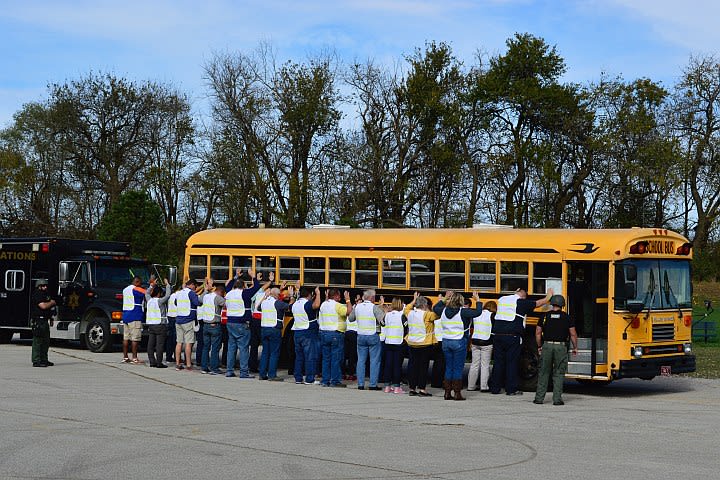
The National Association for Pupil Transportation held an interactive security exercise at its annual Summit in November. Here, attendees participate in a hostage situation exercise with local law enforcement.
The National Association for Pupil Transportation held an interactive security exercise at its annual Summit in November. Here, attendees participate in a hostage situation exercise with local law enforcement.
Although it can be frightening to think about, and the last thing anyone wants to do is scare staff, administrators, and parents, violent incidents on the school bus are a reality. While not very likely, one potential incident could include an active assailant. However, what is more likely to occur is a disgruntled parent or an angry student boarding a bus. Adequate training to deal with these incidents doesn’t have to be costly or time-consuming, and can possibly save lives. Seeking support, alleviating fears by preparing staff for possible scenarios, getting buy-in from administrators, and familiarizing law enforcement with school buses are key.
1. Enlist TSA support
Although costs and time can present obstacles to training staff on security, one school bus contractor is getting support to disseminate security training not only within its own staff but with its state association members as well.
Smith Bus Co. in Blairsville, Pennsylvania, partnered with the Transportation Security Administration (TSA) to organize a security exercise at the upcoming annual Pennsylvania School Bus Association (PSBA) convention in June.
The exercise, which is called a demonstration tabletop, will involve a range of stakeholders, as opposed to one bus company, says John Yimin, a regional security inspector (acting) for TSA surface region 7.
The two-hour demonstration tabletop will include about 25 school bus company and district personnel at a U-shaped table acting as “players” in various threatening scenarios, with about 80 to 100 personnel observing, and first responders in the audience. Standing to the side will be a few evaluators noting responses. TSA representatives will direct scenarios, asking the players questions and facilitating the discussion to keep it on track.
The players respond with what they think drivers, mechanics, district personnel, and emergency responders might do to mitigate the threat. Within a few weeks, the representatives will deliver an after action report (AAR) to participants.
During the exercises, representatives start with “insignificant” incidents and build up to the actual event, Yimin says.
“There is a shadowy figure at a school bus stop [for] three days in a row. What would the operator do?” Yimin says. “Then, there’s a car that follows a school bus. There is a backpack with a wire hanging out of it stuffed under a seat.”
The sample scenario leads up to an empty bus blowing up. What would the district do to respond?
As scenarios progress, players sometimes discover they don’t have a response because they haven’t thought about that particular situation before. However, because it’s a no-consequence exercise, the focus is on making participants aware, Yimin says.
Participants are not given specific scenarios before the event takes place, allowing them to be spontaneous and assess what they are currently prepared for, says Richard Serafin, staff coordinator at Smith Bus Co., who worked with the TSA to organize the event.
“It makes for a better exercise if we’re answering from the knowledge we have, than from a script we prepared because we got the questions beforehand,” he says. “Our hope is to develop a heightened sense of awareness and possibly prevent a terrorist attack while assisting first responders’ awareness [of pupil transportation situations].”
When participants get the AAR, people in the organization who are tasked with security can submit it to the school board or higher-ups and highlight items to fix that won’t cost anything.
One stumbling block for school bus operators to plan an event like a tabletop demonstration is the cost, but the TSA conducts them for free, so operators may only have to pay for the location.
Serafin says that the TSA organized the event almost entirely, only asking Smith Bus and the PSBA to get the exercise players.
“We say that we hope nothing like this ever occurs, but trying to be prepared, there is never anything wrong with that,” he adds. “That doesn’t mean it can’t happen, but taking steps to be prepared is a good thing.”
2. Emphasize preparation
The National Association for Pupil Transportation (NAPT) also partnered with the TSA in November to lead an even more interactive school bus security exercise and demonstration at its annual Summit.
The event, decidedly more large-scale than a tabletop demonstration, took about six months to plan, and included group and panel discussions, as well as live enactments performed by local law enforcement using school buses and attendees to train on preparing for violent incidents.
“We talked to [the TSA] about how we can better prepare our members, and part of that preparation is seeing how events would actually go,” says Keith Henry, director of transportation for Lee’s Summit (Mo.) R-7 School District and NAPT president.
The TSA, through its Intermodal Security Training and Exercise Program, which provides training and planning tools, contracted with a vendor to organize, evaluate, and implement the exercise. NAPT also worked with local first responders in Kansas City, Missouri, for the event.
“Fire, police, and EMS need to know how [school bus] operations run, but also we need to know how to work with them,” Henry says.
Although the event was well-received, Henry points out that a security exercise doesn’t have to be large-scale to be effective.
For example, the TSA can conduct a Highway Baseline Assessment for Security Enhancement (BASE) review study at an operation’s facility. The process involves a couple days’ worth of work onsite with local TSA field agents who provide a comprehensive report on the safety and security of the operation and facility. It includes site visits and reviewing processes and procedures. Some study recommendations are simple, such as changing procedures, while others are more involved, like putting a sensor around your facility’s perimeter, Henry says.
Henry has also been involved in two BASE studies at Lee’s Summit R-7 School District, and describes them as “very worthwhile.”
The recommendations are a helpful guide because they come from professionals who are up to date on current threats, and they think of things that pupil transportation providers may not have, he adds.
Meanwhile, all school staff members in Missouri are required to receive training every year, and transportation directors are working with first responders to design plans more specific to the school bus.
“Sometimes in a school building, they shelter in place; it’s hard to shelter in place in a school bus,” Henry says. “[We need to] develop techniques, and first responders, whether it’s your sheriff, police, or highway patrol, they’re eager to help, because the more knowledge we have, the more they can help us [during an incident].”
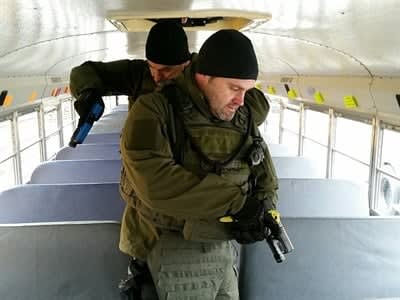
Krapf Bus Companies provided two school buses at its West Chester, Pennsylvania, location for a local SWAT team to train on last year.
3. Alleviate fears
Henry adds that although the thought of being faced with these incidents is scary, “we can’t stick our head in the sand and say it won’t happen, because we don’t know.”
“What we deal with is an unknown reality that hopefully will never happen, but all the same, it’s a reality that we have to grasp.”
Explaining to staff that the training will equip them with the tools they need should something potentially happen can hopefully ease those fears.
“Not knowing is probably the hard part, but being prepared is the easy part,” Henry notes.
He likens training to pre-tripping a bus: You hope you never have a breakdown, but if you pre-trip, you may find an issue and prevent it.
Henry also points out that dealing with an active shooter is unlikely, but encountering hostile parents and others who don’t understand how school bus operations work and are upset is more likely.
“We can take a lot from our active shooter training and use that information in other areas,” he adds.
4. Secure buy-in
Just as important and potentially challenging as what kind of exercise to put on is where to hold it, and getting buy-in, says Gabriel Rose, director of pupil transportation at the Maryland State Department of Education.
Rose previously worked for a small county in Maryland, assisting the transportation manager and handling school security, such as running lockdown drills to prepare for active assailants.
Despite completing extensive research, the transportation department wasn’t able to facilitate a security exercise, due to possible school board concerns over public perception.
The transportation department’s buses have the county name on the side, making it problematic to determine where to hold an exercise, particularly if it were located in a parking lot that people could see in passing.
“What message would we be sending by conducting the drill? The concern was that the public would think that this is a problem and become fearful of putting kids on buses,” Rose explains.
The transportation department could have suggested holding the exercise in a back parking area, without any line of sight, but the school board may still have had concerns about having police cars in the area.
Rose recommends getting approval to hold the exercise on school grounds, or if need be, somewhere that the public doesn’t have access to.
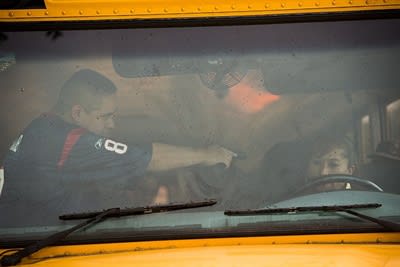
Although the thought of being faced with an incident such as an active assailant may be scary, preparing staff through training can alleviate fears. Shown here is an armed intruder training held by Houston Independent School District.
5. Donate buses
Prior to Lee’s Summit, Henry worked for Independence (Mo.) School District. The transportation department had an old bus that was, as Henry put it, “more valuable for the scrapyard than for trade-in.”
“If you have a bus that’s not worth much, it’s a good idea to allow your first responders to utilize it because [school] buses are different from other buses,” he adds. They are built with steel, providing more integrity for the occupant compartment, but are harder to access, unlike a charter bus, which is built with plastic, he notes. Additionally, school bus windows are smaller, making it tougher for police, especially those wearing body armor, to enter.
The transportation department allowed police officers to experience what it would be like to break into a bus: cutting into the side, entering through a window, breaking windows, and entering through a locked back door.
Krapf Bus Companies also provided two school buses at its West Chester, Pennsylvania, location for a local SWAT team to train on last year.
Krapf hoped the buses would familiarize SWAT team members with the vehicle’s unique aspects if they ever need to respond to an incident on a school bus, particularly while equipped with vests and rifles, says Shawn McGlinchey, vice president of risk management for Krapf Bus Companies.
During the two-day training, the SWAT team received an overview of the vehicle, access points, and communication capabilities on board, he adds.
More Safety

How to Build a Better School Bus Driver Training Program
Is it time to strengthen your driver training? Here’s how to pick the right talent and improve recruitment, retention, and safety. This video is brought to you by IC Bus.
Read More →
Recent School Bus Accidents Leave 2 Dead, 2 Injured
Four school bus crashes in Florida, Illinois, and Georgia highlight risks in transportation lots, at bus stops, and during student loading and unloading.
Read More →
When Every Second Matters, Clarity Keeps Routes Moving
From routine delays to urgent incidents, strong communication practices help drivers, dispatchers, schools, and families respond with confidence.
Read More →

What Happens When a School Bus Catches Fire — and What Can Help
School bus fires are rare but can be devastating. Learn how advances in fire suppression and asset protection help fleets detect fires earlier, reduce damage, and improve safety.
Read More →
Geotab Launches Tool to Help Fleets Investigate Road Incidents
Geotab Investigations combines telematics data, video, documents, and other evidence to help fleets reconstruct incidents, resolve claims, and determine what happened.
Read More →
Texas Sixth Grader Wins 2026 National School Bus Safety Poster Contest
Sai Darshana Yekolu of Moseley Middle School in Prosper, Texas, was named the newest winner for her artwork, bringing the theme of “Safe Rides, Everyday Heroes” to life.
Read More →
Doing More With Less: How Transportation Directors Can Prioritize Safety Amid Budget Uncertainty
With diesel prices soaring and nearly one-third of transportation directors expecting budget cuts, maintaining student safety has never been more challenging. Download this guide to learn how leading districts are prioritizing risk, funding critical safety technology, and building stronger budget cases with data.
Read More →
Walton County Schools Adds Gatekeeper Stop-Arm Enforcement System
The Florida district will deploy Gatekeeper’s updated Student Protector technology, which now incorporates AI to improve video evidence.
Read More →
How To Build a More Secure School Bus Yard During and After Hours
As thefts and overnight security threats continue, school transportation leaders are combining stronger operational practices with AI-enabled surveillance to better protect buses, facilities, and staff.
Read More →
FMCSA Names New Chief Safety Officer: What School Bus Operators Should Know
Steve Dowling is set to lead the federal agency's efforts to advance commercial motor vehicle safety and reduce crashes, fatalities, and injuries on the nation's roadways.
Read More →