




5 Questions: Bucky Law Reflects on The Bus Center's Half Century
The company that started as a Tennessee Blue Bird dealer is now a franchise that sells Thomas Built Buses. For Bucky Law, pupil transportation is in the blood.

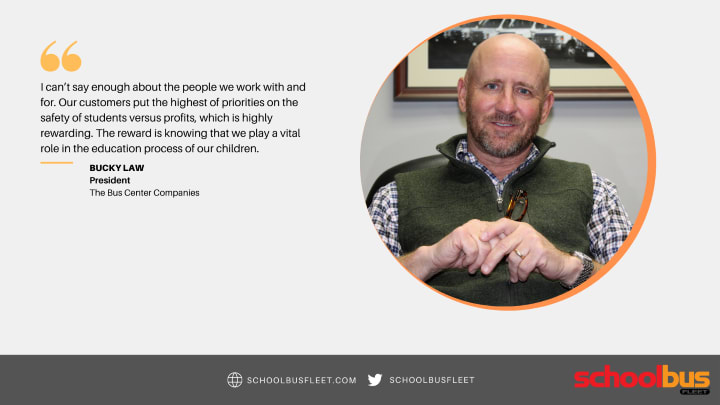
Bucky Law’s father, George, got his start as a summer worker at Blue Bird in 1961. Eventually, he went to work for Jack Beebe, a Blue Bird dealer in Connecticut. The first bus Bucky rode was driven by Mr. Pearcy, and it took him to Mitchell Neilson Elementary School in Murfreesboro, Tenn., when he was 9. He joined the sales team after graduating college in 1986. Bucky Law, who lives in Birmingham, Ala., now leads The Bus Center companies as president. In his spare time, he plays golf, hunts, skis, and spends time with family.
In this interview with School Bus Fleet, Law talks about the evolution and future of the pupil transportation industry through the lens of a school bus dealer.
1. What does it mean to be part of a company that’s not just been around for half a century, but also has been such a deeply ingrained part of your life?
The school bus business has been an integral part of my life for literally all of my life, as my dad first worked for Blue Bird at the plant in Fort Valley when I was born in 1963. My dad was so immersed in the business of buses that discussions of the bus business were a normal topic at dinner each night as I was growing up. Unfortunately for my family, I have carried forward that dinner table topic to today – and I’m sure they tire of it but have learned to tolerate it. My dad always used to say that the school bus business was an honorable business – so much so because of the cargo our buses are entrusted to carry – our children and grandchildren. It’s a real source of pride for me to be a part of this business.
2. Describe some of the key ways that you’ve seen the pupil transportation industry evolve since the 1970s.
The safety improvements through the years are so well thought through with absolute collaboration between manufacturers, dealers, and operators. The school bus I rode had metal back seats, no emergency exits and gasoline engines that got 3 miles per gallon. Today’s buses are equipped with the latest and greatest safety equipment, routing software, clean diesel engines, and so many features that could not have been fathomed back in 1972. In 2004, we became a proud Thomas Built Bus dealer. In addition, today our drivers are well trained and our buses are for the most part efficient, and the improvements keep coming especially in regard to technology.
3. What are the greatest benefits of working in the school bus industry?
The people. I can’t say enough about the people we work with and for. Our customers put the highest of priorities on the safety of students versus profits, which is highly rewarding. The reward is knowing that we play a vital role in the education process of our children. In 2007, we embraced the American School Bus Council’s Love the Bus program to show appreciation to school bus drivers. We hold a statewide event which encourages people to share their stories of the extra measures school bus drivers go to make sure their students have a safe and secure ride to and from school. The letters of recommendation pour into our office with amazing stories of how so many bus drivers connect with their students. It’s a challenge to pick the Alabama winners each year, and it’s an honor for us to reward these caring and selfless drivers who make such an impact on the lives of the kids they serve.
4. What are the most significant challenges your company currently faces as it embarks on its next 50 years?
Finding skilled young talent that is seeking the same sense of satisfaction and enjoyment to working within our industry as I do. We have extremely talented young people but our business is not quite as “sexy” as cars, boats, automobiles – so it takes a special person to realize that the honor in our business outweighs “sexy” all day long. In addition, the transition from clean diesel to electric will be a challenge but is probably one of the more exciting developments of my career. My opinion, and I express this to our customer friends, is that to consider other options such as gas, propane, etc., is a waste of the next few years – diesel is clean today, and clearly efficient, and so the only logical next step is zero emissions which only electric can accommodate. But we have to be deliberate as we approach the transition and consider all aspects ‐ range, charging, V2G, etc.
5. How do you expect your business to evolve with the push toward fleet electrification?
This might be exactly what drives young people to our business. Tomorrow’s maintainers will not be the “shade tree” technicians of years past. They’ll be highly driven in regard to technology. As a result, I can imagine our workforce will look completely different 10 years down the road. It’s very exciting and just another page in the evolution of our industry. In addition, our model will be different ‐ an electric motor is much simpler than an internal combustion engine and so our service opportunities may in fact reduce. As a result, we'll look for opportunities that fill that void. That could mean a range of opportunities from battery recycling, battery leasing, etc.
More Management

How to Build a Better Driver Training Program
Ready to boost up your school bus instructor training? Here’s how to pick the right talent and improve recruitment, retention, and safety.
Read More →
CALSTART and Forth Combine to Form Catalyst Mobility
The new name represents a renewed vision for the nonprofit focused on advancing clean, equitable, and affordable transportation solutions that move people and goods.
Read More →
What Makes a Great School Bus Driver Trainer?
Choosing the right school bus driver trainer takes more than experience. Learn six keys to selecting and developing trainers and evaluating program effectiveness.
Read More →


School Bus Contractors Expand Through New Deals, Acquisitions & Partnerships
STA's Canadian division acquires Ontario-based G&L Stevenson Transport while Durham School Services adds a new district contract in California, First Student adds a New Jersey contract, and Minnesota Coaches acquires Halo Transportation.
Read More →
Logan Bus Company Rolls Out AI Phone System for NYC School Bus Families
A summer pilot found that AI agents could handle most routine calls, freeing up time for customer service staff to focus on emergencies and complex family concerns.
Read More →
From Intent to Impact: What I Learned About Leadership from TAPT
A Texas transportation supervisor shares lessons on self-awareness, accountability, managing stress and building trust — and why investing in leadership development matters at every stage of your career.
Read More →
NAPT Names 2026 Award Recipients, Hall of Fame Inductee
Who earned national recognition for their work in student transportation? This year, NAPT named five recipients of its 2026 awards for service, safety, and leadership, plus its newest Hall of Famer.
Read More →
2026 State of Student Transportation Report
Driver shortages. Rising costs. Growing safety expectations. More data, but not enough time to act on it. The 2026 State of Student Transportation Report reveals what transportation leaders say is putting the most pressure on their operations—and where they’re investing next. See how your priorities compare.
Read More →
How to De-Escalate an Angry Person: 5 Steps for Handling Workplace Conflict
What makes emotions run high, and how should you handle an angry colleague or parent? Follow these steps for staying calm, listening, showing empathy, and resolving conflict.
Read More →
What Readiness Looks Like This School Year
Learn about the challenges shaping the 2026–2027 school year, from persistent driver shortages and budget pressure to technology and readiness gaps. See how school districts are responding and adapting in Zonar’s 2026 Back-to-School Readiness Report.
Read More →