



Tips on Buying and Selling Used School Buses
Shrinking school budgets are forcing some school bus fleets to look at the 'pre-owned' market, where research and comparison shopping can save thousands of dollars.
Ed Hellmers is planning a road trip. Hellmers, co-owner of Hellmers Transportation Inc. in Equinunk, Pa., has scheduled a six-hour drive across Pennsylvania to look at a used school bus for his contractor operation. It’s not that he can’t find a similar model closer to home, it’s the potential savings — $6,000 — that makes it worth his time and energy.
“You can save a lot of money buying used school buses, but you have to know what you’re looking for,” Hellmers says.
That’s good advice, especially considering that an estimated 40,000 used school buses hit the market every year. These retired buses find their way back to dealers as trade-ins or can end up in the hands of exporters who transport them to Latin America or even the Middle East and Russia.
Growing Interest Seen in Used School Buses
Indeed, the market for used school buses is growing, and not just among churches, day-care centers and exporters. School districts and contractors are giving the used-bus market a closer look because of budget shortfalls and greater emphasis on putting dollars into the classroom, not ancillary services like transportation.
“Some school districts just can’t afford the luxury of buying new school buses,” says David Tinsley, sales manager at Midwest Bus Sales Inc. in El Reno, Okla. “In most cases, they can pick up a used school bus. The way they’re built today, these buses have extended life cycles. A used bus is not for every school district or contractor; but it’s an option.”
Because some school districts have discovered economies in shortening their fleet replacement cycles, retired buses with high residual value are becoming more readily available for sale to other school systems and to contractors.
San Diego Sells Out
For example, San Diego Unified School District has shortened its replacement cycles to six years for conventional buses and 10 years for transit-style buses. Because the vehicles are in such good shape when they’re put on the market, the district has no problem finding buyers.
“We have people waiting in line for them,” boasts Roger Hansen, manager of the district’s 530-bus fleet. “We can sell everything we have.”
He says interest in used buses, especially those offered by his district, has grown, particularly among smaller school districts that can’t afford the heavily spec’d buses that San Diego Unified acquires for its fleet.
“Because we buy so many buses, we can get options and other special things that smaller districts can’t,” Hansen explains. “If you’re only buying one or 10 or 20 buses, [the factory] won’t do a lot of the special stuff that they’ll do for us. These smaller districts couldn’t buy a [new] bus like the ones that we sell.”
Hansen says the district’s used school buses are marketed at trade shows and through advertising in industry publications. The target audience includes transportation and purchasing managers, but Hansen says cost-conscious school board members also show interest in used school buses. Although San Diego Unified has to purchase a greater number of buses each year with its shortened replacement cycle, Hansen says the cost savings on the maintenance side are worth it. Because the buses are in such good shape, he can run his fleet maintenance program with fewer mechanics.
In fact, his bus-to-mechanic ratio is an astounding 44 to 1.
“With an old fleet, you couldn’t do that,” he says. Although school districts like San Diego Unified are beginning to generate high-value used buses that it can sell on the open market, the traditional source of these vehicles is school bus dealers and used-bus traders who specialize in the “pre-owned” market.
Internal Sources Tapped for Used Buses
Some dealers, such as Midwest Bus Sales, tap a steady source of late-model used buses from affiliated contractor fleets. In the case of Midwest, the dealership acquires 95 percent of its used buses from its contractor operation, School Services and Leasing in Shawnee, Kan., which operates more than 2,000 school buses.
“Our fleet averages about 3 1/2 years of age, and it gives school districts from coast to coast the opportunity to buy 1- to 5-year-old buses that come out of our fleet,” Tinsley says, adding that the prime market is 3- to 5-year-old buses.
“The used bus business is a big part of our business,” says Dave Fitzgerald, vice president of sales for Wolfington Body Co. Inc. in Exton, Pa. “The new sale generates the used sale. We feel we can be aggressive selling new buses because we have such a good used-bus market.”
Fitzgerald says the dealership sells approximately 1,100 used buses per year. Before they’re put on the block, the buses are inspected and reconditioned, with seat repairs, body work for minor dents and scratches, new brakes and tires. Fitzgerald says school districts and contractors are typical buyers of late-model used buses.
More “mature” buses, those between 8 and 10 years old, generally are sold to churches and exporters.
Ross Transportation in Oklahoma City can’t afford to rely on trade-ins for its used-bus sales because school districts in Oklahoma “pretty much run the buses until they’re dead,” says Bill Ross, owner of the dealership.
Instead, the company will acquire late-model buses from other parts of the country, especially the Northeast. However, buses from the Great Lakes and Gulf states are avoided, Ross says, because of the salt and rust problem. Profits from used-bus sales can range from $500 to $800 for older models to $2,000 for late models, Ross says.
Typical buyers are school districts, contractors and churches. Ross says customers are offered a 45- to 60-day “bumper-to-bumper” warranty on buses that are 5 years old and younger. Customers in the market for buses 10 years and older might want to consider an auction rather than purchasing from a dealer. “Yeah, for the most part, auctions are not a bad way to go,” Ross says.
He adds, however, that you might not know what you’re buying. “At half of the auctions I’ve been to, they won’t even let you start the buses,” he says. Ross also cautions auction buyers from getting “caught in the moment” and paying too much. “I’ve seen church groups end up paying $2,500 for a bus that they could have bought from us for $2,000,” he says.
Is the Price of the Used School Bus Right?
Accurately judging the value of a used school bus requires experience, knowledge and research. An experienced buyer or seller will generally gauge the price of a used model on a host of factors, including age, mileage, condition of body, chassis and engine, passenger capacity, cleanliness, maintenance and repair documentation and visual inspection. Hellmers of Hellmers Transportation Inc. says relying simply on the odometer reading can be misleading.
“To me, mileage is not important,” he says. “You could have a bus with 50,000 miles on it, but you don’t know how often the oil’s been changed.” Hellmers, who spent eight years working at an International dealership and helps maintain his company’s fleet of nine buses, knows what to look for when inspecting a bus.
For example, if the kingpins don’t look like they’ve been greased, that’s a bad sign.
“You can also look at the paint and tell if the bus has been washed and waxed,” he says. “And you can also tell a lot by the condition of the interior, whether there’s a lot of gum on the floor.”
Fitzgerald of Wolfington Body Co. Inc. says “industry experience” is what’s used to set prices. Each sales representative has a trade-in book that’s compiled at Wolfington.
Buying guides, he says, are rarely used.
“The prices are too low in some areas and too high in other areas,” he says. When the buyer and seller don’t agree on the price, that’s when bargaining comes into play. “There’s a significant amount of bargaining, especially with Central Americans,” Fitzgerald says, laughing. “They’ve become part of our customer base.”
Tinsley of Midwest Bus Sales says prices are heavily influenced by the options included on the bus. For example, he says a lightly spec’d 1998 model may be comparable in price to a heavily spec’d 1996 model. He also says that a heavily spec’d bus is more marketable because it satisfies more state mandates than a lightly spec’d model. An option like fire-blocking seating material is valuable because it’s mandated in some states.
“You open up your customer base with a heavier spec’d bus,” he says.
Tips on Creative Marketing
School districts and contract operators who want to unload their really old buses need to be creative when looking for potential buyers. Rather than just offering the equipment as a valueless trade-in, they might consider some unusual alternatives. The Yellow School Bus Book, which used to be published annually by Yellow School Bus Inc. in Los Angeles, suggested the following strategies for selling those hard-to-move units.
Consider alternative customer groups, such as summer camps, farms that need to transport laborers, semi-pro sports teams, dude ranches and remote resorts.
Take out the seats, black out the windows and market the units as mobile storage facilities.
Market the bus to public parks as a playhouse for children.
Consider selling the vehicles to component remanufacturers, who may be interested in the motors, alternators, turbo chargers, engines, transmissions and tires.
More Management

Zum Reaches 19 States With New York Expansion
The addition of the Empire State to the student transportation company's roster marks a growing expansion in the Northeast as it scales its tech and school bus services.
Read More →
First Student Updates Its Parent App
First View connects both yellow bus and alternative transportation, giving families one platform to track student trips for the new school year, with 15 languages supported.
Read More →
The Back-to-School Checklist Every Director Should Complete Before the First Bell
Help your transportation team start the school year strong with these tips for contingency planning, communication, fleet visibility, technology, and trip management.
Read More →
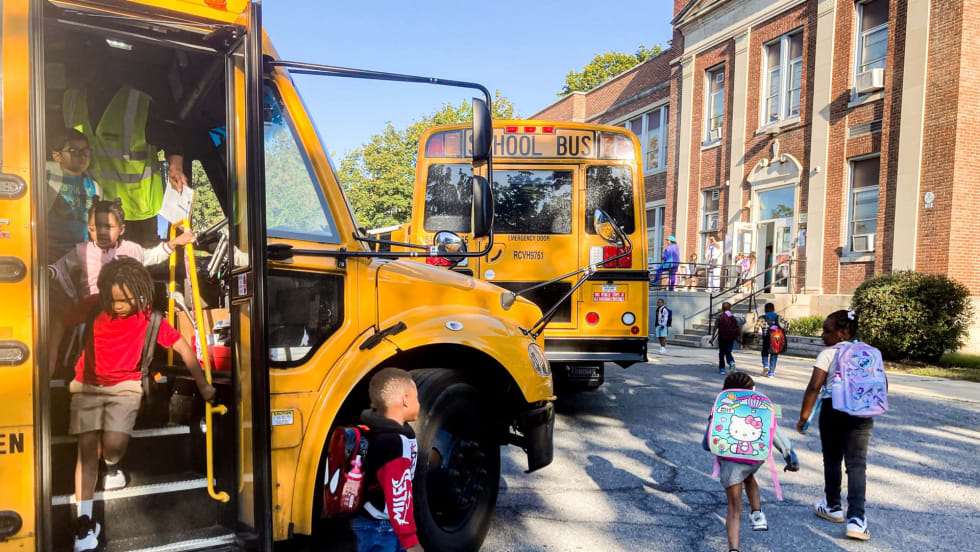
How a New York District Cut Nearly $1M in Transportation Costs While Expanding Bus Access
A data-driven overhaul with BusRight reduced Poughkeepsie City School District's planned routes from 26 to 17 while extending school bus service to about 1,200 additional students.
Read More →
Budgets Down, Enrollment Shifting: What the Data Says Districts Should Watch
School transportation departments face two converging challenges this year: tightening budgets and shifting enrollment. Most districts still address these issues separately, but the assumption that either trend will simplify operations is proving incorrect.
Read More →
These 8 School Transportation Companies Made the 2026 Inc. 5000 List
Find out which school transportation contractors, technology providers, and suppliers ranked among America’s fastest-growing private companies.
Read More →
The Link Between Emotional Intelligence and School Bus Safety
How can emotional intelligence help transportation pros navigate stress, manage change, and build stronger relationships? Listen to find out.
Read More →
What Emotional Intelligence Has to Do With School Bus Safety
In this video, discover how emotional intelligence can help transportation leaders and drivers navigate stress, manage change, and build stronger relationships. The Route is sponsored by IC Bus.
Read More →
Beyond Two-Way Radios: School Bus Communications Evolve With Push-to-Talk Over Cellular
PRYME Radio and PositionPTT join forces to advance hands-free radio use and reduce distracted driving. See how PoC compares with traditional radios on range, cost, safety, and connectivity.
Read More →
Have School Districts Adapted to Bus Driver Shortages or Simply Accepted Less Service?
According to a recent report from HopSkipDrive, many districts appear to have recalibrated what "normal" transportation service looks like.
Read More →