




Working Animals: Service Dogs and the School Bus
How and When to Buy a Used School Bus
When it comes to purchasing a used school bus, you may already know a lot more than you think about making the right choice.
by Calie Shackleford
May 1, 2019
Uncovering a used vehicle’s past in order to determine its potential future is not the easiest of tasks.
Photo: Barry Johnson
6 min to read
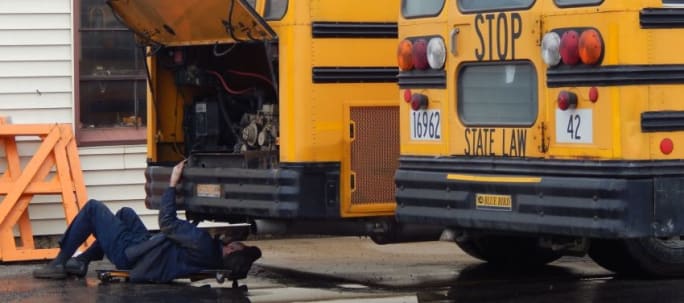
An inspection by your mechanic can reveal potential problems with the engine or other significant components such as the transmission or brakes.
Photo: Barb Kracheck
When it comes to purchasing a used school bus, you may already know a lot more than you think about making the right choice.
Executives seasoned in both buying and selling in the used bus market say the experience bears a striking resemblance to a used car purchase. But don’t worry. Chances are you won’t hear a bus salesman say, “What do I have to do to put you in this 2002 Blue Bird?”
So what do we know about purchasing a used car? The most important thing to look for is a healthy engine with a lot of life left.
According to Gavin Berwald, transportation supervisor for Beachwood (Ohio) City Schools, the same is true for a used bus.
“The chassis is the biggest thing to pay attention to. It’s where you have the biggest cost factor, and it determines the life of your bus,” says Berwald. “You’ve got to make sure the engine is still a workhorse.”
Know the History of the School Bus
Uncovering a used vehicle’s past in order to determine its potential future is not the easiest of tasks. Wayne Winkler, sales representative with Trucks of Bismarck, a Thomas Built Buses dealer in North Dakota, suggests starting with a review of the actual mileage as well as the service history.
It is not uncommon for an older bus to have had an engine or transmission replaced, which changes the effective age as indicated by the mileage report. Documentation of those replacements is very important. You will need to know if the replacement equipment was new or used and how long ago it was installed to assess the future life of the vehicle. In most cases, your dealer can provide you with the necessary paperwork and background information. Without it, the inherent risk associated with such a purchase does increase.
“Your research should not end with a review of paperwork,” says Berwald. “Bringing along an experienced technician to examine the condition of the chassis can make all the difference when it comes to your final decision and your bargaining power.”
An inspection by your mechanic can reveal potential problems with the engine or other significant components such as the transmission or brakes. With the final word from your mechanic and sufficient information from your dealer, your next step is to begin critiquing the body.
Appraise the Body of the Bus
Although the condition of the chassis is the best indicator of a used buses’ life expectancy, giving due attention to the body is still important. As with a used car, you would like your bus to look as new as possible. But what is more important is how the body will hold up when it comes to passenger safety. Carefully examining the body for rust, corrosion, secure steps and a solid floor will help determine the overall safety of the bus while also serving as an indicator of the vehicle’s longevity.
By now the scale should be tipping toward your final decision. But there is one last thing to consider before you are ready to negotiate price — equipment improvements. When purchasing a used car, it’s often the lack of new safety equipment that leaves you longing for the new car lot. After all, a car without air bags or anti-lock brakes might not be as appealing even if it is in great overall shape.
In most cases, new regulations and improvements in the design of school buses and their equipment have made old ideas obsolete. Often, such updates are considered standard and are not optional. As a result, you will likely need to invest at least a small amount of time and money to update equipment such as mirrors and tires.
School Bus Specs, Warranties, and Financing
"Buyers should also check state and federal guidelines before purchasing a used vehicle,” says Lynn Deason of Tri-State Bus Sales, an International bus dealer in Crete, Ill. “This will provide an accurate picture of the items that may need updating and the potential out-of-pocket costs.”
Cost, after all, is what it often boils down to. A used bus, depending on the condition and specifications, can run anywhere from $3,000 to $7,000, while a new bus will hit in the $50,000 range or higher. The initial savings are substantial, but repairs will eventually be necessary. Therefore, a late-model used bus is generally the best investment.
Many school districts are now purchasing 10-year extended warranties for their new buses. Generally, these warranties, which cost $400 or $500, can be transferred to the new owner and add significant value to the vehicle.
Financing is another consideration. You would expect financing options to be available when purchasing a used car, and the same is true for a used bus. Various options should be available through the dealer or other financial institutions.
In addition, when negotiating costs, be aware that the make of the body and chassis play a role in determining the reliability as well as the price of a used bus. Information on the application of premiums and discounts based on brand can be found in The Official School Bus Resale Guide, which you can order by calling (800) 775-4577.
Whether you are looking into purchasing a used bus because you’ve found yourself in a crunch and need a bus or two right away or because money is tight and it’s a short-term fix until budgets increase, the reality is the same. A used bus is not a long-term investment.
However, many used buses serve a useful purpose when districts are in need of non-route vehicles, which include activity buses or those used exclusively for field trips. According to the 2002 school district survey published in the November 2002 issue of School Bus Fleet, about half of school bus fleets (50.8%) operate with a spare ratio of 10 to 20 percent.
Therefore, there are a few things you should consider to extend the life, performance and safety of your used bus.

Make your used buses part of a regular preventive maintenance program, following all original manufacturer guidelines.
Photo: IC Bus
Protect Your Used Bus Investment
According to Winkler, the first step is to change all the fluids, especially the oil, which should be changed twice. The oil on the dipstick should be good before and after you run it. Having the oil analyzed at every change until you know better is also a good exercise. These analyses will provide a solid indication of what may be going on or coming up.
Second, perform the most comprehensive DOT-type inspection you can imagine.
“Don’t do it with the idea of what it will take to pass inspection, do it with the intent of learning anything and everything you can about the unit,” says Winkler. “The more you are willing to take apart and rebuild, as you would do if you were restoring a collector car, the more you will learn and allow yourself to maintain or prevent.”
Finally, make your used buses part of a regular preventive maintenance program, following all original manufacturer guidelines. This is the most effective tool in ensuring the future performance and safety of all your used vehicles.
Understand the Risks of Buying a Used School Bus
Purchasing a used bus comes with a number of risks. Things are bound to go wrong that probably are no longer under warranty, and parts can be hard to find as some manufacturers have gone out of business. However, thoroughly investigating a vehicle’s history and condition and implementing a standard maintenance program can help you get the most from your investment.
If you’re looking for long-term savings, “the best investment is having a regular replacement schedule so you can annually replace buses and keep them under warranty,” says Berwald. “This will save you time and money, while side-stepping many of the challenges of dealing with older buses.”
About the Author: Calie Shackleford is a freelance writer in Brentwood, Tenn.
Subscribe to Our Newsletter
More Management

How to Build a Better Driver Training Program
Ready to boost up your school bus instructor training? Here’s how to pick the right talent and improve recruitment, retention, and safety.
Read More →
CALSTART and Forth Combine to Form Catalyst Mobility
The new name represents a renewed vision for the nonprofit focused on advancing clean, equitable, and affordable transportation solutions that move people and goods.
Read More →
What Makes a Great School Bus Driver Trainer?
Choosing the right school bus driver trainer takes more than experience. Learn six keys to selecting and developing trainers and evaluating program effectiveness.
Read More →


School Bus Contractors Expand Through New Deals, Acquisitions & Partnerships
STA's Canadian division acquires Ontario-based G&L Stevenson Transport while Durham School Services adds a new district contract in California, First Student adds a New Jersey contract, and Minnesota Coaches acquires Halo Transportation.
Read More →
Logan Bus Company Rolls Out AI Phone System for NYC School Bus Families
A summer pilot found that AI agents could handle most routine calls, freeing up time for customer service staff to focus on emergencies and complex family concerns.
Read More →
From Intent to Impact: What I Learned About Leadership from TAPT
A Texas transportation supervisor shares lessons on self-awareness, accountability, managing stress and building trust — and why investing in leadership development matters at every stage of your career.
Read More →
NAPT Names 2026 Award Recipients, Hall of Fame Inductee
Who earned national recognition for their work in student transportation? This year, NAPT named five recipients of its 2026 awards for service, safety, and leadership, plus its newest Hall of Famer.
Read More →
Sponsored•September 2, 2026
2026 State of Student Transportation Report
Driver shortages. Rising costs. Growing safety expectations. More data, but not enough time to act on it. The 2026 State of Student Transportation Report reveals what transportation leaders say is putting the most pressure on their operations—and where they’re investing next. See how your priorities compare.
Read More →
How to De-Escalate an Angry Person: 5 Steps for Handling Workplace Conflict
What makes emotions run high, and how should you handle an angry colleague or parent? Follow these steps for staying calm, listening, showing empathy, and resolving conflict.
Read More →
Sponsored•September 1, 2026
What Readiness Looks Like This School Year
Learn about the challenges shaping the 2026–2027 school year, from persistent driver shortages and budget pressure to technology and readiness gaps. See how school districts are responding and adapting in Zonar’s 2026 Back-to-School Readiness Report.
Read More →